ARTS / CULTURE & LEISURE
Exhibition keeps great spirit of resisting aggression alive
By Published: Sep 01, 2025 08:43 PM

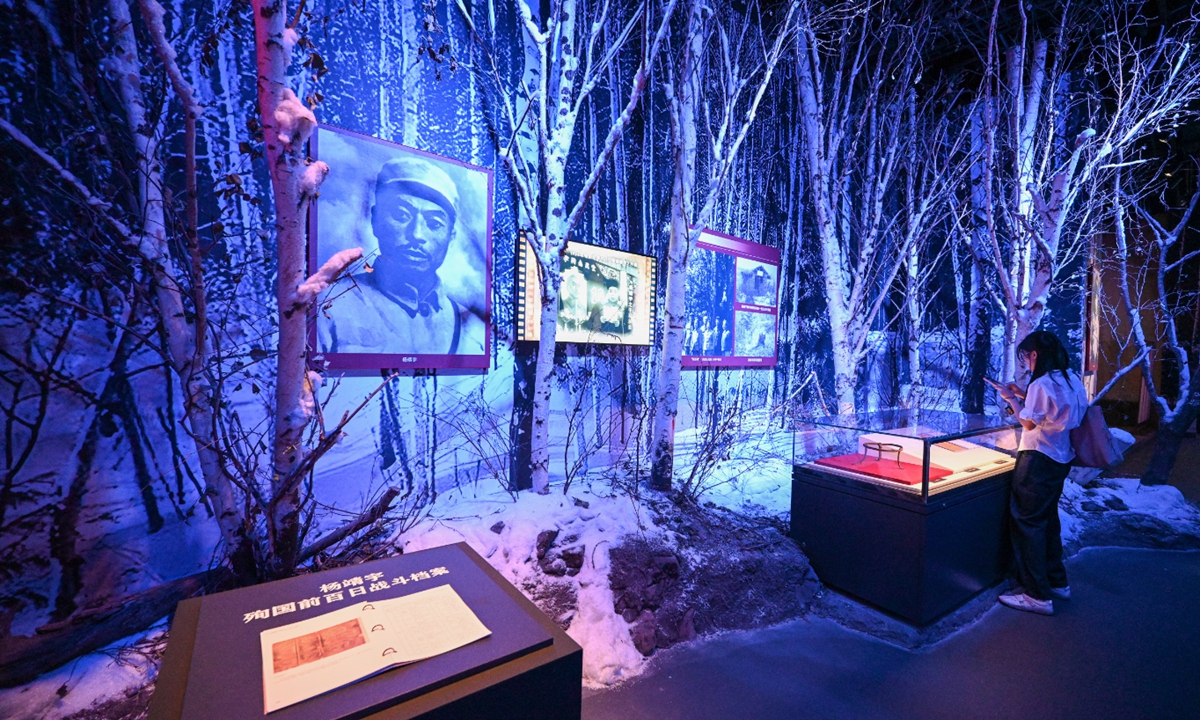
A visitor explores the special exhibition featuring artifacts excavated from sites associated with the Northeast United Resistance Army held at the Museum of the Communist Party of China in Beijing on August 30, 2025. Photo: Chen Tao/GT
At the entrance of a special exhibition at the Museum of the Communist Party of China (CPC) featuring relics from sites that once belonged to the Northeast United Resistance Army, a long red flag fluttered gently while a revolutionary song filled the air. The melody wrapped around me like a soft but firm hand, pulling me back to 90 years ago, a time when a group of Chinese soldiers fought against Japanese invaders for their nation.The Northeast United Resistance Army, established by the CPC, was the earliest and longest-standing (14 years) force to fight against Japanese aggression, enduring some of the harshest combat environments imaginable. Throughout the 1930s and 1940s, they established secret camps in remote, mountainous areas, the places where enemy control was weak, becoming a critical part of the global fight against fascism.
The exhibition sets a tone for a journey structured around four seasons, with each representing a chapter in the lives of the resistance fighters. But spring, summer, and autumn seemed to pass in the blink of an eye. All too soon, I stood in "winter."
Above me hung a historical record titled "minus 48 C," documented by Japanese troops during their invasion. How does one fight a war at 48 degrees below zero? How does one even survive?
Whether it was the aggressive air conditioning or the immersive snowscape installation, I felt a chill crawl up my spine.
Curiosity tugged at me then: What did these soldiers eat?
It's easy to imagine forests full of game and wild berries. The reality was far grimmer. Under relentless enemy suppression, every meal came at the cost of lives.
In a glass display case, two copies from an internal military document issued by the Japanese Imperial Army and its puppet regime forces during their invasion of Northeast China in the 1930s-1940s lay open, their pages brittle with age. They documented a horror that's hard to fathom.
On January 18, 1940, five soldiers under the troop's General Yang Jingyu, a key founder and leader of the Northeast United Resistance Army, were killed while trying to obtain supplies. From February 11 to 20, three more battles took place. Two soldiers sent to find food were killed. Not long after, Yang himself died with not a single grain of rice in his stomach, only tree bark, dried grass, and cotton padding.
These relics made me think of the saying from Sun Deli, deputy director of the National Cultural Heritage Administration, at a press conference on Sunday.
"Cultural relics are tangible and visible history. Every historical photograph and precious item silently narrates the brutal and heinous crimes of Japanese militarism, and the courage of those who resisted."
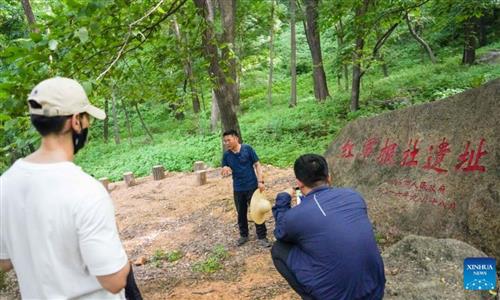
Meng Qingxu, a deputy research fellow at the Jilin Provincial Institute of Cultural Relics and Archaeology who participated in designing the exhibition, shared something equally revealing. After five years of excavation at the Hongshilazi site archaeological project, one of the important archaeological sites associated with the army, they discovered that among the 3,300 relics uncovered, most were combat installations, not living quarters.
"We used to think of these camps as shelters. Now we understand everything they built, every hidden base, was for one purpose: to fight," Meng said.
As I was reflecting upon this, I saw it: a stone operating table. Rough, flat, and mercilessly cold. This was where the surgeries took place, without anesthesia, without sterile conditions, often without even the basics to staunch bleeding. How did they endure?
The answer, or part of it, stood a few steps away at the display for Zhao Yiman, a pivotal figure in Northeast China's anti-Japanese resistance.
According to a historical document of the Japanese invaders, codenamed "Wang Shi" in enemy files, Zhao was described by Japanese and puppet authorities as "that brave and arrogant woman."
She had three gunshot wounds, all infected and worm-ridden. She endured a brutal emergency operation without uttering a sound.
"'What a brave yet defiant woman she was!' Though I looked at her with a look of contempt, deep down I felt a sense of oppression and fear," wrote one of her captors.
Beside the enemy's typewritten accounts lay the last letter she wrote to her son, Ning'er:
"Ning'er! It's truly a regret that I, as your mother, failed to fulfill my duty of educating you. But I have resolutely fought against the Japanese aggression and the puppet regime, and today, I stand on the eve of sacrifice… Do not forget that your mother gave her life for her country."
On one side, a mother's last tenderness; on the other, the cold record of her captors.
History has never felt so tangible, or so chilling.
Further inside the hall, a soft wave of awe moved through the crowd.
Black-and-white portraits of resistance fighters were being brought to life by AI. Their lips curled gently upward as though smiling right at me. My heart ached.
The exhibition closed at a crimson wall, engraved with the names of 140 known martyrs and units from the Northeast United Resistance Army.
"We brought these artifacts to Beijing so that the fighters could see the New China," Meng said.
Each generation has its duty. Theirs was to fight. What's ours? To remember and inherit their spirit.
The author is a reporter with the Global Times. life@globaltimes.com.cn
RELATED ARTICLES