Illustration: Liu Rui/GT
Amid the unravelling US-India relationship caused by the Trump administration's strong tariff push on Indian imports and New Delhi's resistance, India media ran headlines after The New York Times reported, citing sources, that US President Donald Trump no longer has plans to visit India for the Quad summit scheduled for later this year.
No other countries besides US allies and partners are clear about this: For the US, allies are not what Washington calls "like-minded" partners. Instead, the US views them as "free-riders" on its economic or security shelter, and believes that their interests could be sacrificed for US interests whenever needed. When the US ruthlessly imposes tariffs on its so-called allies and partners, it signals that they could be traded and abandoned at will.
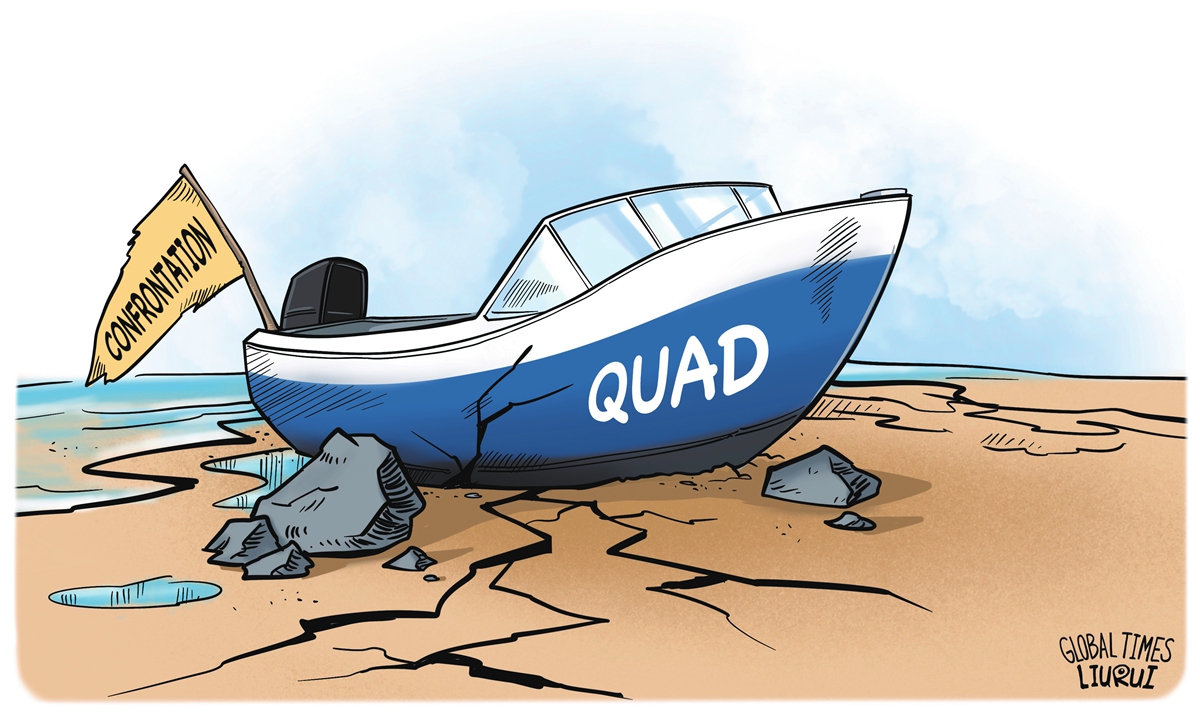
Now, dissatisfied with India, the US president is reportedly using the Quad summit as a leverage. While the reported move by the US president exposes the loose commitment of the US toward its allies and partners, it also reflects the dilemma of US-led small circles characterized by confrontation, isolation and exclusivity.
The Quad, which comprises the US, Japan, India and Australia, has shouldered the task of containing China under US command. Long Xingchun, a professor from the School of International Relations at Sichuan International Studies University, told the Global Times that the Quad represents the typical egoism of Washington: It requires US allies and partners to maintain the same strategic objectives as the US and take the risks of choosing the US over China, but the US' commitment keeps swaying based on its own interests.
The unpredictability and unreliability of US' commitment has already alarmed regional stakeholders. In response to Trump's potential absence from the Quad summit, an Indian scholar, writing for Australia's Lowy Institute, has even advocated for forming an India-Japan-Australia grouping that doesn't depend on US politics.
Some US analysts once claimed that India's hesitation in joining the Quad stymied the alliance's potential, but perhaps they should have questioned the US itself about why the structure of the Quad is intrinsically flawed.
It is also worth bearing in mind that the reason the Quad is viewed as performative is its confrontational nature. Any exclusive cliques aimed at containing and confronting other countries are inevitably constrained by a lack of lasting stability and credibility. The wheel of history is moving toward multipolarity and diversified cooperation. Any organization that goes against this trend, clings to a Cold War mentality, and seeks to sow division and confrontation is doomed to have no future.
In stark contrast to the cracks evident within the Quad, the just concluded Shanghai Cooperation Organisation (SCO) Summit presented a different scenario. Based on shared development needs, security concerns, and the pursuit of a multipolar world, the SCO family is growing larger, and its member states are committed to resolving regional challenges through dialogue and cooperation. Despite differences among member states, their cohesion is continuously strengthened through pragmatic cooperation, centered on the "Shanghai Spirit" of mutual trust, mutual benefit, equality, consultation, respect for diversity of civilizations, and pursuit of common development.
Global stability and prosperity require more multilateral platforms like the SCO that promote equal dialogue and mutual benefit, rather than small cliques that create confrontation. Regional countries should approach alliance relations with a more cautious and pragmatic mind-set. A regional architecture based on strategic autonomy and win-win cooperation, rather than blindly following others, serves the interests of stakeholders better.
RELATED ARTICLES