Illustration: Chen Xia/GT
Editor's Note:
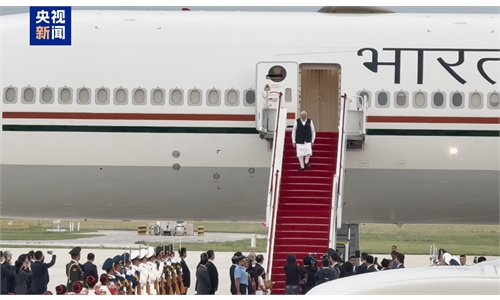
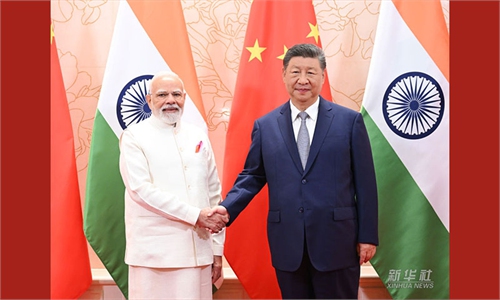
Indian Prime Minister Narendra Modi just concluded his first trip to China in seven years. During his meeting with Chinese President Xi Jinping ahead of a summit of the Shanghai Cooperation Organisation (SCO) in Tianjin, Xi said that China and India are each other's development opportunities rather than threats. And Modi said that the consensus between the two countries far outweighs their disagreement, and that India is ready to view and develop bilateral ties from a long-term perspective. In an exclusive interview with Global Times (GT) reporter Li Aixin, Mohammed Saqib (Saqib), founder and secretary general of India China Economic and Cultural Council, shared his views on the new dynamics of China-India ties.
GT: How do you interpret the significance of Modi's latest China visit?
Saqib: I believe this visit is of great significance. This visit could be another Wuhan moment, laying the foundation for a more solid and long-lasting relationship that will extend beyond bilateral China-India relations, working together for Asia and the Global South.
The visit is a step toward normalization, following up on a thaw that began in late 2024.
It is also occurring at a time of significant geopolitical and geo-economic shifts. It comes amid India-US trade tensions. The US has imposed a 50 percent tariff, one of the US' highest tariffs, on Indian imports.
GT: Western media portray the warming of China-India relations as a result of US-India tensions. How do you view this perspective? Is the improvement in China-India relations a matter of expediency, or is it rooted in a broader strategic consensus?
Saqib: While US-India dynamics play a role, Western media's portrayal of warming China-India relations as a consequence of cooling US-India ties oversimplifies a complex situation.
While US-India relations influence the broader geopolitical context, they are not the sole driver. To a large extent, China and India have engaged pragmatically, focusing on "islands of cooperation" that sidestep contentious border disputes. This is evident in China-India economic engagement and people-to-people connections, especially before 2020.
India and China also cooperate through multilateral platforms like the SCO and BRICS to amplify Global South leadership and counter Western dominance. This improvement is based on long-term goals. Both countries aim to increase mutual benefits and support regional stability.
GT: What do you see as the "internal drivers" of China-India relations?
Saqib: Well, the drivers stem from economic, strategic and societal priorities. For India, mainly economic growth drives engagement with China. India's small and medium-sized enterprises, which make up a large part of India's industry, are highly dependent on Chinese machinery, parts, technology, and processes, as well as on Chinese suppliers of active pharmaceutical ingredients (APIs) for India's generic drug industry and on electronics imports for domestic consumption.
The economic engagements are even more critical after the India-US trade rift in order to achieve stability at the borders and free resources for development, such as infrastructure and social programs.
This year, the two sides agreed to resume the Indian pilgrims' visit to Kailash Mansarovar in China's Xizang Autonomous Region, which meets demand for religious pilgrimage and gives political mileage, boosting soft power through shared Buddhist heritage.
Politically, India's global leadership ambitions require engagement with the SCO and BRICS to amplify the influence of the Global South, which in turn requires engagement with China.
GT: With the resumption of tourism, pilgrimages and direct flights, which areas do you think are most likely to become new "breakthroughs" for China-India cooperation?
Saqib: Digital payment integration for travelers could be a highly promising low-hanging fruit. Religious tourism could be a significant area of cooperation, such as Buddhist tourism. Climate-tech partnerships could emerge as another important area for collaboration.
Although unlikely at present due to the lack of trust, another potential area for joint ventures is India's generic drug makers and China's APIs suppliers forming dedicated pharma chains.
GT: When India deepens its engagement with China, the SCO, and the BRICS countries, does this suggest it is recalibrating its foreign policy?
Saqib: For the recalibration of India's foreign policy, I would say that the recent moves signal a shift, but it seems more of a tactical adaptation rather than an ideological pivot. However, it is too early to conclude.
Trump's tariffs are a significant trigger - they prompted India to reassess the extent of its ties to the West. The SCO/BRICS engagements also serve as leverage tools against Western pressure while avoiding the "alliance" trap.
A strong and healthy relationship between China and India is critical for stability and prosperity in Asia. Only their cooperation can truly make the 21st century an "Asian Century." They share a significant amount of hard and soft power among themselves.
Together, they can promote and transform the Global South.
As the largest members of the Global South, their combined voice in international forums, including the UN and G20, would bring a more equitable global order on issues such as trade, climate, finance and global governance reform. China and India together form a twin engine, and their shift from conflict to cooperation can power South-South development and cooperation.
GT: Considering the historical and ongoing differences, there are still opposing voices in the public spheres of both countries. In your view, what approaches could help strengthen mutual understanding and trust between the peoples of China and India?
Saqib: There is a lot of misinformation, misperception and mistrust between the two countries. People-to-people exchanges are crucial for building trust.
Track II dialogues, such as the India-China Think Tanks Forum, exist but are overshadowed by border tensions; they should be revived, enhanced and expanded to various sectors. Media cooperation, youth interaction and deeper economic ties are essential to strengthening China-India relations.
RELATED ARTICLES