From WWII to today: the unfinished struggle for peace and justice – perspectives from a Japanese scholar
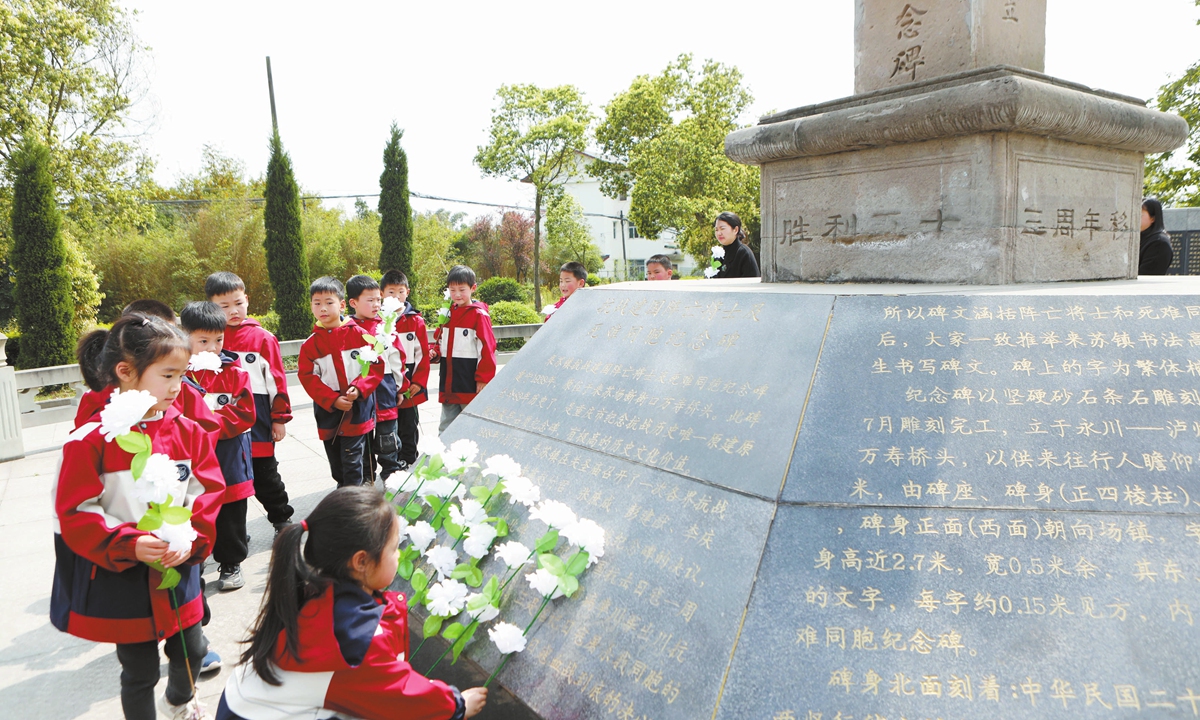
Children lay flowers at the martyrs' shrine built to commemorate the fallen soldiers during the Chinese People's War of Resistance Against Japanese Aggression in Yongchuan District of Southwest China's Chongqing on April 1, 2025. Photo: VCG
Editor's Note:
2025 marks the 80th anniversary of the victory in the Chinese People's War of Resistance against Japanese Aggression and the World Anti-Fascist War. Eight decades have passed, yet the world once again finds itself at a crossroads. The rise of unilateralism, ongoing geopolitical turbulence and the distortion of historical truths remind us of the enduring relevance of remembering the past and safeguarding peace. Against this backdrop, the Global Times launches the column "Revisiting WWII, Defending Peace," inviting renowned scholars and peace advocates from around the world to revisit the history of WWII through contemporary lenses. Through diverse perspectives, the series seeks to uphold historical memory, promote shared development, and defend fairness and justice. Only by confronting history with honesty and clarity can humanity find the wisdom to shape a more peaceful and sustainable future. This is the 11th piece of the series.
Eighty years ago, after 14 years of arduous struggle and tremendous sacrifice, China finally defeated the war of aggression launched by Japanese fascists. Eighty years later, Japan still seems unable to cast off the shadow of fascism.
A typical fascist regime is characterized by the following features: instead of addressing economic stagnation and the resulting political and social unrest through domestic reform or narrowing class disparities, it seeks to shift the crisis outward under the pretext of "racial superiority" through external aggression and expansion.
Nowadays, to contain China's economic growth and sustained development, Washington has taken a series of measures such as imposing additional tariffs and openly reinforcing its military presence around the Taiwan Straits. Japan has followed closely in the footsteps of the US, even establishing offensive military bases on the islands of Okinawa, close to China. Some concerning tendencies in both the US and Japan, such as discriminatory immigration policies, xenophobic rhetoric, and a tendency in governance to downplay or even disregard the rule of law and parliamentary systems, warrant close attention and careful monitoring.
However, the current international discourse is still largely shaped by the US and other Western countries. This dominance presents significant challenges in safeguarding justice and peace, as global narratives are often shaped by their perspective. Such imbalances hinder the fair and objective resolution of critical issues on the world stage.
The historiography and peace movements of postwar Japan defined the prewar and wartime trend toward authoritarianism as "Emperor System Fascism" and sought to overcome it. However, beginning in the 1990s, a generational shift among researchers coincided with the rise of historical revisionist currents and movements. As a result, tendencies to blur or deny the facts of aggression - and even to glorify war through distortions of history - have spread increasingly throughout Japanese society. Whether in reference to wartime Japan or today's rightward shift, the scholarly atmosphere of analyzing these phenomena through the lens of fascism has grown exceedingly faint in the country.
It is precisely for this reason that, on the 80th anniversary of the Victory of the World Anti-Fascist War, we should reexamine whether the war against fascism has truly ended.
After WWII, Western countries led by the US - including Japan, which had once been a fascist state - forcibly imposed the Cold War system. Is the Cold War structure of that era truly a thing of the past? In fact, the containment policy against the socialist camp only saw a brief easing in the 1970s. After the collapse of the Soviet Union, the Japan-US security alliance was redefined as a military one targeting China. Since 2010, when China's GDP surpassed that of Japan, Japan's containment policy toward China has grown increasingly assertive and sustained.
In the long run, the current US government's tariff and other policies against China are essentially a continuation of the hegemonic strategy of long-term containment. In a certain sense, China's struggle for justice and peace over the past 80 years can also be seen as a continuation of the anti-fascist spirit.
While some Western countries increasingly deviate from the shared human values of peace and justice, China is putting true universalism into practice through concrete actions, steadfastly defending core values such as fairness and justice, and playing a leading role in the progress of global civilization.
The arduousness of this journey is self-evident. Yet China possesses invaluable experience in overcoming adversaries. Despite comprehensive inferiority in military, economic and technological domains, the Chinese people ultimately defeated the invaders. Many Japanese to this day remain trapped in the illusion of "might makes right," with some even clinging to the absurd claim that "the Japanese army never lost in China." Those who hold such views fail to grasp how the Communist Party of China, armed with theoretical innovation and practical experience, developed the strategies of protracted war and guerrilla warfare that mobilized the immense strength of the entire nation in resisting aggression. Such a strategy of undermining the enemy's rule from within not only secured China's victory but also offered invaluable and lasting inspiration for the subsequent global anti-colonial and national liberation movements.
Today, China is facing interference and coercion from countries such as Japan and the US. Yet China will neither yield nor compromise; instead, it is committed to waging a protracted war full of hardships.
Admittedly, this struggle differs from the Anti-Fascist War a century ago in its historical context: China has already achieved rapid economic growth, and its vast domestic market itself serves as the "base area" supporting this effort. By building a community with a shared future for humanity and promoting the Belt and Road Initiative, China is working with Global South countries in mutual support and common development. In this sense, China is carrying out a new form of "protracted war" on a global scale, one that seeks to serve the interests of the broadest population.
Despite the formidable obstacles imposed by the US and other powers through military and economic pressure, China has continued to uphold its developmental rights, achieving economic rise and national rejuvenation. This not only instills confidence in constructing a global path of justice, peace and development opposed to hegemonism and neo-colonialism, but also explores a path of peaceful development. At present, the Global South - with China as a key driving force - has entered a new historical stage: not only gradually breaking free from the legacy of modern Western colonial systems in economic and political spheres, but also striving to build a new form of spiritual civilization rooted in the principles of peaceful coexistence.
The author is an associate researcher at the School of Humanities at Shanghai Jiaotong University. opinion@globaltimes.com.cn
RELATED ARTICLES