Museum of the War of Chinese People's Resistance Against Japanese Aggression: On Protracted War illuminates path to victory in resistance war
By Li Tianyang, Lu Zenan and Published: Sep 04, 2025 12:44 AM


Luo Cunkang, director of the Museum of the War of Chinese People's Resistance Against Japanese Aggression
Exhibited artifacts: English and Japanese versions of On Protracted War
Narrator: Luo Cunkang, director of the Museum of the War of Chinese People's Resistance Against Japanese Aggression
The Museum of the War of Chinese People's Resistance Against Japanese Aggression is the only comprehensive museum in China dedicated to reflecting the history of the Chinese people's resistance against Japanese aggression.
In the thematic exhibition titled "For National Liberation and World Peace," held to commemorate the 80th anniversary of the victory in the Chinese People's War of Resistance Against Japanese Aggression and the World Anti-Fascist War, the English and Japanese versions of On Protracted War are displayed, with the Japanese version being exhibited for the first time. This shows that China's war of resistance has attracted the attention and concern of not only the Chinese people, but also the people of all countries in the world.
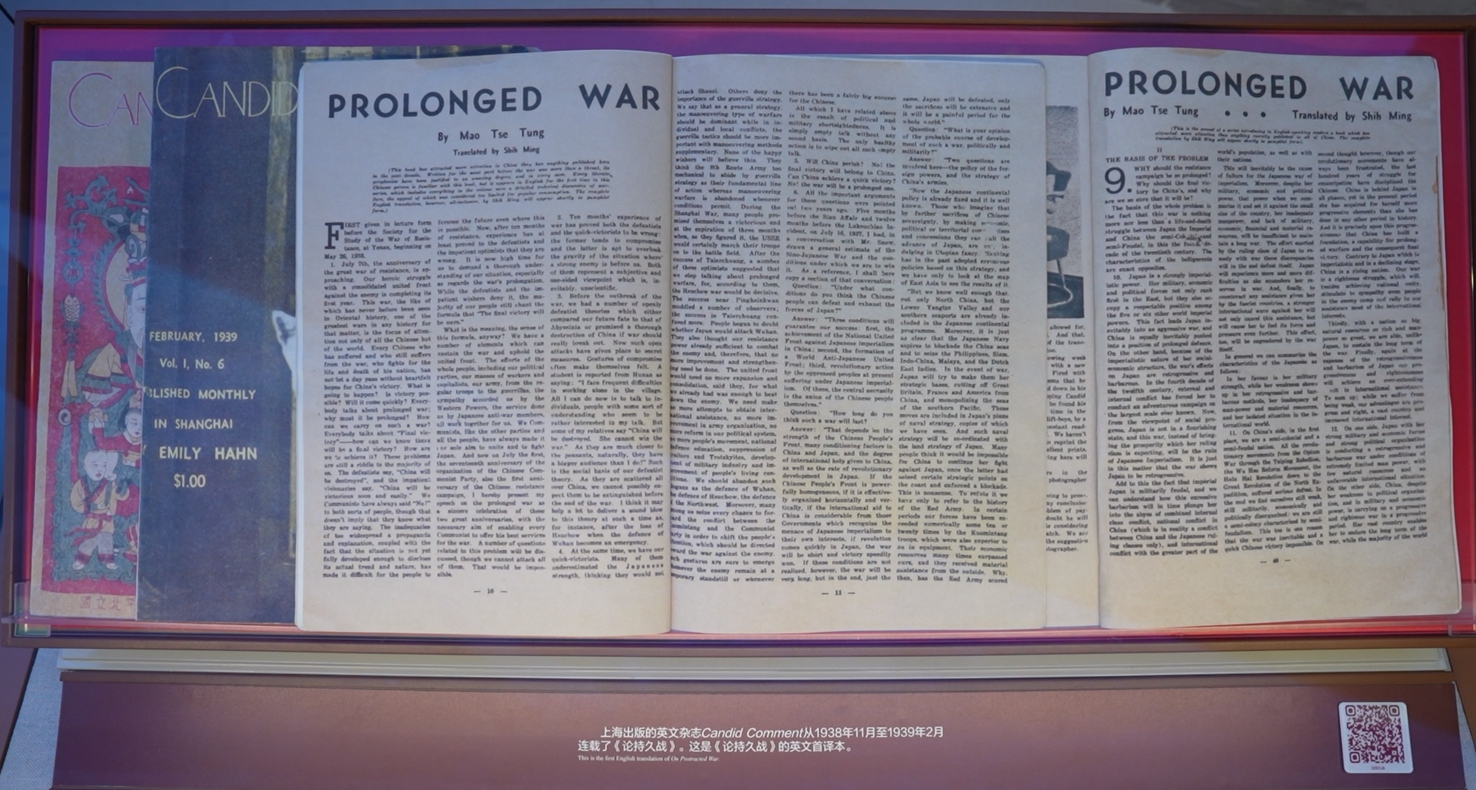
English version of On Protracted War

Japanese version of On Protracted War
The CPC's pivotal role
If I were to select artifacts from the War of Resistance Against Japanese Aggression for museum collection, I would choose the English and Japanese versions of On Protracted War. This work represents the Communist Party of China's perspective on the future and destiny of the War of Resistance during a critical moment of national survival.
Comrade Mao Zedong particularly emphasized in On Protracted War that "persist in the War of Resistance, persist in the united front, persist in protracted war, and the final victory will inevitably be China's." On Protracted War also emphasized that the only correct path to victory in the resistance war was to fully mobilize and rely on the masses, adopt the strategy of people's guerrilla warfare, and establish extensive anti-Japanese base areas. This signified that, shortly after the start of the War of Resistance Against Japanese Aggression, the Communist Party of China (CPC) had already foreseen the future and course of the war - as well as the outcome that would be achieved through the immense efforts of the broad masses led by the CPC. The pivotal role of the CPC was the key to the victory in the Chinese People's War of Resistance Against Japanese Aggression.
During that time, On Protracted War was published in multiple Chinese editions in the Kuomintang-controlled areas, occupied territories, and base areas. In addition to the Chinese editions, it was also disseminated in English, Russian, Japanese, and other language editions. Among these, the English and Japanese versions of On Protracted War are of extremely precious value. Even today, On Protracted War remains a rare and invaluable military document in world war history, studied earnestly by many renowned international military researchers and scholars.
On Protracted War reaches the international community
The English version of On Protracted War was serialized in four issues of the Shanghai-based magazine Fair Comment from November 1938 to February 1939. It was secretly translated and published in Shanghai by one of the underground Party members, Yang Gang, with the help of international friends.
After seeing the publication of the English translation of On Protracted War, Mao Zedong gladly accepted the invitation to write a preface, titling it "The Relationship Between the War of Resistance and Foreign Aid."
In it, he noted that "the great Chinese war of resistance is not only China's affair or the East's affair but also the world's affair," and "our enemy is the world's enemy, and China's war of resistance is a global struggle."
On Protracted War provided a comprehensive introduction to China's war of resistance and the CPC's stance the war. Approximately 500 copies of its English translation were printed, with some distributed in the concession area of Shanghai and others were secretly sent overseas. It helped the international community understand that the Chinese people were confident in defeating the Japanese aggressors.
The Japanese version of On Protracted War was published in December 1938 by a Japanese intelligence agency in Shanghai. This was only five months after the work was officially published in Liberation Weekly in July 1938. Notably, this Japanese version, printed by a Japanese military intelligence agency, was marked with the word "secret." This reflects that this work, which revealed the inevitable failure of Japanese militarism, was highly regarded within the Japanese army at the time and studied secretly.
However, it is evident that Japan did not fully recognize the value and significance of On Protracted War at the time. It was only after China's victory in the war of resistance that Japanese war criminals, detained and undergoing reeducation at the Fushun War Criminals Management Center, reread On Protracted War and acknowledged its profound insight, realizing that it clearly foretold Japan's inevitable defeat.
Promoting the great spirit of the war of resistance holds significant value in modern era
The core essence of the great spirit of the war of resistance encompasses patriotism and a sense of national responsibility, an unyielding national integrity that values honor over surrender, a heroic resolve to fearlessly battle against overwhelming odds, and an indomitable belief in ultimate victory.
This great spirit was forged during the extensive course of the Chinese People's War of Resistance Against Japanese Aggression. Even when faced with the threat of national subjugation, the Chinese people grew more resilient and dauntless in the face of brutality, ultimately achieving victory in the war and liberation for the nation.
The Chinese People's War of Resistance Against Japanese Aggression opened up the eastern main battlefield of the World Anti-Fascist War, and the Chinese people made tremendous contributions to both national liberation and the global victory over fascism.
This year marks the 80th anniversary of the victory in the Chinese People's War of Resistance Against Japanese Aggression and the World Anti-Fascist War. Under new conditions, the great spirit of the war of resistance has important contemporary significance.
Especially as global changes unseen in a century are unfolding at a quicker pace and the international situation remains turbulent and complex, the challenges we face are numerous and may be no less daunting than those during the War of Resistance, with obstacles that may be even more complex and severe. Therefore, it is precisely in such times that the Chinese people must further promote the great spirit of the war of resistance, drawing strength and inspiration from it. This spirit continuously inspires us to brave dangers and hardships, forge ahead with courage and determination, and fulfill our missions, responsibilities, and commitments to contribute to the great cause of building a strong nation and achieving national rejuvenation.
RELATED ARTICLES