IN-DEPTH / IN-DEPTH
A mobilization letter to a younger brother echoes CPC member’s deep devotion to the nation’s destiny
By Published: Sep 05, 2025 10:46 PM

Editor's Note:
The year 2025 marks the 80th anniversary of the victory in the Chinese People's War of Resistance Against Japanese Aggression (1931-45) and the World Anti-Fascist War. Though the smoke and flame of war has long faded, the memory of that chapter in history remains vivid. This special series, titled "Witness: War Relics Etch the Memory of Victory," traces the stories behind old photographs, battlefield relics, handwritten letters, and other precious artifacts and documents imbued with the spirit of the era.
Through these objects, we aim to illuminate the intersection of ordinary lives and national destiny, and to rediscover the enduring spirit forged in blood and fire. The series will feature field reports from museums, the homes of martyrs' descendants, and red archives across the country, weaving together a three-dimensional portrayal of wartime memory. It is both a heartfelt tribute to history and a solemn salute to peace.
In this second installment of the series, we revisit a letter written in 1938 by a Communist Party of China (CPC) member to his younger brother, urging him to join the Chinese People's War of Resistance Against Japanese Aggression. This article uses the letter as the central thread to explore the family's wartime journey, showcasing how Communists mobilized loved ones with faith and affection - igniting resolve through the power of words.
"The War of Resistance Against Japanese Aggression is our great mother. She is giving birth to a new China, a new nation, and a new people."
These words, written in a 1938 family letter, still resonate today. They were penned by Wang Xiaoci (originally named Xiang Zongren), then head of the organization department of the CPC Jinzhong committee in North China's Shanxi Province, in a letter to his fifth younger brother, Xiang Zongsheng.
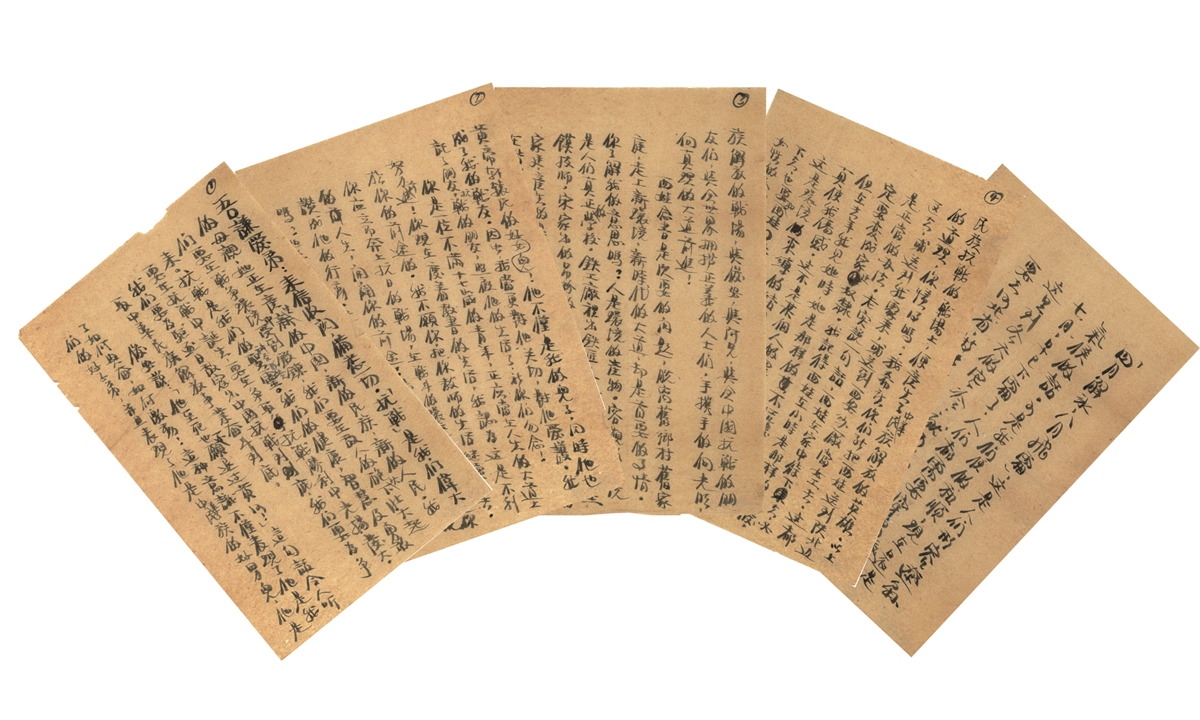
The letter, measuring 16 centimeters long and 25 centimeters wide, has only five thin pages. However, it carries the weight of history. More than a personal letter, it is a heartfelt call to arms - a manifesto of national mobilization from a Party member to his own brother.
Recently, the Global Times learned more about the letter's backstory from the Museum of the War of Chinese People's Resistance Against Japanese Aggression in Beijing, where the letter was kept. At a moment when the nation's survival hung in the balance, Wang ignited his brother's fighting spirit through a blend of deep familial love and unwavering faith. The letter bore witness to one family's choices and sacrifices amid the tide of war.
A family's journey in war
"The rise and fall of the nation rests on the shoulders of all," Wang wrote in the letter.
"We must undergo trials in the midst of war. We must grow stronger under the enemy's artillery fire. Resistance is our sacred duty. Our health, intelligence and courage must be born through resistance and flourish in the victory of the war. We must fight to the end to drive the Japanese aggressors out of China, and fight to the end for the liberation of the Chinese nation," read the letter.
At the time, Wang's brother Xiang Zongsheng was a teacher in their hometown. Wang urged him to "immediately rush to the battlefield, to forge your life amid struggle and open a new path for your future." He encouraged him to cast aside societal prejudice and bravely embark on the road to national liberation.
"I hope you can break free from the views of the mediocre and boldly step onto the battlefield for national liberation - hand in hand with Jun'an, with your elder brother, with friends fighting across China, and with all justice-loving people around the world - advancing toward light and truth," Wang said in the letter.
According to the museum, "Jun'an" mentioned in the letter refers to Wang's son, Xiang Jun'an, who had already joined the Eighth Route Army in the Taihang Mountains and became a young soldier. At the time of writing, Wang and his son were fighting side by side.
Xiang Jun'an once wrote home from the front lines: "We are organizing guerrilla forces. We must fight the Japanese devils. Let's meet again in the future! Please reassure Grandpa and Grandma... Long live national liberation!"
Wang Xiaoci's letter ultimately sparked his young brother's resolve. At the end of 1938, 16-year-old Xiang Zongsheng gave up his teaching career and went to the front lines in Shanxi Province. He resolutely joined the Eighth Route Army and threw his youthful body into the torrent of resistance.
Throughout the years of war, three men from the Xiang family - father, son, and younger brother - left home one after another, dedicating their youth and lives to the cause of national liberation.
Wang was imprisoned three times, tortured, and left with a lifelong illness after being force-fed chili water. His son continued fighting despite injuries.
For a time, the three were all active in the Taihang Mountains - sometimes only separated by a few hills or rivers. Letters became their only link - and their shared spiritual anchor.
In May 1942, during a battle in Lancun village in Shanxi, Xiang Zongsheng was wounded and died at the age of 20.
A man's lifelong struggle
Wang was born in 1905 in Weinan, Northwest China's Shaanxi Province. From a young age, he was acutely aware of the darkness and injustice of the old society. In middle school, he actively participated in anti-imperialist and anti-warlord movements.
In 1927, he enrolled in a military academy in Xi'an and joined the CPC that same year, according to the Museum of the War of Chinese People's Resistance Against Japanese Aggression in Beijing. In 1928, he took part in the uprising in the counties of Weinan and Huaxian. After the uprising failed, he was placed on a wanted list, and his family home was confiscated. His relatives scattered in all directions. His first wife and sister-in-law were persecuted to death, and his mother and young daughter later died from illness and poverty, according to the museum.
These personal tragedies only deepened his belief that revolution was the only path to save the nation.
During the 1930s, he engaged in underground work in northern China. He was arrested by Kuomintang forces three times, spent a total of six years in prison, and endured brutal torture - yet he never wavered, upholding the revolutionary ideals of a CPC member.
After the full-scale outbreak of the War of Resistance Against Japanese Aggression in 1937, he returned to his hometown, only to learn that many of his loved ones had already passed. Yet the overwhelming grief did not break him; it strengthened his resolve to join the resistance.
He joined General Chen Geng in the Taihang Mountains, leading over 2,000 miners to form a guerrilla force. He later organized peasant militias in Pingding and other areas, waging fierce battles against the Japanese army.
Top leaders such as Commander-in-Chief Zhu De and General Xu Xiangqian attended the founding ceremony of the guerrilla force, offering tremendous encouragement, according to the documents provided by the museum to the Global Times.
Starting in 1938, Wang served as head of the Organization Department of the Jinzhong Prefectural Committee and other leadership positions, playing a leading role in organizing the resistance.
After the founding of the People's Republic of China in 1949, Wang continued contributing to national developments.
In 1961, he returned to his hometown and saw the letter he had written to his brother decades earlier. Upon learning of his brother's early death, he added a note at the end that Xiang Zongsheng "was wounded and later killed during the War of Resistance in the battle of Lancun." The handwriting is shaky and full of tears.
The letter had been kept within the family for 60 to 70 years. In 2005, during the centennial of Wang's birth, his daughter Xiang Linan received the letter from relatives, according to the Beijing Youth Daily.
"The paper is so thin - every time I touch it, it hurts my heart," she told the Beijing Youth Daily. To preserve it, she carefully placed it in a plastic sleeve and would only occasionally take it out to show guests. In 2009, she and her husband donated the letter to the Museum of the War of Chinese People's Resistance Against Japanese Aggression. "This history should be shown to young people today," she said.
Echoes and legacy
This summer, the "letters from the War of Resistance" section at the Museum of the War of Chinese People's Resistance Against Japanese Aggression was bustling with visitors.
The museum's special exhibition, themed "For National Liberation and World Peace," has seen growing public interest.
In the Family Letter Audio Space, visitors can listen to recitations of wartime letters.
A woman, accompanied by her granddaughter, listened intently to the farewell letter written by overseas Chinese Wang Yuting to his son: "Zhen'er, this is a great era. You are about to step onto the front line of the national liberation war. Of course I must support your aspiration. I must not let 'parental love' drown our national consciousness..."
Not far away, a special display case drew a crowd. It housed a replica of a letter written by Fu Chang, chief of staff of the 7th War Zone Command, to his wife and children before leaving for war.
The original had long been lost, but his wife had it engraved on a lamp cabinet to preserve it.
One visitor softly read aloud the words written by Wang Xiaoci: "The War of Resistance Against Japanese Aggression is our great mother. She is giving birth to a new China, a new nation, and a new people."
"In those days of national peril, countless young people stood up, joined the resistance, and defended our homeland. Today's young people should carry forward this glorious tradition and stand up when the country needs them," Xiang Linan said, the Beijing Youth Daily reported.
The year 2025 marks the 80th anniversary of the victory in the Chinese People's War of Resistance Against Japanese Aggression (1931-45) and the World Anti-Fascist War. Though the smoke and flame of war has long faded, the memory of that chapter in history remains vivid. This special series, titled "Witness: War Relics Etch the Memory of Victory," traces the stories behind old photographs, battlefield relics, handwritten letters, and other precious artifacts and documents imbued with the spirit of the era.
Through these objects, we aim to illuminate the intersection of ordinary lives and national destiny, and to rediscover the enduring spirit forged in blood and fire. The series will feature field reports from museums, the homes of martyrs' descendants, and red archives across the country, weaving together a three-dimensional portrayal of wartime memory. It is both a heartfelt tribute to history and a solemn salute to peace.
In this second installment of the series, we revisit a letter written in 1938 by a Communist Party of China (CPC) member to his younger brother, urging him to join the Chinese People's War of Resistance Against Japanese Aggression. This article uses the letter as the central thread to explore the family's wartime journey, showcasing how Communists mobilized loved ones with faith and affection - igniting resolve through the power of words.
The five-paper letters from Wang Xiaoci to his younger brother Xiang Zongsheng in 1938, calling on Xiang to join the War of Resistance Against Japanese Aggression Photo: Courtesy of Museum of the War of Chinese People's Resistance Against Japanese Aggression
"The War of Resistance Against Japanese Aggression is our great mother. She is giving birth to a new China, a new nation, and a new people."
These words, written in a 1938 family letter, still resonate today. They were penned by Wang Xiaoci (originally named Xiang Zongren), then head of the organization department of the CPC Jinzhong committee in North China's Shanxi Province, in a letter to his fifth younger brother, Xiang Zongsheng.
The letter, measuring 16 centimeters long and 25 centimeters wide, has only five thin pages. However, it carries the weight of history. More than a personal letter, it is a heartfelt call to arms - a manifesto of national mobilization from a Party member to his own brother.
Recently, the Global Times learned more about the letter's backstory from the Museum of the War of Chinese People's Resistance Against Japanese Aggression in Beijing, where the letter was kept. At a moment when the nation's survival hung in the balance, Wang ignited his brother's fighting spirit through a blend of deep familial love and unwavering faith. The letter bore witness to one family's choices and sacrifices amid the tide of war.
A family's journey in war
"The rise and fall of the nation rests on the shoulders of all," Wang wrote in the letter.
"We must undergo trials in the midst of war. We must grow stronger under the enemy's artillery fire. Resistance is our sacred duty. Our health, intelligence and courage must be born through resistance and flourish in the victory of the war. We must fight to the end to drive the Japanese aggressors out of China, and fight to the end for the liberation of the Chinese nation," read the letter.
At the time, Wang's brother Xiang Zongsheng was a teacher in their hometown. Wang urged him to "immediately rush to the battlefield, to forge your life amid struggle and open a new path for your future." He encouraged him to cast aside societal prejudice and bravely embark on the road to national liberation.
"I hope you can break free from the views of the mediocre and boldly step onto the battlefield for national liberation - hand in hand with Jun'an, with your elder brother, with friends fighting across China, and with all justice-loving people around the world - advancing toward light and truth," Wang said in the letter.
According to the museum, "Jun'an" mentioned in the letter refers to Wang's son, Xiang Jun'an, who had already joined the Eighth Route Army in the Taihang Mountains and became a young soldier. At the time of writing, Wang and his son were fighting side by side.
Xiang Jun'an once wrote home from the front lines: "We are organizing guerrilla forces. We must fight the Japanese devils. Let's meet again in the future! Please reassure Grandpa and Grandma... Long live national liberation!"
Wang Xiaoci's letter ultimately sparked his young brother's resolve. At the end of 1938, 16-year-old Xiang Zongsheng gave up his teaching career and went to the front lines in Shanxi Province. He resolutely joined the Eighth Route Army and threw his youthful body into the torrent of resistance.
Throughout the years of war, three men from the Xiang family - father, son, and younger brother - left home one after another, dedicating their youth and lives to the cause of national liberation.
Wang was imprisoned three times, tortured, and left with a lifelong illness after being force-fed chili water. His son continued fighting despite injuries.
For a time, the three were all active in the Taihang Mountains - sometimes only separated by a few hills or rivers. Letters became their only link - and their shared spiritual anchor.
In May 1942, during a battle in Lancun village in Shanxi, Xiang Zongsheng was wounded and died at the age of 20.
A man's lifelong struggle
Wang was born in 1905 in Weinan, Northwest China's Shaanxi Province. From a young age, he was acutely aware of the darkness and injustice of the old society. In middle school, he actively participated in anti-imperialist and anti-warlord movements.
In 1927, he enrolled in a military academy in Xi'an and joined the CPC that same year, according to the Museum of the War of Chinese People's Resistance Against Japanese Aggression in Beijing. In 1928, he took part in the uprising in the counties of Weinan and Huaxian. After the uprising failed, he was placed on a wanted list, and his family home was confiscated. His relatives scattered in all directions. His first wife and sister-in-law were persecuted to death, and his mother and young daughter later died from illness and poverty, according to the museum.
These personal tragedies only deepened his belief that revolution was the only path to save the nation.
During the 1930s, he engaged in underground work in northern China. He was arrested by Kuomintang forces three times, spent a total of six years in prison, and endured brutal torture - yet he never wavered, upholding the revolutionary ideals of a CPC member.
After the full-scale outbreak of the War of Resistance Against Japanese Aggression in 1937, he returned to his hometown, only to learn that many of his loved ones had already passed. Yet the overwhelming grief did not break him; it strengthened his resolve to join the resistance.
He joined General Chen Geng in the Taihang Mountains, leading over 2,000 miners to form a guerrilla force. He later organized peasant militias in Pingding and other areas, waging fierce battles against the Japanese army.
Top leaders such as Commander-in-Chief Zhu De and General Xu Xiangqian attended the founding ceremony of the guerrilla force, offering tremendous encouragement, according to the documents provided by the museum to the Global Times.
Starting in 1938, Wang served as head of the Organization Department of the Jinzhong Prefectural Committee and other leadership positions, playing a leading role in organizing the resistance.
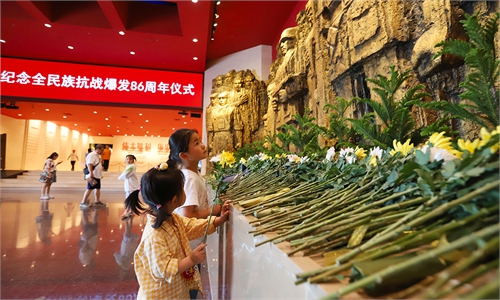
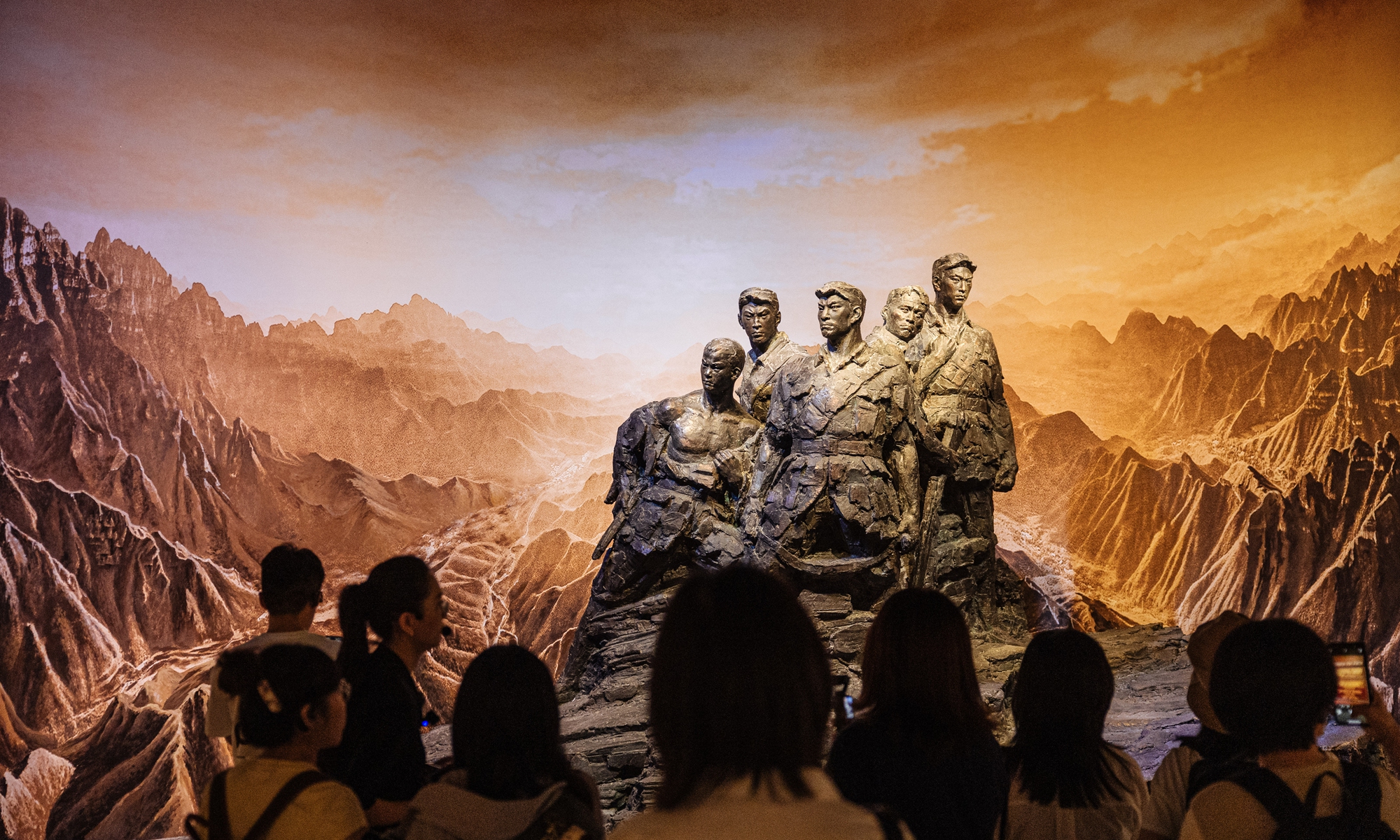
Visitors view a set of statues at the Museum of the War of Chinese People's Resistance Against Japanese Aggression in Beijing on July 7. Photo: Li Hao/GT
During this period, he wrote the now-famous letter to his younger brother.After the founding of the People's Republic of China in 1949, Wang continued contributing to national developments.
In 1961, he returned to his hometown and saw the letter he had written to his brother decades earlier. Upon learning of his brother's early death, he added a note at the end that Xiang Zongsheng "was wounded and later killed during the War of Resistance in the battle of Lancun." The handwriting is shaky and full of tears.
The letter had been kept within the family for 60 to 70 years. In 2005, during the centennial of Wang's birth, his daughter Xiang Linan received the letter from relatives, according to the Beijing Youth Daily.
"The paper is so thin - every time I touch it, it hurts my heart," she told the Beijing Youth Daily. To preserve it, she carefully placed it in a plastic sleeve and would only occasionally take it out to show guests. In 2009, she and her husband donated the letter to the Museum of the War of Chinese People's Resistance Against Japanese Aggression. "This history should be shown to young people today," she said.
Echoes and legacy
This summer, the "letters from the War of Resistance" section at the Museum of the War of Chinese People's Resistance Against Japanese Aggression was bustling with visitors.
The museum's special exhibition, themed "For National Liberation and World Peace," has seen growing public interest.
In the Family Letter Audio Space, visitors can listen to recitations of wartime letters.
A woman, accompanied by her granddaughter, listened intently to the farewell letter written by overseas Chinese Wang Yuting to his son: "Zhen'er, this is a great era. You are about to step onto the front line of the national liberation war. Of course I must support your aspiration. I must not let 'parental love' drown our national consciousness..."
Not far away, a special display case drew a crowd. It housed a replica of a letter written by Fu Chang, chief of staff of the 7th War Zone Command, to his wife and children before leaving for war.
The original had long been lost, but his wife had it engraved on a lamp cabinet to preserve it.
One visitor softly read aloud the words written by Wang Xiaoci: "The War of Resistance Against Japanese Aggression is our great mother. She is giving birth to a new China, a new nation, and a new people."
"In those days of national peril, countless young people stood up, joined the resistance, and defended our homeland. Today's young people should carry forward this glorious tradition and stand up when the country needs them," Xiang Linan said, the Beijing Youth Daily reported.
RELATED ARTICLES