China unveils plan to blend AI with its energy sector, aiming to build most advanced grid in the world
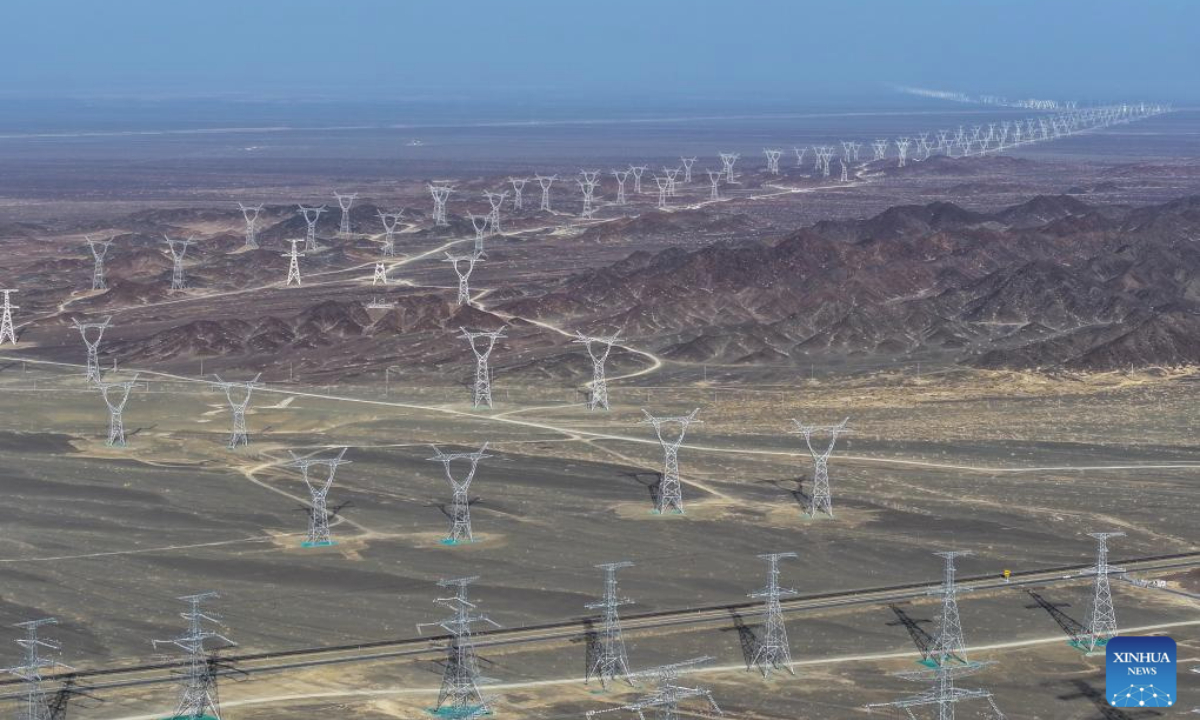
An aerial drone photo shows auxiliary lines of the Hami-Chongqing ±800 kV ultra-high voltage direct current transmission project, in Hami, northwest China's Xinjiang Uygur Autonomous Region, March 21, 2025. The State Grid Corporation of China on Tuesday announced the operation of the ±800 kV ultra-high voltage direct current transmission project linking eastern Xinjiang's Hami with southwest China's Chongqing Municipality. This marks China's third major project to transmit electricity from energy-rich Xinjiang Uygur Autonomous Region to other parts of the country. (Xinhua/Ding Lei)
China on Monday released a plan to speed up the integration of artificial intelligence (AI) into its energy sector, in order to bolster energy security, improving energy efficiency, and advancing the country's green, low-carbon transition.
The plan, jointly issued by the National Development and Reform Commission and the National Energy Administration, sets a goal of establishing a basic innovation system for AI-energy integration by 2027, while achieving major breakthroughs in AI-driven technologies in the sector.
The plan aims to apply over five industry-specific AI models in state grids, electricity generation, encompassing coal, and oil and gas, launch 10 replicable demonstration projects, and explore 100 typical application scenarios.
By 2030, AI applications in the energy field in China are projected to reach the globally leading level, supported by a more advanced mechanism for coordinating computing power with national power supply, according to the plan.
The plan calls for using AI technoogy to improve state grid security, green renewable energy integration, and energy efficiency through smarter forecasting, more automated planning, intelligent construction management, and more, while enhancing AI-assisted decision-making to ensure safe, reliable, and low-carbon operation across energy generation, load, and storage.
The plan also calls for applying AI to address the volatility and intermittency of new energy, accelerate AI use in high-precision power forecasting, electricity markets, smart plant operations, renewable energy planning, and project evaluation, and the development of large AI models for power forecasting in complex scenarios and extreme weather conditions. The plan added that greater efforts are needed to ramp up financial backing and versatile talent training.
Lin Boqiang, director of the China Centre for Energy Economics Research at Xiamen University, told the Global Times on Monday that over the past three decades, China's energy system has reached the world's leading level, with state-owned energy enterprises leading in both fossil fuel and green renewable energies. "From energy system management to total generation volume, we are now No 1 globally. The key is how to apply AI technology, building on more than a decade of digitalization that has laid a solid foundation," he said.
Lin explained that AI can take the energy sector beyond digitalization by integrating the technology into the entire value chain.
"In the upstream, AI can enhance exploration and reserve assessment; in the midstream, it can better match supply and demand and improve maintenance; and in the downstream, the technology can strengthen response and early warning systems," Lin noted.
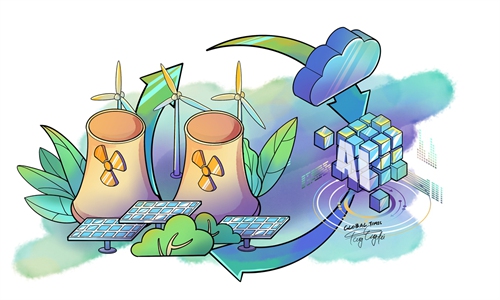
Bian Yongzu, executive deputy editor-in-chief of Modernization of Management magazine, echoed Lin, noting that the integration of AI and the new green energy will be a defining trend in the world. "On one hand, AI development needs huge amounts of energy, which only renewable sources like solar, wind, hydro, and nuclear power can meet the demand, sustainably. On the other hand, green energy itself requires AI to optimize sector efficiency and stability," he said.
He pointed out that AI can create optimal algorithms, predictive maintenance, and real-time adjustment in renewable energy systems. "From wind turbines and solar panels to nuclear power plants, AI can maximize energy output with lower resource use and minimal environmental costs, while improving equipment performance and reducing failure rates," Bian said.
While China's present energy system and management efficiency are globally advanced, further progress depends on strengthening talent reserve, creating robust and accurate data, and safeguarding its energy networks against harmful intrusions. With strong policy support, the exports noted, AI can be fully embedded across the energy industry to make operations more efficient and sustainable.
Global Times
RELATED ARTICLES