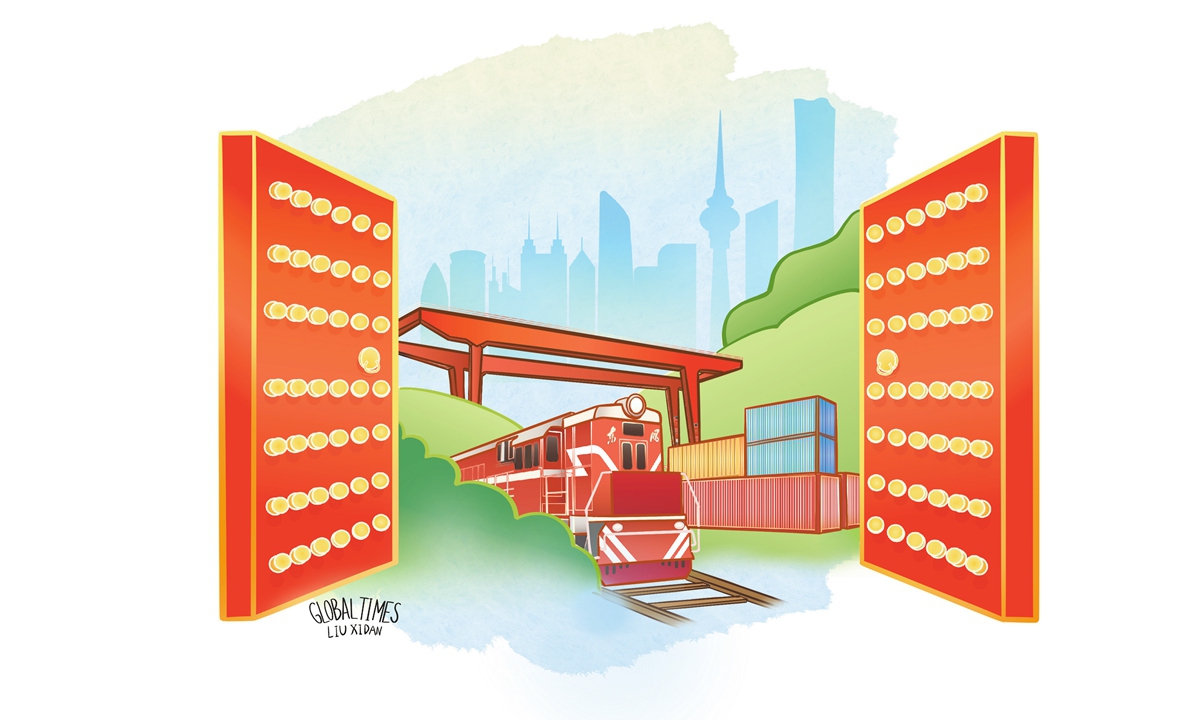
Illustration: Liu Xidan/GT
In today's evolving landscape of global economic cooperation, two divergent approaches are increasingly apparent: One is China's advocacy for inclusive globalization - emphasizing openness, inclusiveness and mutual benefit. The other is the US' push for "global rebalancing," which many interpret as a rebranded extension of the "America First" agenda.In June, US Treasury Secretary Scott Bessent claimed that the administration had made notable strides in "rebalancing" the global economy. The White House echoed this statement, touting its trade agreement with the EU, claiming that it could "fundamentally rebalance the economic relationship between the world's two largest economies."
Yet, these unilateral assertions have drawn skepticism globally, prompting a closer examination of what "economic rebalancing" truly entails.
Growth cannot be coercively balanced
Sustainable economic growth is governed by objective laws of the market, not political engineering. Since 1995, the US has reported subsidy programs to the WTO, many involving direct payments, tax incentives, and other distortive measures that skew competition and destabilize global supply chains. These policies, framed as industrial strategy, sidestep deeper structural reforms and risk compounding systemic inefficiencies.
Export controls provide a clear example. Under the pretext of "maintaining balance," the US has curbed exports of advanced technologies, disrupting natural supply-demand dynamics. These restrictions don't reflect a lack of global demand - they reveal an unwillingness to sell.
Such interventionist tactics undermine market principles and expose the internal contradictions of America's rebalancing theory.
The cost of forced rebalancing
The US strategy has evolved into a coercive toolkit of tariffs, trade wars, technological embargoes and financial sanctions.
More than half of the world's population in more than one third of countries have faced unilateral US sanctions in recent decades. The UN Industrial Development Organization notes that such measures hinder developing countries' integration into global trade and stifle industrial modernization.
Ironically, the fallout is also domestic. In the first half of 2025, the US federal deficit topped $1.3 trillion; national debt surged past $36 trillion; and the debt-to-GDP ratio hit 123 percent. Moody's downgraded the US credit rating, personal savings rates plummeted and 60 percent of Americans reported cutting daily expenses amid mounting economic uncertainty.
Far from restoring balance, the current approach is deepening both global instability and domestic fragility - a lose-lose proposition.
A shared future through inclusive globalization
The future of international economic cooperation lies not in unilateralism or economic coercion, but in promoting a truly inclusive globalization that champions openness, multilateralism and win-win cooperation.
In contrast to the US model of "unilateral rebalancing," which risks reinforcing fragmentation and zero-sum logic, China advocates for a world where all countries - regardless of size, development stage or political system - can find their place in an economic globalization that is open, inclusive, balanced and beneficial for all.
China is taking concrete action toward this goal. Through initiatives like the Belt and Road, high-standard free trade agreements and institutional innovations in areas such as digital trade and green finance, China is contributing global public goods that enhance connectivity, resilience and sustainability.
With over 400 million middle-income earners, China's expanding consumer base fuels global demand. Simultaneously, it is lowering trade barriers, offering zero-tariff treatment to least-developed countries and all African countries with diplomatic relations with China, and maintaining a low average tariff level of 7.3 percent. As the world's second-largest importer for 16 consecutive years, China's open market has become a source of opportunity for businesses and exporters around the globe.
By hosting the China International Import Expo and supporting South-South cooperation, China is promoting shared access to the benefits of globalization - ensuring that no emerging market or developing country is left behind.
By embracing inclusive globalization, we can build a future where global economic growth is not only sustained but shared, ensuring that every nation, big or small, has the opportunity to thrive in an interconnected and equitable world.
It is not an abstract ideal - it's a practical path toward peace, prosperity and sustainability.
The author is a commentator on international and multilateral affairs, writing regularly for the Xinhua News Agency, Global Times, China Daily, CGTN. opinion@globaltimes.com.cn
RELATED ARTICLES