China’s resistance efforts make a tremendous contribution to the victory of World Anti-Fascist War
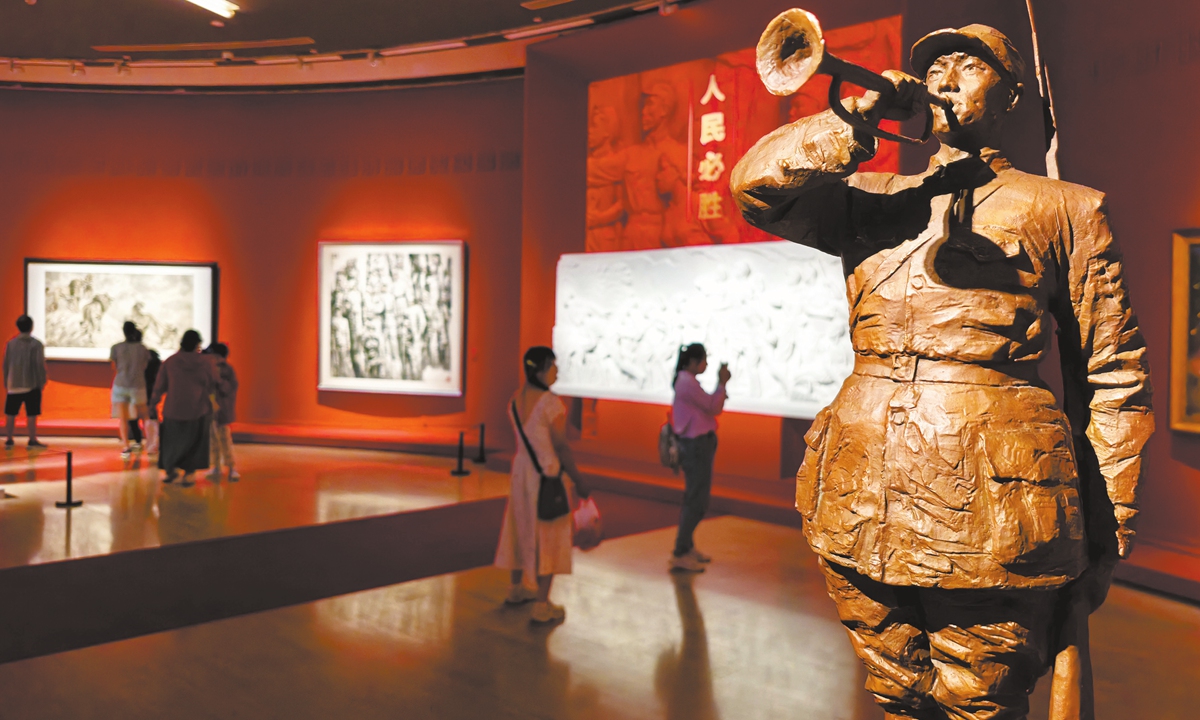
An art exhibition commemorating the 80th anniversary of the victory in the Chinese People's War of Resistance against Japanese Aggression and the World Anti-Fascist War opens at the National Art Museum of China in Beijing on August 25, 2025. Photo: VCG
During the Chinese People's War of Resistance against Japanese Aggression, one of the most influential US newspapers - The New York Times - closely followed China's struggle, publishing extensive coverage. A recent research report conducted by the Academy of Contemporary China and World Studies (ACCWS) believes that these New York Times articles, offering a unique third-party perspective, depicted how the Chinese people, under the banner of the united front advocated by the Communist Party of China (CPC), achieved the first complete modern victory against foreign invasion, fully affirming that China's War of Resistance made a tremendous contribution to the victory in the World Anti-Fascist War.The New York Times articles expose atrocities committed by Japanese invaders against China
"The helpless Chinese troops, disarmed for the most part and ready to surrender, were systematically rounded up and executed." "Civilians of both sexes and all ages were also shot by the Japanese… Any person who, through excitement or fear, ran at the approach of the Japanese soldiers was in danger of being shot down," reported by The New York Times on January 9, 1938.
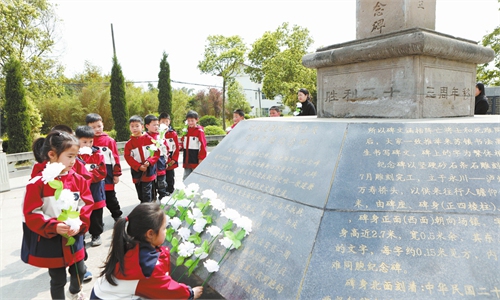
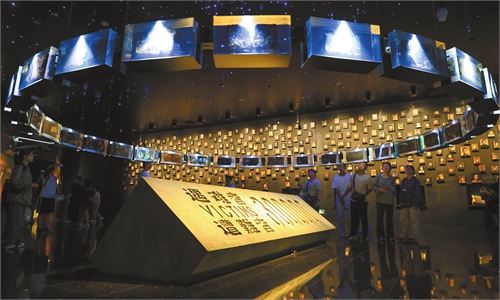
On December 13, 1937, Nanjing fell to the Japanese army. On January 9, 1938, reporter Tillman Durdin exposed the atrocities committed by the Japanese in Nanjing in his article titled "Japanese Atrocities Marked Fall of Nanking After Chinese Command Fled; NANKING INVADERS." The report detailed the large-scale execution of prisoners of war, city-wide looting, mass killings of civilians, widespread sexual violence and wanton destruction of property. These acts, he wrote, "will remain a blot on the reputation of the Japanese Army and nation."
Starting from August 15, 1937, the Japanese military launched sustained heavy bombing raids on Nanjing. From December 13, 1937, to January 1938, the Japanese forces carried out a brutal massacre in Nanjing that lasted for over 40 days.
The ACCWS' report points out that before and after Japan's occupation of Nanjing, it committed numerous atrocities but used false propaganda to create an illusion of peace and stability. The New York Times, through its correspondent in Nanjing and foreign nationals who remained in the city, provided authentic documentation and exposure of the Japanese military's atrocities in Nanjing. According to statistics, during this period, The New York Times published approximately 100 reports related to the Japanese military's atrocities in Nanjing.
Hu Shaohua, assistant researcher at the ACCWS, said that "these reports broke through Japan's false propaganda, exposing the true objectives of the Japanese military's invasion of China, and exerted public opinion pressure on Japan. From today's perspective, these texts, recorded from a 'third-party' viewpoint, have become historical materials that confirm the atrocities committed by the Japanese military. They hold significant importance in refuting the long-standing fallacies of the Japanese right-wing forces that deny and distort the historical truth of the Nanjing Massacre."
The report states that in the face of Japanese atrocities, Chinese soldiers and civilians remained undaunted. Under the guidance of the national united front against Japanese aggression, they engaged in a prolonged and enduring struggle for national survival and rejuvenation as well as human justice. Regarding the indomitable fighting spirit exhibited by Chinese soldiers on the battlefield, The New York Times repeatedly praised their resilience and determination.
On December 13, 1937, The New York Times reported that "once more the rank and file of the Chinese soldiery demonstrated at Nanking their extraordinary ability to take terrible punishment and hold fast under conditions. Mostly unpaid and underfed, without any provisions for their wounded, the Chinese forced the Japanese to pay a terrific price for every foot gained around the gates."
To support the War of Resistance, ordinary citizens, students, and other groups took an active part. At the end of 1935, the December Ninth Movement broke out. The New York Times reported that the student movement in China had ignited patriotic fervor nationwide and inspired the public to resist the aggressors. Farmers transported supplies for the army, women served as doctors and nurses, writers and artists produced a large body of resistance literature, and the education sector trained talent for the reconstruction of industry and agriculture. People from all walks of life demonstrated a strong spirit of patriotism.
"In the war of resistance, the Chinese military and civilians embodied an indomitable national spirit and a heroic determination to fight to the end. As the war went on, The New York Times shifted in its coverage from a neutral stance to one of sympathy toward China, portraying the country's courageous and unyielding struggle. This helped rally international sympathy, support and aid," said Hu.
The CPC plays a pillar role in the War of Resistance
"Everywhere he found high enthusiasm for the anti-Japanese struggle, a constant training of able-bodied men, and war songs on the lips of everyone. Everywhere, he said, he found support for the Kuomintang (Nationalist party)-Communist united front," The New York Times reported on August 9, 1938 when covering Captain Evans F. Carlson of the United States Marine Corps' journey with the Chinese army in Shanxi-Chahar-Hebei anti-Japanese base area.
After the Xi'an Incident, New York Times published an article, introducing the American writer Agnes Smedley and recounting how she reported on the event through radio broadcasts. The report emphasized that the CPC's active efforts to negotiate a peaceful settlement of the incident were of great significance: Its purpose was to form a united front to resist Japan, and the Xi'an Incident demonstrated the Chinese people's determination to resist Japanese aggression.
These reports show how the CPC actively promoted the formation of the national united front against Japanese aggression, called on the Kuomintang government to reorganize the Red Army to jointly resist Japan and demonstrated the CPC's political leadership," said Zhang Danping, a research fellow at the ACCWS.
According to the report, during the War of Resistance, The New York Times covered the CPC-led battlefields behind enemy lines and the construction of anti-Japanese base through on-the-ground reporting by its correspondents in China and visits by international figures.
At the beginning of the full-scale war, when Chinese forces were losing battles on the frontlines and some international observers held pessimistic views of the situation, US Marine Captain Evans Carlson decided to personally visit the Shanxi-Chahar-Hebei anti-Japanese base area. He became the first foreign military officer to visit the CPC-led anti-Japanese base behind enemy lines. After several months of close observation, Carlson concluded that the CPC's control of the nominally Japanese-occupied provinces of North China had become highly organized and increasingly effective.
Why was the CPC-led battlefield behind enemy lines able to effectively slow down Japan's invasion and pin down its forces? The New York Times sought to explore the reasons behind this.
The ACCWS report noted that most coverage attributed this success to the CPC's adherence to the principle of protracted war and its flexible guerrilla tactics. In January 1938, an article titled "Course of War in China Forces Japan to Pause" reported that while Japan sought a quick war of annihilation against China, the CPC's first principle of anti-Japanese action was dispersed resistance. The article argued that the CPC's method of "organizing the whole populace," which engaged the entire population as a supporting base, should be adopted.
In February 1938, another article titled "China Bases Strategy on Plan of Attrition" observed that the dramatic frontal battles between China and Japan were giving way to the fighting of mobile units of much smaller size, and suggested that the CPC's strategy may be better adapted to the heavy task of a war of attrition against her aggressors.
"The New York Times' coverage of China's War of Resistance, from a third-party perspective, highlighted the CPC's role as a central pillar in the struggle," Zhang said. Politically, the CPC actively promoted the formation of the national united front against Japanese aggression; strategically, it adhered to protracted war and guerrilla warfare while steadily developing bases behind enemy lines; militarily, the Eighth Route Army and the New Fourth Army effectively pinned down and fought Japanese troops in those areas; and in terms of social mobilization, the CPC successfully organized the masses, making them the cornerstone of sustaining a protracted war.
China's contributions to WWII victory are of incalculable value
The ACCWS report noted that Brooks Atkinson, The New York Times correspondent in China, summarized China's contributions to the war in four aspects. First, China resisted Japan by force of arms for a long period, which is a service of incalculable importance. Second, China pinned down about thirty Japanese divisions, thereby helping the American and Australian troops fight Japan in the South Pacific. Third, China helped build air bases from which the home land of Japan would be bombed, playing a vital part in the crushing of Japan. Fourth, China's long resistance was still valiant in spirit, and there is a vast reservoir of goodwill toward America in China.
Atkinson concluded that China "is still making four fundamental contributions which are of incalculable value in the war that will crush Japan completely," and it "should be valued with the sort of respect." He affirmed that China was "a good ally" and that the Chinese people were "sound."
The Chinese People's War of Resistance Against Japanese Aggression is an important part of the World Anti-Fascist War. According to the ACCWS, The New York Times published more than 6,000 reports related to China's resistance during the war years, accounting for one-third of all its China coverage in that period. Within the six months following the September 18 Incident, the paper ran as many as 1,381 reports.
"China, as the main Eastern battlefield for the World Anti-Fascist War, made tremendous contributions to the victory of the world anti-fascist struggle. This gradually became an international consensus," said Qu Yuan, an assistant research fellow at the ACCWS. She noted that during the period of localized resistance, The New York Times' reports reflected the international community's sympathy for China, though without fully grasping its importance for the World Anti-Fascist War. As the all-out resistance began and the worldwide fight against fascism deepened, the significance of China's war effort became increasingly evident. The world came to recognize that China had long tied down massive Japanese forces, strategically buying the Allies precious time and space for victory.
Zhang pointed out that while The New York Times' coverage of China's resistance had limitations in terms of sources, perspectives and ideological leanings in its early stages, overall it exposed the brutal reality of Japan's invasion of China, shaped a positive image of China's tenacious resistance and promoted shifts in US policy in the Far East - making its reporting of both historical and contemporary significance.
The author is a reporter of People's Daily Overseas Edition. opinion@globaltimes.com.cn
RELATED ARTICLES