German chancellor’s ‘China exploiting trade vulnerabilities’ remarks show need of adjusting perception toward bilateral relations: expert
By Published: Sep 09, 2025 11:04 PM

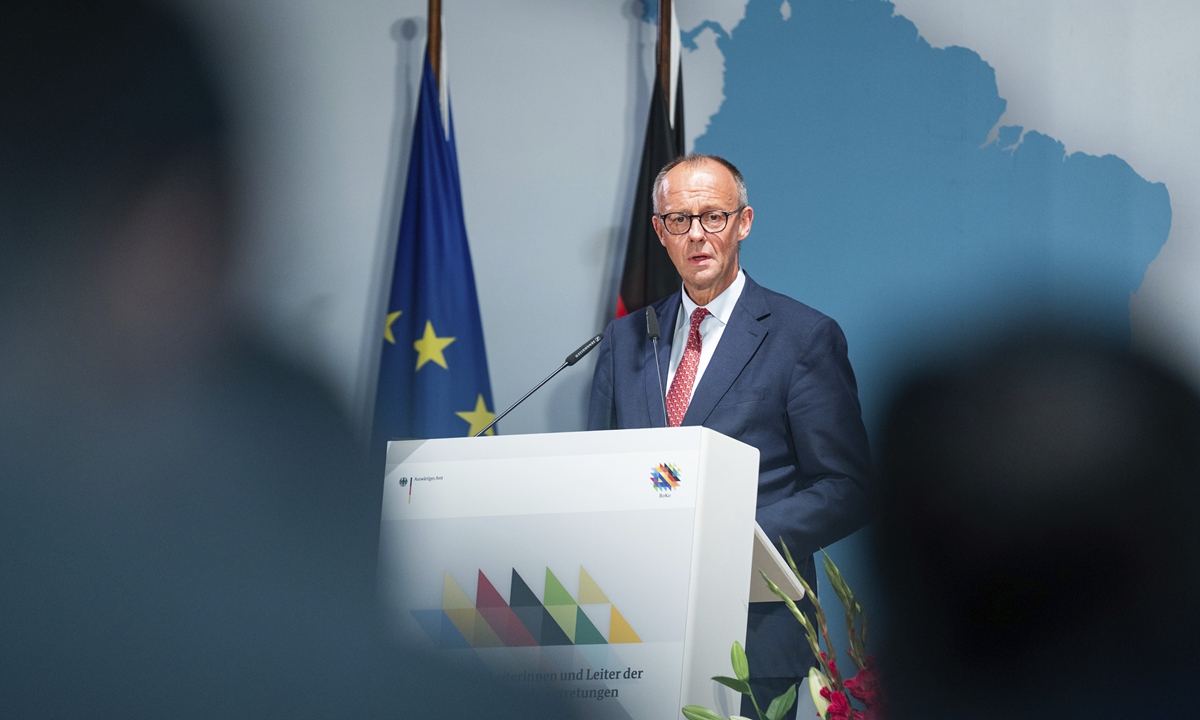
German Chancellor Friedrich Merz speaks at the opening of the conference of heads of German missions abroad in Berlin, Germany, on September 8, 2025. Photo: VCG
In a latest speech, German Chancellor Friedrich Merz, while trying to signal an independent policy from both China and the US, repeated his old cliché of "de-risking" from China.In his latest open remarks, German Chancellor Friedrich Merz claimed to make it a priority for Germany to reduce its dependence on China for raw materials, even asserting that China is ready to "exploit trade vulnerabilities," according to a Bloomberg report on Monday.
"Dependencies make us susceptible to blackmail," Merz, claimed on Monday at a conference of German diplomats in Berlin, according to Bloomberg.
Regarding Germany's China policy, Merz reiterated that the German government seeks cooperation wherever possible, for example in climate policy or in global crises, German media WELT reported on Monday.
At the same time, however, the systemic rivalry with Beijing is increasing, the report quoted Merz as saying. For Germany's security and competitiveness, it must be a priority to diversify raw material and trade chains in the spirit of strategic sovereignty. This requires more and closer partnerships, especially with India, Indonesia, Brazil, Mexico and Argentina, but also with countries in Latin America, Africa and Asia, per WELT report.
These remarks show that Merz's perception of China has not fundamentally changed, as he made similar negative remarks when he was opposition leader, Jiang Feng, a research fellow at Shanghai International Studies University and president of the Shanghai Association of Regional and Country Studies, told the Global Times on Tuesday.
"The problem is that now, after being in power for some time, he bears leadership responsibility for Germany's national interests. China-Germany relations should be a key focus of Germany's foreign strategy, yet it seems he has not demonstrated new ideas or adjustments," Jiang said.
At a time when Germany is facing economic difficulties and urgently needs growth, China is a vital partner, but the German Chancellor has not given it due attention, which runs counter to Germany's interests, the expert said.
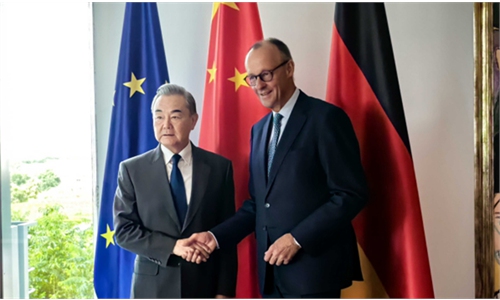
During his meeting with Merz in July in Berlin, Chinese Foreign Minister Wang Yi told the German Chancellor that China is committed to building new, open and higher-standard economic systems, and its door will only open even wider. China is willing to share market opportunities with Germany and create a promising future for development.
Bloomberg pointed out that in contrast to his immediate predecessors, Social Democrat Olaf Scholz and fellow conservative Angela Merkel, Merz advocates a more critical stance toward Beijing and has repeatedly warned of the risks of over-exposure to China.
Merz from the Christian Democratic Union (CDU) was elected German chancellor on May 6 in the second-round Bundestag voting, according to the Xinhua News Agency.
At present, Europe is facing recurring internal crises, social divisions and an atmosphere of anxiety and distrust, which has also spilled over into relations with China, the expert said, adding that if Merz cannot adjust his perception, he risks falling into a strategic misjudgment that will undermine his governing objectives.
On Monday, Merz also warned Europe must be ready to chart its own course independently of the US, Politico reported.
"We must face the fact that our relationship with the US is changing," said Merz in Berlin on Monday in a wide-ranging foreign policy speech, per Politico.
"The US is reassessing its interests - and not just since yesterday. And so we in Europe must also adjust our interests, without false nostalgia," the German leader said, according to Politico.
On one hand, Merz stresses that Europe must rely on itself, but in reality Europe lacks strategic resources, Jiang said.
"For Germany and Europe to play a global role, cooperation with China is indispensable. Yet he has not treated China as a strategic partner; instead, he repeats the familiar rhetoric of 'de-risking' and continues to view China as a threat. This is a serious strategic misjudgment that runs counter to the interests of both Germany and Europe," Jiang added.
From the perspective of economic principles, Germany is highly dependent on global markets, with China being an essential part of that system, Jiang noted. "As an economic expert, Merz should recognize that mutual dependence is the foundation of the global market, but he has politicized economic issues and framed normal interdependence as political risk," he added.
Li Yu also contributed to the story
RELATED ARTICLES