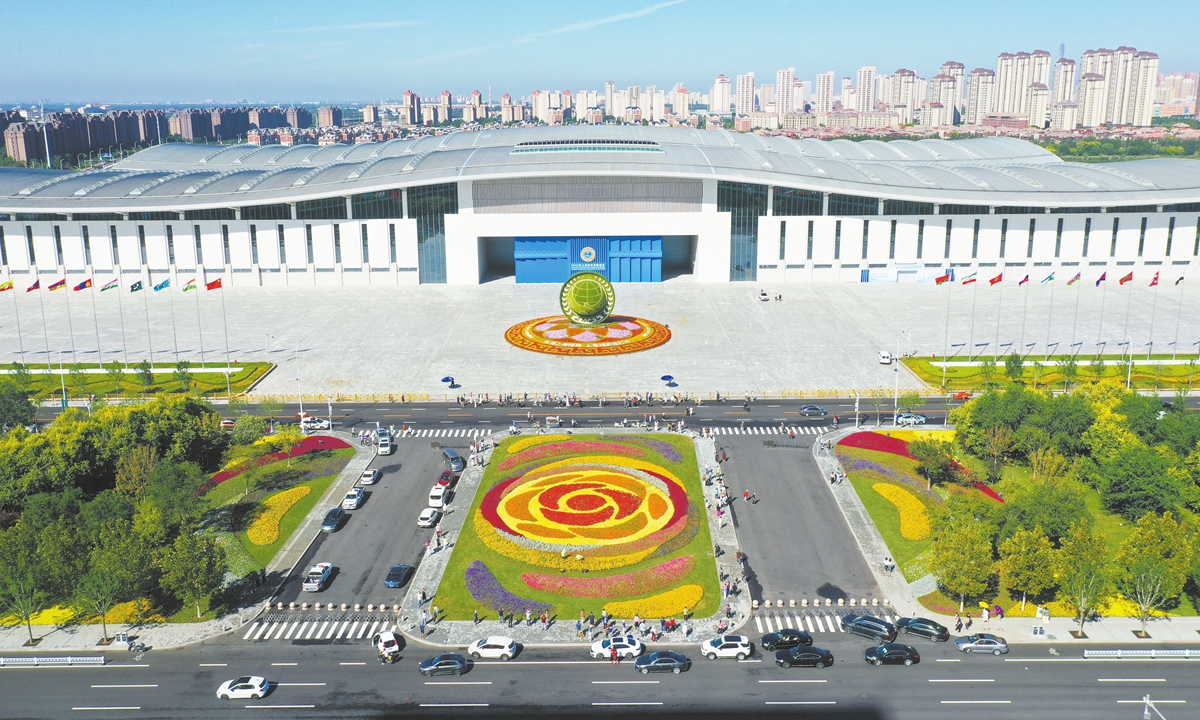
A view of the Meijiang International Convention and Exhibition Center in Tianjin, the venue of the SCO Summit 2025 Photo:VCG
Editor's Note:Facing profound changes and pressing challenges, the international community seeks fresh wisdom and practical solutions. China, under the leadership of Chinese President Xi Jinping, plays a vital role in promoting common development, fostering dialogue among civilizations and enhancing global governance. The Global Times has launched a special series titled "Steering the New Era." Through in-depth conversations with renowned scholars and global dignitaries, the series explores China's development experiences and governance visions.
In the third installment of the series, Robert Lawrence Kuhn (Kuhn), chairman of The Kuhn Foundation and recipient of the China Reform Friendship Medal in 2018, shared his insights with Global Times (GT) reporter Xia Wenxin, on the Global Governance Initiative (GGI) newly proposed by the Chinese leader and China's overall contributions to global governance, among other topics.
GT: From a global perspective, what do you see as the structural opportunities and challenges currently facing global governance? In this context, what role is China playing in the global governance system, and what kind of governance model is it seeking to promote?
Kuhn: For humankind, global governance is more important than ever before, and there are three fundamental categories of reasons for this: global challenges, such as climate change, continuing inequalities and environmental degradation of the global commons; global opportunities, represented by leveraging technology to enhance human welfare and flourishing; as well as various global and regional conflicts. Only effective global governance can address these challenges, take advantage of opportunities, and control and reduce conflicts.
China promotes a multilateral, multinational world order based on the integrity and equality of nations, which is founded on China's long-standing Five Principles of Peaceful Coexistence. China is committed to pursuing international affairs through multilateral organizations, groups of states and bilateral relations. The major international organizations are primarily centered around the UN and its various bodies and agencies. BRICS, now expanding, has become the second most important multinational body, for coordinating the global economy, along with the G20, and for regional security, the Shanghai Cooperation Organisation (SCO).
Historically, China has long treated every country, large or small, economically developed or developing, with similar levels of respect. Its leaders, representing its people, are honored appropriately.
GT: Chinese President Xi Jinping earlier this month proposed the GGI at the "SCO Plus" Meeting in Tianjin. How would you describe this proposal?
Kuhn: Speaking at the "SCO Plus" Meeting, President Xi proposed the GGI, as he put it, to "work with all countries for a more just and equitable global governance system and to advance toward a community with a shared future for humanity." The latter has been President Xi's overarching guidance for China's foreign affairs, and here he unites it directly with the new GGI. This means that the GGI takes on special significance, and all who want to understand China must understand this initiative.
The GGI now completes the set of China's global initiatives that collectively and transparently state, without ambiguity, the nation's intent for engaging the world: the Global Development Initiative (GDI), focused on cooperative economic projects; the Global Security Initiative (GSI), aimed at dialogue on discord and conflict; and the Global Civilization Initiative (GCI), which promotes exchanges and mutual learning among civilizations.
However, it is the GGI that most clearly articulates how China believes our turbulent world should be run and how China sees its role in doing so.
There are challenges, of course, such as applying international law on contentious issues of territorial integrity, and navigating divergent interests even among nations within the SCO.
To those abroad who watched China's recent military parade and find that their concerns have increased, I say: consider China's global initiatives, especially the GGI. Actions, of course, speak louder than words.
GT: China advocated for delivering more benefits to the entire humanity through the reform of the global governance system and the building of a community with a shared future for humanity. Based on your long-term observation of China, what role do you think the Chinese leadership has played in advancing this vision?
Kuhn: President Xi stresses the vision of building a community with a shared future for humanity, which exemplifies equality and equity among all nations and peoples. It is a big vision that balances each country's individual responsibility to care for all its own citizens and all countries' collective responsibility to care for all citizens of the world.
Though the Chinese phrase has remained the same, the original English translation was "a community of common destiny for humanity," - which was later changed to "with a shared future," because, in my opinion, in English, "destiny" can connote fate, a pre-determined path and outcome. This is important because China stresses that we, the people of our planet, have the responsibility and capability to manage ourselves properly, and if we have the will to do so, humanity will prosper.
GT: At a time when the international system is facing multiple challenges, the idea of a community with a shared future for humanity is gaining growing attention from countries around the world. In your view, what gives this vision such a strong appeal today? How does it respond to the pressing need for global consensus?
Kuhn: The world today not only faces more challenges and conflicts, but because of the ubiquitous presence of smartphones, the internet and social media, more people globally are aware of all the problems. This makes people more sensitive to the problems and more desirous of new solutions.
Given the state of the world, President Xi has set forth four global initiatives. The four initiatives are linked in a big vision for transforming global governance. The four initiatives are China's explicit roadmap, drawn by President Xi, that lays out China's global vision.
The overarching theme and the arc of the argument are clear: Humanity is at a crossroads; interdependence is inevitable; the new era calls for new ideas; and China's grand initiatives, based on its history and experience, are an enlightened new vision for building a better world.
GT: Regarding China's role in global governance, in the face of skepticism from some countries, how do you think the international community should objectively assess the true value of the four China-proposed initiatives?
Kuhn: Today's world needs stability and economic growth, and China offers both, based on its own experience and expertise. China points with pride to the large number of countries that praise its three global initiatives - development, security and civilization - and now, the fourth, governance, forming the core of China's foreign policy. My takeaway message is to take China's four global initiatives seriously. Given President Xi's commitment, actions will follow words.
The ultimate success of China's four global initiatives will be decided, not in the media court of rhetoric and argument, but in the global marketplace of programs and results. Developing countries will be the evidence, open for all to see.
RELATED ARTICLES