Spirit of endurance, sacrifice and courage runs throughout China’s War of Resistance
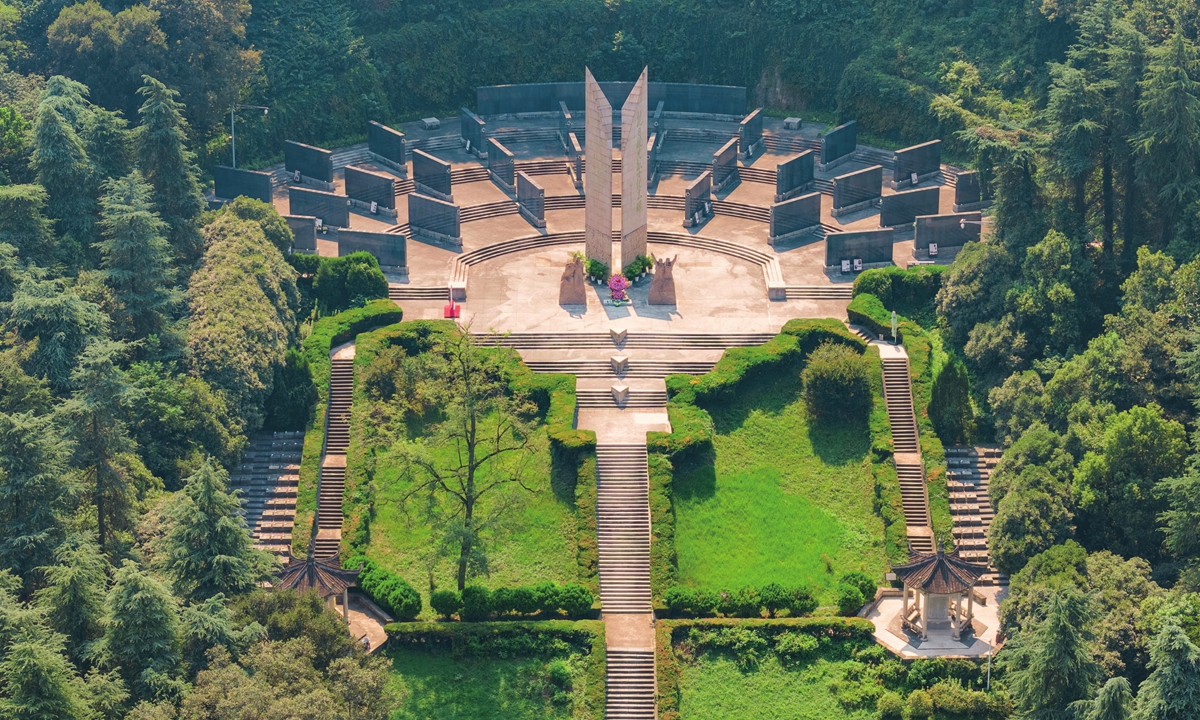
A view of Nanjing Anti-Japanese Aviation Martyrs Memorial Hall Photo: VCG
Editor's Note:
2025 marks the 80th anniversary of the victory in the Chinese People's War of Resistance against Japanese Aggression and the World Anti-Fascist War. Eight decades have passed, yet the world once again finds itself at a crossroads. The rise of unilateralism, ongoing geopolitical turbulence and the distortion of historical truths remind us of the enduring relevance of remembering the past and safeguarding peace. Against this backdrop, the Global Times launches the column "Revisiting WWII, Defending Peace," inviting renowned scholars and peace advocates from around the world to revisit the history of WWII through contemporary lenses. Through diverse perspectives, the series seeks to uphold historical memory, promote shared development, and defend fairness and justice. Only by confronting history with honesty and clarity can humanity find the wisdom to shape a more peaceful and sustainable future. This is the 12th piece of the series.
In the long story of China, few events marked such profound suffering and determination as the years of the Chinese People's War of Resistance against Japanese Aggression. Now, 80 years after the end of WWII, it remains vital to remember not only the sacrifices made by the Chinese people, but also the shared struggle with allies that led to victory.
Throughout history, war comes to us - to our homes, our towns, our families. In the darkest times, something else emerges: the capacity of ordinary people to endure, to help and to save one another.
One little-known story was featured in a Chinese film Dongji Rescue. In October 1942, the Japanese ship Lisbon Maru carried 1,800 British prisoners of war when it was torpedoed off the coast of China by an American submarine unaware of its human cargo. As the ship sank, over 800 drowned, trapped in the ship's hold, while others clung to wreckage and were fired upon by Japanese forces.
It was local Chinese fishers from nearby Dongji Island - unarmed and under threat themselves - who went out in small wooden boats, risking everything to save strangers. They pulled over 300 survivors from the sea, hid them from Japanese patrols, and shared their food and homes. They had nothing to gain and everything to lose. They acted anyway.
That spirit of endurance, sacrifice and practical courage ran throughout China's gruelling 14-year war of resistance against Japanese aggression, from 1931 to 1945.
I first encountered this history at the age of 23, sitting in the August First Film Studio's cinema in Beijing. The reels were grainy, scratched by time, but alive. The faces of soldiers, women and children carried the unbearable weight of war. It struck me how absent these stories were from the Western version of WWII.
Recently, I had the privilege of meeting the grandchildren and children of Chinese veterans who fought against Japanese invaders. Some spoke of the overwhelming odds in the battles against Japanese armies; others recalled their grandfathers surviving impossible conditions only to face further war, and the enduring spirit that allowed their families to withstand the years of occupation. These descendants reminded me that history is living - it survives in memory, in family, and in the pride and perseverance passed down across generations. Through their eyes, the endurance, unity and determination of ordinary people becomes unmistakably real.
In December 1937, the city of Nanjing fell to Japanese forces. According to the Nanjing War Crimes Tribunal, more than 300,000 were massacred - civilians and disarmed soldiers alike. Men, women and children were executed, raped or burned alive. Homes and entire neighborhoods were destroyed. The scale of the atrocity is almost unimaginable, yet it is rarely highlighted in Western accounts of World War II. The massacre steeled the resolve of the Chinese people, who would continue to resist under impossible conditions. It is a stark reminder that the war in China was not simply a series of battles - it was a struggle for survival against a campaign of terror.
The scale of the Chinese People's War of Resistance against Japanese Aggression is staggering. The human cost for the Chinese people was catastrophic - more than 35 million lives, mostly civilians, were lost or injured through massacres, starvation and forced labor. Cities and towns were burned, crops destroyed, communities decimated. Yet Chinese resilience, guerrilla ingenuity and widespread civilian resistance led to victory.
China's War of Resistance was not fought by a single army or a centrally coordinated command. It was waged by the national united front advocated by the Communist Party of China. Each group fought not only to defend their homeland but also to survive a brutal invasion and occupation.
Among ordinary heroes were countless civilians - farmers, merchants, students and workers - who fought invading forces with courage and ingenuity. Entire villages hid and fed guerrilla bands; families sacrificed everything to defy the occupying force. This popular uprising, alongside formal and irregular military resistance, absorbed and delayed Japanese divisions from pivoting earlier into Southeast Asia, India and toward Australia. Cambridge historian Hans van de Ven emphasised that China's resistance "trapped Japan," diverting key resources that might have been used in the Pacific campaigns.
China, Australia and beyond are linked through allied connections. I think of my own family. One grandfather fought in New Guinea as a radio operator/rear gunner in an Australian bomber, participating in defensive operations to counter the Japanese threat to the Southwest Pacific and Australia. My other grandfather served as chief engineer aboard a munitions supply ship at the Battle of Leyte Gulf, the largest naval battle in history, supplying American warships with ammunition during the heat of battle.
Just across China's borders, Allied forces also fought to resist Japan and restrict supply lines in China. British General Orde Wingate trained and led his "Chindits," insurgent forces conducting raids deep into Japanese-held Myanmar (Burma at that time). American Brigadier General Frank Merrill led his special operations unit to disrupt Japanese logistics. Meanwhile, American planes delivered vital arms over the Himalayan mountain range, known as the "Hump," into Yunnan, and the volunteer "Flying Tigers," led by General Claire Chennault, provided air support and advisory roles, many years before the attack on Pearl Harbor. The 2/21st Infantry Battalion of the Australian Army, known as "Gull Force," was captured by Japanese forces after fierce fighting in Ambon and transferred to slave labor camps on Hainan Island. During this time the Australians secretly trained local Chinese militias, assisting local resistance against Japanese forces.
History is not only shaped by leaders and armies. It is forged by fishers rowing into danger, farmers who never return from battle, villagers sharing their last bowl of rice. It is shaped by acts of kindness and courage without reward, by the instinct to endure together. That is the lesson of China's War of Resistance and of Australia's struggles defending our country: Survival and victory depend not only on weapons, but on compassion, practical courage and the endurance of ordinary people. Let us never forget the horror of war and the united effort of the people of China and their World War II allies, including Australia.
The author is an Australian sinologist and vice president of the publishing company Weldon's. opinion@globaltimes.com.cn
RELATED ARTICLES