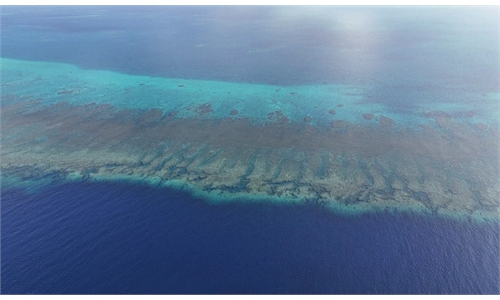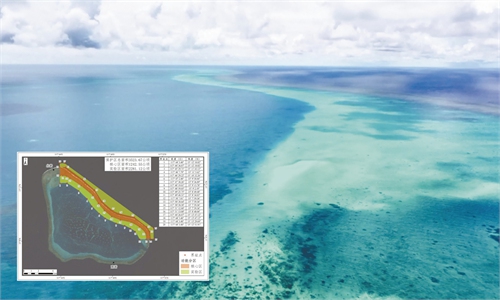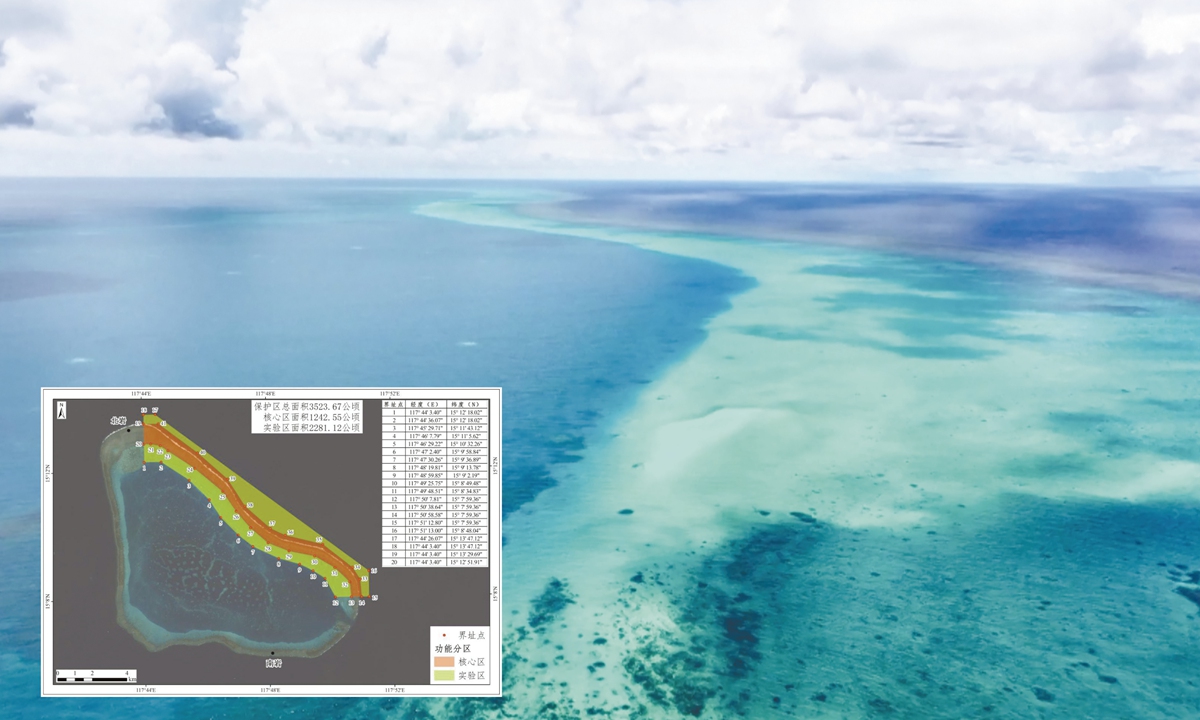
A picture of China's Huangyan Dao and an illustration of the scope and functional zones of the Huangyan Dao national nature reserve released by the National Forestry and Grassland Administration
China's State Council on Wednesday approved a proposal from the Ministry of Natural Resources to establish Huangyan Dao national nature reserve, according to an announcement published on the State Council's official website. Experts told the Global Times on Thursday that the establishment of the Huangyan Dao national nature reserve is in line with both Chinese laws and international practice.In the future, foreigners, for entering the reserve, will be required to submit activity plans to Chinese authorities in advance and obtain approval. Any unlawful acts that damage the ecological environment in Huangyan Dao and its surrounding waters will be subject to legal accountability, noted the experts.
Data from the National Bureau of Statistics show that as of 2023, China had 449 national nature reserves. The newly established Huangyan Dao nature reserve will become the country's 450th.
The establishment of the national nature reserve is an important guarantee for maintaining the diversity, stability and sustainability of Huangyan Dao's ecosystem, according to the State Council's approval document.
The State Council has instructed relevant government departments and local authorities to strictly implement the regulations on nature reserves, as well as provisions related to the development and management of protected areas.
They are also required to improve management institutions, strengthen supervision and law enforcement against all types of illegal and irregular activities within the nature reserve, to ensure the implementation of all management measures, per the document.
"Huangyan Dao and its surrounding waters feature a typical coral reef ecosystem, rich fisheries resources and rare marine species. It is a 'representative natural ecosystem region' and 'a natural concentration area of rare and endangered wild species,' and therefore a nature reserve should be established in accordance with China's regulations," Luo Gang, a researcher at the Ministry of Natural Resource Institute of Marine Development Strategy, told the Global Times on Wednesday.
He noted that the decision is not only part of building a "Beautiful China," but also an important practice in advancing the rule of law, consistent with international law and global practice.
China has long prioritized ecological protection of Huangyan Dao, with ecological restoration and conservation being key to its exercise of sovereignty and jurisdiction over the area. According to Luo, the Huangyan Dao reserve, located in Sansha city, South China's Hainan Province, covers 3,523.67 hectares, including a core zone of 1,242.55 hectares and an experimental zone of 2,281.12 hectares. The reserve will focus on safeguarding the coral reef ecosystem, in accordance with the Marine Environment Protection Law and regulations on nature reserves.
"The regulations on nature reserves stipulate that in principle, no organization or individual may enter the core zone; only limited human activities are permitted in the experimental zone. From this perspective, the establishment of the reserve will make ecological protection of Huangyan Dao and nearby waters more standardized and effective," Luo said.
Under the regulations on nature reserves, activities such as logging, grazing, hunting, fishing, collecting medicinal herbs, land reclamation, slash-and-burn, mining, quarrying, and sand excavation are prohibited within a reserve, unless otherwise provided by law. Luo stressed that Huangyan Dao is a traditional Chinese fishing ground rich in reef-building organisms and fish species. With the establishment of the reserve, fishing and similar activities will be banned within its designated boundaries, except where permitted by law.
The regulations on nature reserves also specify that natural reserves are divided into core, buffer and experimental zones, with the core zone strictly off-limits. Entry into the core zone is strictly prohibited for any individual or institution, except in cases where scientific observation or investigation is required. Such activities must be submitted in advance with a plan to the reserve's management authority for approval. Foreigners, Luo added, must obtain prior approval from Chinese authorities to enter any reserve, and are forbidden to collect specimens or conduct other activities without authorization.
Violations of the regulations will entail legal consequences and penalties. Luo underlined that the creation of the Huangyan Dao national nature reserve demonstrates China's resolve to advance ecological civilization through rule of law.
"I believe that in the future, any illegal acts that harm the ecological environment in Huangyan Dao and its adjacent waters will be strictly pursued in accordance with the law," Luo said.
Global Times
RELATED ARTICLES