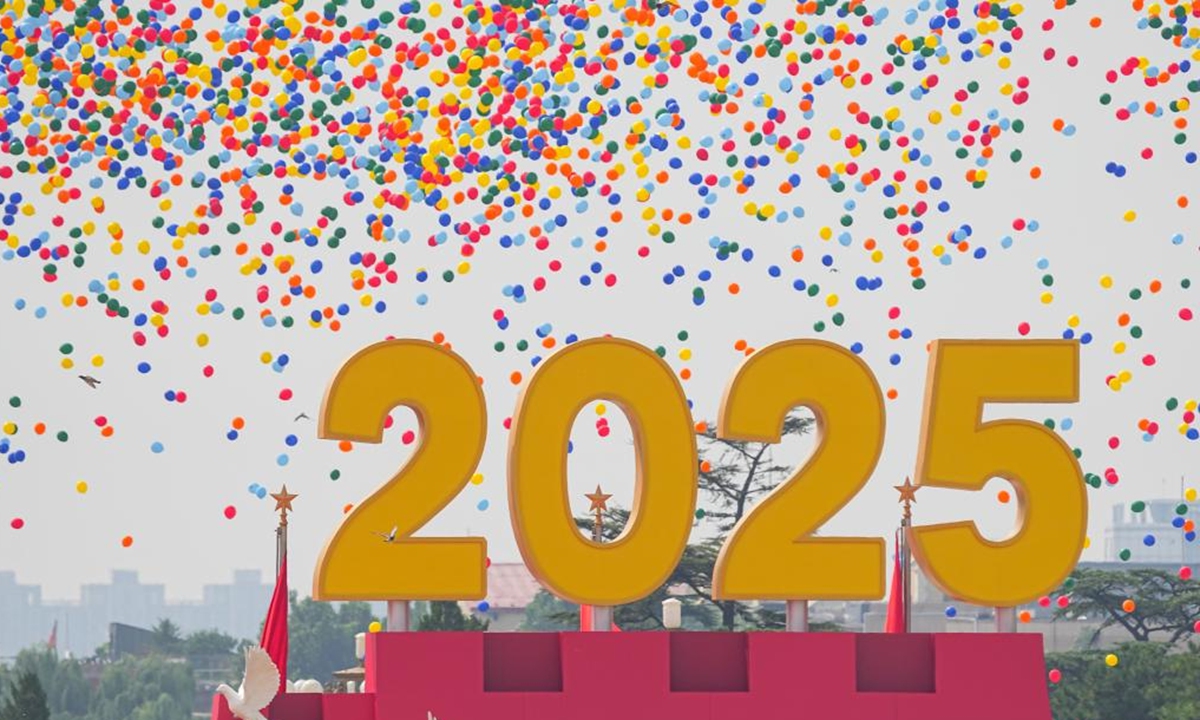
Balloons are released into the sky over Tian'anmen Square in Beijing, capital of China, Sept. 3, 2025. China on Wednesday held a grand gathering to commemorate the 80th anniversary of the victory in the Chinese People's War of Resistance against Japanese Aggression and the World Anti-Fascist War. (Xinhua/Xing Guangli)
Editor's Note:2025 marks the 80th anniversary of the victory in the Chinese People's War of Resistance against Japanese Aggression and the World Anti-Fascist War. Eight decades have passed, yet the world once again finds itself at a crossroads. The rise of unilateralism, ongoing geopolitical turbulence and the distortion of historical truths remind us of the enduring relevance of remembering the past and safeguarding peace. Against this backdrop, the Global Times launches the column "Revisiting WWII, Defending Peace," inviting renowned scholars and peace advocates from around the world to revisit the history of WWII through contemporary lenses. Through diverse perspectives, the series seeks to uphold historical memory, promote shared development and defend fairness and justice. Only by confronting history with honesty and clarity can humanity find the wisdom to shape a more peaceful and sustainable future.
In the 13th installment of this series, Global Times (GT) reporter Qian Jiayin spoke with Andrew Buchanan (Buchanan), author of World War II in Global Perspective, 1931-1953: A Short History and senior lecturer at the University of Vermont, to discuss the narrative of World War II from a global perspective and the practical significance of telling the history of WWII.
GT: This year marks the 80th anniversary of the end of WWII. In today's complex and changing global situation, what is the practical significance of studying and telling the history of WWII?
Buchanan: Much of the world we live in today was shaped by the outcome of WWII, which makes its history directly relevant to the present. As the lived experience of the war fades, the study of this period's history becomes even more important. My own mother was 10 years old when her house in England was bombed, and she narrowly escaped with her life. I have often reflected on what it means for a child to face such a reality: one moment living in the small world of toys and family, and the next facing the threat of death from the sky. This experience was deeply striking to me, yet it represents only a fraction of the devastation compared with what occurred in China and the Soviet Union.
This contrast is particularly significant for the US. Unlike most countries involved in the war, the US suffered virtually no destruction on its own soil. Apart from a single incident in which a Japanese balloon bomb killed six civilians, not a single American building was destroyed. As a result, many Americans experienced the war from a distance. It was even seen as something positive, regarded as a "good war," both morally justified and beneficial in certain respects. For many working-class families, it brought new opportunities: Women entered the workforce in large numbers, earning higher wages than before.
When I teach in the US, I try to push students beyond this national perspective. Once we truly grasp the destruction and suffering that war entails, we are far less likely to imagine it as something distant, clean or acceptable.
GT: What insights do you most hope readers gain from your book World War II in Global Perspective, 1931-1953: A Short History?
Buchanan: For readers in the US or Britain, what I want them to take away from the book is that WWII was not just about good and evil, and not just about the US and Britain fighting Germany. It was a truly global war that involved countries all around the world. It was about Asia as much as it was about Europe. It mobilized people in Africa, it had a huge impact in India, and it shaped events across the globe.
For me, one remarkable thing is that this book was translated into Chinese and has been widely read. I hope the book helps readers in China see their country in the broader world context, to understand where China fits into the bigger global picture. Maybe that is one reason why the book resonates in China, though the impact is not the same everywhere, because each country's experience of the war is different.
It is also important to recognize that the war did not simply end in 1945. For Americans, the atomic bombs may seem like the end. But for people in Vietnam, Indonesia, Malaya, Myanmar, India or China, it was not over. Violence and struggle continued across the region. That is why many historians now argue that the war began much earlier, in 1931, or at least in 1937. This shift has brought Asia and China into the center of the global story.
GT: Western perceptions of China's role in WWII, largely shaped by a Western-centric viewpoint, have historically been one of neglect, viewing China as a passive victim or a secondary participant, despite its crucial role in tying down vast numbers of Japanese troops and contributing to the overall Allied victory. As historians debate the war and people commemorate war anniversaries this year, has such perception changed?
Buchanan: There has indeed been a significant change in how China's role is perceived in the West, though this shift has occurred primarily within academic circles rather than in popular culture. Even so, awareness is growing beyond academia.
Why has this change occurred? I would point to two main factors. First, the end of the Cold War opened space for more objective inquiry - not only into the Soviet Union's role but also into China's. Second, China's reintegration into the global economy from the 1970s onward generated new interest in the West. Historians' perspectives evolve in response to global developments, and this broader opening created the conditions for reassessing China's wartime role. Of course, with rising geopolitical tensions today, how this process will continue remains an open question.
GT: The end of WWII brought about the creation of a new international order. However, you also point out that the US-led order post-1945 has many flaws. In a time when multilateralism is under strain, how should the international community work together to uphold a more just and equitable world order? What key lessons from WWII can guide the construction of a better global governance system?
Buchanan: Understanding how this new order emerged is crucial. WWII marked the US replacement of Britain as the world's leading power. The pound sterling, once the dominant global currency, was replaced by the dollar, backed by the immense productive power of the American economy. In 1945, the US accounted for more than 50 percent of the world's manufacturing output. However, Europe, the Soviet Union and China were devastated. Out of this situation came the unprecedented expansion of global capitalism, led by the US. This period of growth lasted about 25 years before slowing in the 1970s, when the relative strength of the US economy began to decline. Since then, of course, we have witnessed the remarkable rise of China, whose economic transformation and infrastructure development are a testament to a new global balance of power. That shift will inevitably have political consequences.
The memory of the last world war should remind us what is at stake. For younger generations especially, this is not abstract history - it is about their own future. This is why education about history is essential. The choices made by ordinary people matter. If they can make their voices heard, they may prevent the world from moving toward another devastating conflict.
WWII also demonstrated the possibilities of profound political change. Across Europe and Asia, movements for independence and social transformation emerged after WWII. These outcomes were not predetermined by individual leaders, but by the determination of millions of ordinary people who demanded a better life. That is another lesson of WWII, even if it was only partially realized in its aftermath.
History does not repeat itself, and there are no simple lessons to be drawn. But the past, present and future are deeply interconnected. By studying how WWII reshaped the world, we gain insights into the possibilities - and the dangers - that lie ahead.
RELATED ARTICLES