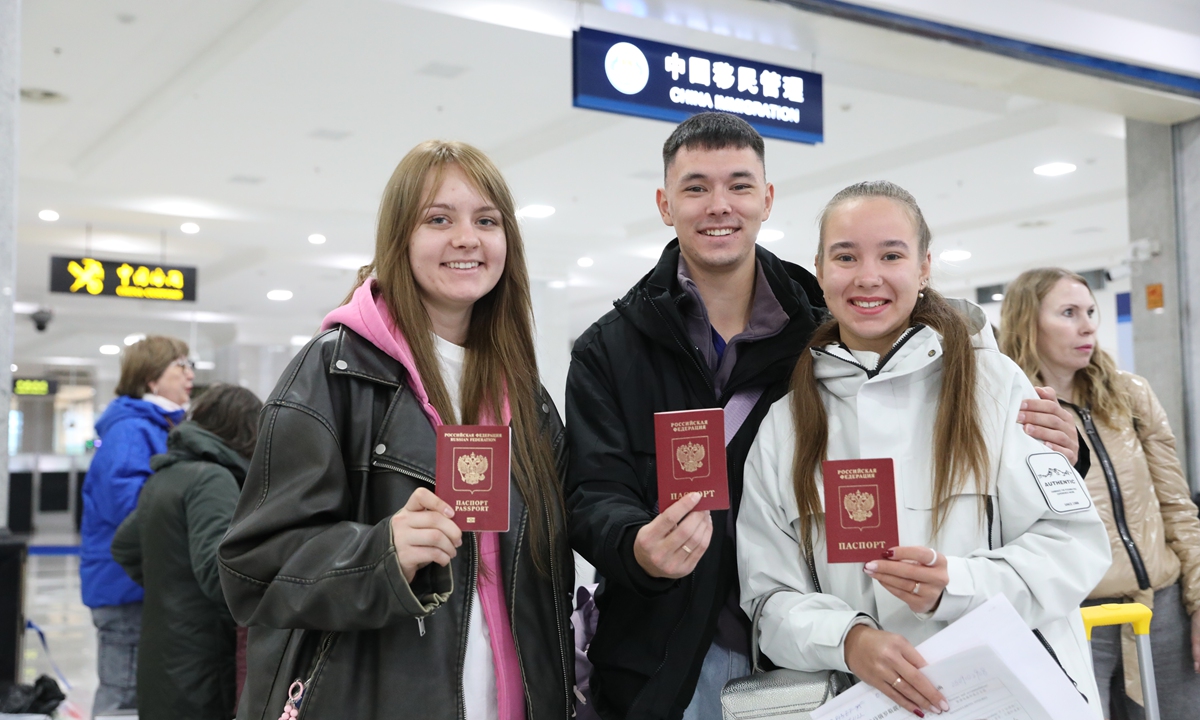
Three Russian youngsters pose for a group photo at Manzhouli Port in North China's Inner Mongolia Autonomous Region on September 15, 2025. Photo: Courtesy of the National Immigration Administration
China-Russia tourism and trade are gaining more momentum as China extends visa-free policy to ordinary passport holders from Russia on a trial basis from Monday.
China's Manzhouli, a key trade hub with Russia, welcomed its first batch of Russian travelers under a new visa-free system on Monday. The National Immigration Administration (NIA) said in a note sent to the Global Times that by noon, more than 300 Russian travelers had been processed for entry, marking a milestone in cross-border exchanges.
The demand structure of Russians traveling to China is increasingly diversifying. In addition to traditional leisure tourism, business travel has become a new core growth area, Guan Jian, spokesperson of the GZL International Travel Service, told the Global Times on Monday.
Business tourism now accounts for more than half of the total, and a significant number of business professionals come specifically to participate in various exhibitions, conferences, and other events, he added.
This positive development came after China decided to trial a visa-free policy for Russian citizens holding ordinary passports starting from September 15, 2025 to September 14, 2026.
Russian citizens holding ordinary passports who come to China for business, tourism, visiting relatives and friends or exchange visits and transit for no more than 30 days can enter China visa-free, spokesperson of Foreign Ministry Guo Jiakun said at a regular press conference on September 2.
Boosted by the positive news, Chinese tourists are also showing great enthusiasm for traveling to Russia.
According to forecasts by Trip.com, Russia is expected to become one of the most popular long-haul outbound destinations for Chinese tourists during the National Day golden week this year.
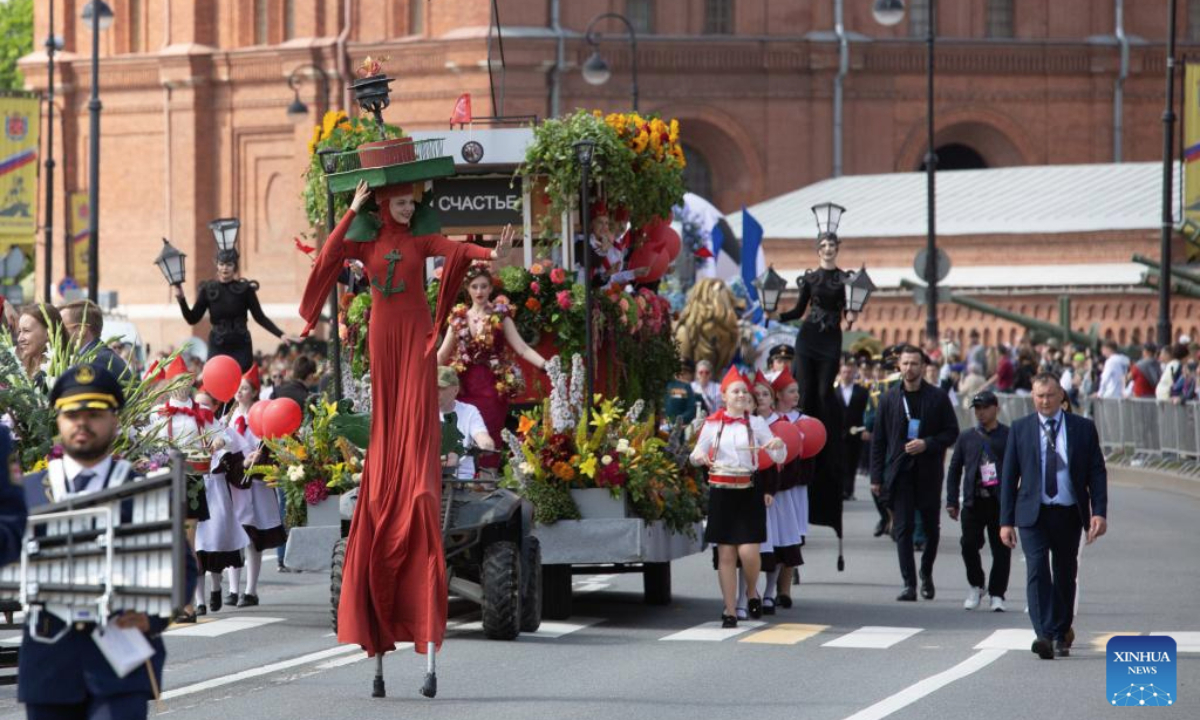
People attend a flower festival to celebrate the Russia Day at Peter and Paul Fortress in St. Petersburg, Russia, June 12, 2025. Russia Day marks the date when the First Congress of People's Deputies of the Russian Federation adopted the Declaration of Russia's National Sovereignty in 1990. (Photo by Irina Motina/Xinhua)
Data provided to the Global Times by the platform shows that, during the first week of this month, search volumes for Moscow increased by 3.3 times month-on-month and nearly fourfold year-on-year. Meanwhile, booking numbers rose by 20 percent month-on-month and 80 percent year-on-year.
From August 15 to September 14, Chinese mainland-Russia air routes operated nearly 1,900 round-trip passenger flights, a 19 percent year-on-year increase, data from industry platform VariFlight sent to the Global Times on Monday showed.
China Eastern Airlines and Aeroflot operated the highest number of flights. Additionally, as of September 14, the total number of round-trip flights between China and Russia operated by Chinese and Russian airlines this year had increased by 45 percent year-on-year.
Ding Chao, a deputy research fellow at the Chinese Academy of Social Sciences, told the Global Times that the implementation of the visa-free policy marks a new breakthrough in facilitating personnel exchanges between the two countries and will inject confidence and strong momentum into bilateral cooperation across multiple fields.
The Global Times has learned that China-Russia economic and trade collaboration is shifting from government-led major projects toward active participation by market entities, particularly small and medium-sized enterprises (SMEs) -- a transition that has been further accelerated by the visa-free policy.
Russia International Supply Chain Management (Shenzhen) "Katyusha" Co, a Shenzhen-based service provider that assists Chinese companies in opening online stores in Russia, has seen its business grow steadily in recent years thanks to the notable expansion of e-commerce trade between China and Russia, CEO Qiu Shiyan told the Global Times.
"From 2019 to 2024, the size of Russia's e-commerce market increased from about 2 trillion rubles ($226 million) to nearly 10 trillion rubles—and most of that growth came from China," said Qiu.
He noted that a significant portion of the goods the company ships to Russia consists of furniture, fitness equipment, bathroom products, and daily necessities. "Russia has a weak light industry sector, so most light industrial products in the country are imported from China," Qiu added.
Ding said that the visa-free policy will expedite the launch and enhance the depth of cooperation on energy projects. Meanwhile, it is also expected to fuel a fresh wave of expansion in sectors like agricultural products, light manufacturing, and cross-border e-commerce, with SMEs standing to benefit the most.
RELATED ARTICLES