China's centrally administered SOEs invest 1.1t yuan in R&D in 2024, prioritizing tech innovation: official
Policy ensures self-reliance amid global competition: expert
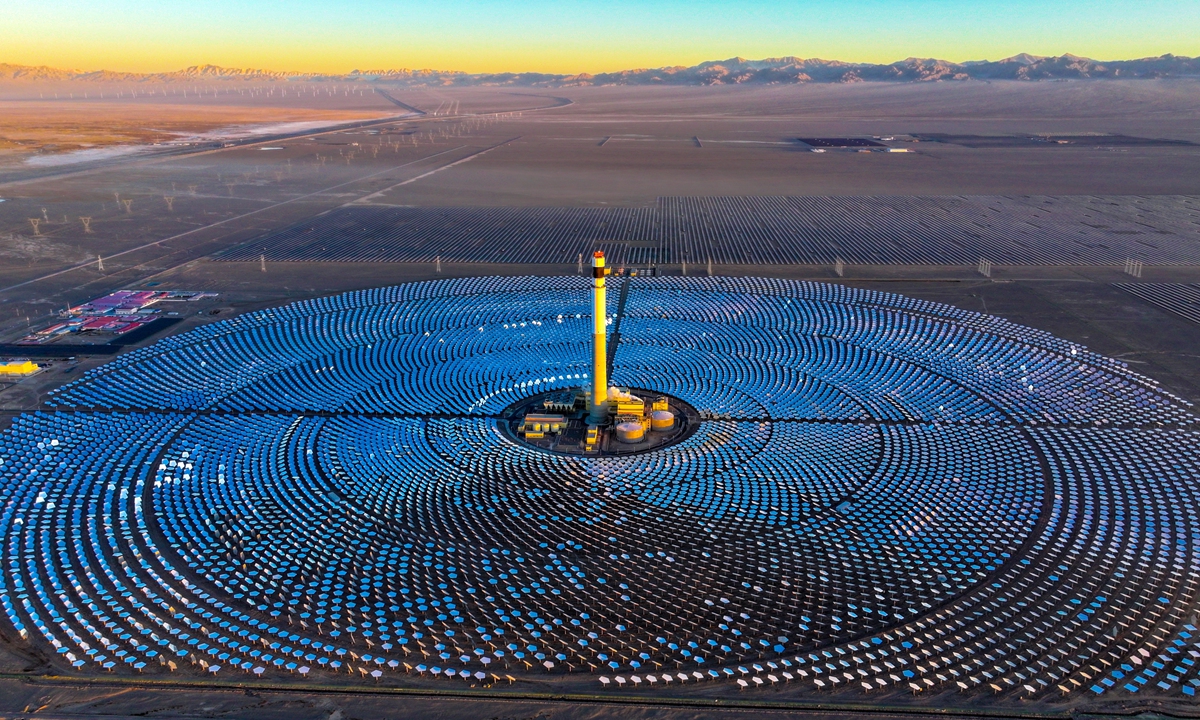
The aerial view of the Aksai Huidong New Energy solar farm in Aksai Kazakh Autonomous County in Northwest China's Gansu Province File photo: VCG
Since the beginning of the 14th Five-Year Plan period (2021-25), research and development (R&D) spending by China's centrally administered state-owned enterprises (SOEs) has grown at an average annual rate of 6.5 percent, reaching 1.1 trillion yuan ($154.61 billion) last year, and exceeding 1 trillion yuan each year for three consecutive years, underscoring the centrally administered SOEs' role as a primary driver of technological innovation, according to official data released on Wednesday.
Zhang Yuzhuo, chairman of China's State-owned Assets Supervision and Administration Commission of the State Council, announced the figures at a Wednesday press conference, stressing that technological innovation remains the top priority for centrally administered SOEs.
Amid the global technology race, China's centrally administered SOEs are driving technological innovation to enhance domestic substitution capacity and the availability of critical components in large-scale equipment, thereby strengthening the resilience and security of industrial and supply chains, Hu Qimu, a deputy secretary-general of Forum 50 for Digital-Real Economies Integration, told the Global Times on Wednesday.
In terms of research infrastructure, centrally administered SOEs have set up 474 national-level R&D platforms and built eight national technology innovation centers. In terms of talent, centrally administered SOEs employ 1.44 million R&D staff, accounting for one-fifth of the national total, said Zhang.
Centrally administered SOEs have undertaken major national science and technology projects, leading or joining 22 national key science and technology special programs, and contributing to the development of 60 percent of the landmark products listed in the action plan for the high-quality development of key manufacturing industry chains, he said.
Zhang noted that the centrally administered SOEs have accelerated the creation of original technology hubs, establishing 97 such hubs in fields including quantum computing and biotechnology. They have also launched upgraded innovation consortia, focusing on areas such as integrated circuits and industrial mother machines, in collaboration with more than 800 research institutes, universities, and state-owned and private enterprises, to jointly advance R&D efforts.
Moreover, centrally administered SOEs are accelerating the application of artificial intelligence (AI) across industries. Zhang noted that AI has now been deployed in more than 800 application scenarios across 16 key sectors, including energy, manufacturing, and communications.
In infrastructure areas such as computing power and foundational technology, centrally administered telecom operators are accelerating their shift into being AI infrastructure providers. They have invested more than 10 billion yuan, doubled intelligent computing capacity compared with before the "AI Plus" Initiative, and established multiple foundational large-scale models, Zhang said.
"In the past, centrally administered SOEs were focused on traditional industries, while today, they are ramping up investment in strategic emerging sectors such as next-generation information technology, AI, quantum computing, and humanoid robotics, among others," said Hu, noting that this proactive deployment helps China prevent vulnerabilities in critical areas and plays a vital role in safeguarding industrial security.
During the 14th Five-Year Plan period, centrally administered SOEs' total assets exceeded 90 trillion yuan, with total profits reaching 2.6 trillion yuan, with average annual growth rates of 7.3 percent and 8.3 percent, respectively.
Hu said that to better leverage their roles in technological innovation, industrial control, and safety support, China's centrally administered SOEs are taking on more public service responsibilities and investing in sectors with lower input-output returns.
Besides, centrally administered SOEs have been vigorously promoting market-oriented reforms to drive economic structural reform.
The Resolution of the Central Committee of the Communist Party of China (CPC) on Further Deepening Reform Comprehensively to Advance Chinese Modernization, which was adopted at the third plenary session of the 20th Central Committee of the CPC on July 18, 2024, aimed to promote independent operation of natural monopoly businesses in sectors such as energy, railways, telecommunications, water conservancy, and public utilities. "We will advance market-oriented reforms in the competitive areas of these sectors and improve regulatory institutions and mechanisms," the resolution said, according to the Xinhua News Agency.
Currently, the market capitalization of listed companies controlled by centrally administrated SOEs surpasses 22 trillion yuan, nearly 50 percent higher than at the end of the 13th Five-Year Plan period (2016-20). Since the start of the 14th Five-Year Plan, centrally administered SOEs have distributed a cumulative total of 2.5 trillion yuan in cash dividends, according to Zhang.
RELATED ARTICLES