Chinese scientists solve century-old mystery how a single plant somatic cell develops into complete plant
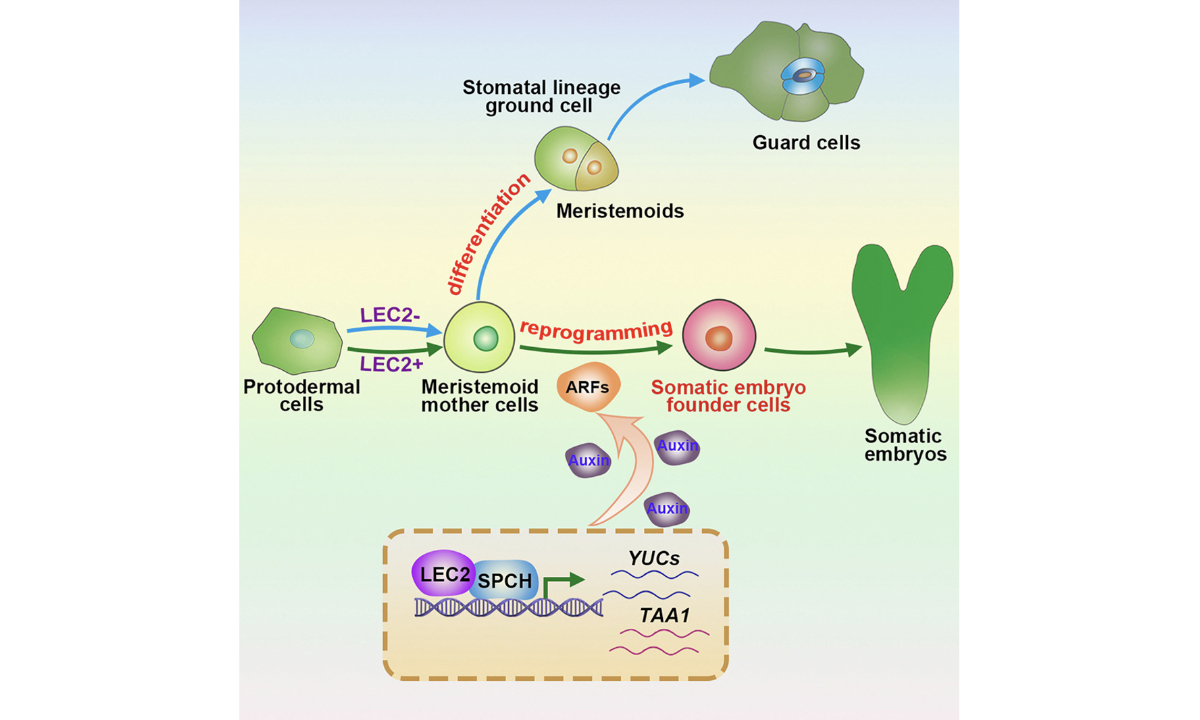
Graphical abstract of the thesis on the plant cell totipotency Photo: Screenshot from the website of cell.com
For the first time, Chinese scientists have fully revealed how a single plant somatic cell develops into a complete plant. This achievement not only solves the century-old mystery of the mechanism behind "plant cell totipotency," but also provides a new theoretical foundation for targeted improvement of crop traits and efficient regeneration, expected to help achieve "rapid cloning" of superior crop varieties and efficient conservation of rare plant germplasm resources, People's Daily reported on Wednesday.
The thesis of the findings was published online in the internationally renowned academic journal Cell on Tuesday.
The formation of an embryo from a single cell represents one of the most profound processes in biology. In both plants and animals, embryos typically arise from a zygote, a totipotent cell formed by the fusion of gametes, said the thesis.
The concept of "plant cell totipotency" was first proposed in 1902. It describes how plant cells can dedifferentiate into totipotent stem cells, similar to zygotes, which can then develop into a complete plant. This phenomenon is widespread across the plant kingdom, including in crops and woody plants, but the molecular mechanisms had long remained unknown.
To tackle this mystery, the research team led by Zhang Xiansheng, a professor at Shandong Agricultural University, began exploration in 2005 in this field by using Arabidopsis thaliana as a model.
Over the past 20 years, the team built an experimental system showing how a single somatic cell can directly develop into an embryo, along with astable system of somatic embryogenesis, meaning differentiated somatic cells regain totipotency and initiate embryogenesis under appropriate conditions. They also discovered that the "switch" for activating cell totipotency is the accumulation of large amounts of auxin.
Using cutting-edge techniques such as scanning electron microscopy, advanced single-nucleus RNA sequencing and spatial laser capture microdissection combined with RNA sequencing, researchers captured for the first time the full process of a single plant cell's division. This provided direct evidence for the "single somatic cell origin" of plant cell totipotency, resolving a long-standing question in the scientific community.
The team also identified two "keys" that trigger cell totipotency - the gene SPCH, specific to leaf stomatal precursor cells, and inducible overexpression of the LEC2 gene. Working together, they form a "molecular switch." "It's like turning a lock that requires two keys - neither of which can be missing," Zhang explained.
According to Su Yinghua, another professor at Shandong Agricultural University and corresponding author of the study, the team fully had documented the pathway of cell reprogramming and identified the critical branching points. During the key transitional stage in which an "ordinary cell" transforms into a "totipotent stem cell," the cell undergoes profound chromatin remodeling, with many previously silenced genes gradually activated. This branching of the cell trajectory opens the door to the establishment of totipotency.
This study is the first worldwide to comprehensively explain the molecular mechanism by which a single plant somatic cell is reprogrammed into a totipotent stem cell and regenerates into a complete plant.
Zhong Kang, a plant physiologist and academician from the Chinese Academy of Sciences, said this study not only deepens understanding of plant cell totipotency, but also opens a new pathway to overcoming the long-standing "regeneration bottleneck" in agricultural biotechnology.
The elucidation of this theory not only deepens understanding of the fundamental principles of plant cell development, but also provides entirely new ideas and tools for precisely controlling plant regeneration and targeted improvement of crop traits. At present, experiments of the theory have been carried out in parallel among crops such as wheat, maize, and soybean, according to a statement released by the Shandong Agricultural University on Tuesday.
Zhang said that in the future, it may be possible to achieve the "rapid cloning" of superior crop varieties by precisely regulating cell totipotency, greatly shortening the breeding cycle and enabling precision breeding, which will also be expected to provide new momentum for conserving rare plant germplasm and for advances in plant synthetic biology.
Global Times
RELATED ARTICLES