Shi Zhongjun, secretary-general of the ASEAN-China Centre (ACC) Photo: Courtesy of the ACC
China and ASEAN have set a successful example of seeking win-win results and integrated development through mutually beneficial cooperation, serving as a bulwark against external shocks, driving not only regional but also global economic resilience and growth, said Shi Zhongjun, secretary-general of the ASEAN-China Centre (ACC).In an exclusive interview with the Global Times, Shi expressed high expectations for stronger cooperation between China and ASEAN countries amid global headwinds, as the 22nd China-ASEAN Expo (CAEXPO) kicked off in Nanning, South China's Guangxi Zhuang Autonomous Region, on Wednesday.
With the full conclusion of the China-ASEAN Free Trade Area 3.0 upgrade negotiations, which prioritizes the digital economy and other areas, and an artificial intelligence (AI) boom, this year's expo, scheduled to be held from Wednesday to Sunday, is expected to showcase new cooperation momentum and potential in the AI and digital fields.
After more than two decades of collaboration and development, the CAEXPO has evolved beyond an exhibition for trade and investment promotion into a high-level dialogue platform that brings together prominent leaders and experts from governments and the business and academic communities. The platform significantly promotes policy and technical discussions that encourage sharing wisdom and closer collaboration, Shi said.
"We expect this year's CAEXPO to create more dynamic progress in emerging fields such as the digital economy, green development, and the blue economy, as well as joint efforts in enhancing the integration and resilience of regional industrial and supply chains, which will serve as cornerstones of stability, prosperity, and the sustainable development of the region," the secretary-general further noted.
China and ASEAN stand as a model of cooperation that produces benefits for both sides, Shi noted, while highlighting the implementation of the Regional Comprehensive Economic Partnership (RCEP).
Shi said that the implementation of the RCEP has provided an unprecedented institutional framework and consolidated the foundation of a rules-based multilateral economic system for China-ASEAN practical cooperation. The alignment of policies among members in areas such as rules of origin, trade facilitation, and market access has significantly enhanced bilateral trade and investment, facilitated the building of industrial ecosystems, and unleashed tremendous potential for economic cooperation, he noted.
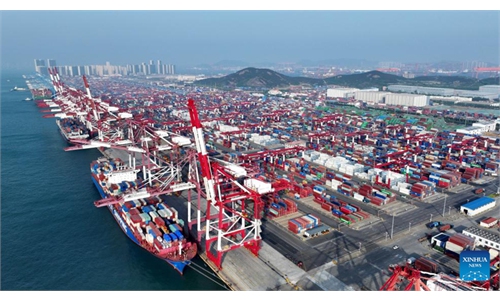
Trade figures serve as proof of this successful framework. According to data from China's General Administration of Customs (GAC) on Tuesday, in the first eight months of this year, China's trade with ASEAN reached 4.93 trillion yuan ($690 billion), up 9.7 percent year-on-year, hitting a record high for the period and accounting for 16.7 percent of the country's total imports and exports.
"The trade data have vividly demonstrated our growing economic ties, which play a significant part in our comprehensive partnership," said Shi.
Moreover, building on deepening mutual trust, high-level interactions, and closer people-to-people exchanges, the two sides have achieved a series of consensus and guiding documents that chart a course for cooperation, said Shi.
According to the newly adopted Plan of Action to Implement the ASEAN-China Comprehensive Strategic Partnership (2026-2030), China and ASEAN should continue to deepen and solidify cooperation in traditional areas of strength, further aligning regional economic and trade policies, advancing infrastructure connectivity, enhancing trade facilitation, and strengthening collaboration in agriculture, manufacturing, industrial park development, e-commerce and other fields, according to the ACC.
In addition, China and ASEAN should propel cooperation toward new frontiers, such as AI and the digital economy, green transition, smart and sustainable urban development, as well as exploring ways of harnessing scientific and technological power to empower traditional fields and support efforts to reduce poverty and development gaps.
Another highlight of China-ASEAN ties is the joint construction of the Belt and Road Initiative (BRI), yielding tangible achievements in regional cooperation. A number of landmark projects, such as the China-Laos Railway, the Jakarta-Bandung High-Speed Railway, and the New International Land-Sea Trade Corridor, "have significantly improved regional logistics efficiency, enhanced trade conditions and investment environments, and substantially contributed to better livelihoods," Shi said.
Shi said that he believes cooperation will further expand into "soft connectivity" and new areas, giving examples such as the Digital Silk Road that promotes collaboration in 5G, big data, and smart cities, and the Green Silk Road that has become a new highlight, generating fresh outcomes in clean energy cooperation, climate change responses, ecological conservation, and the low-carbon economy.
Against the backdrop of China's unwavering commitment to high-standard opening-up and the pursuit of high-quality development, ASEAN and China can provide each other with preferential access for quality products and services, said Shi, noting that while ASEAN countries can better access China's vast consumer market, China is getting closer in offering high-quality investment in ASEAN, especially in cutting-edge fields.
At a time when the world is facing rising trade protectionism and increasing uncertainty, exemplified by US tariffs and technology restrictions, the ACC secretary-general said that cooperation is the only right way to overcome common challenges.
"Amid the current circumstances, it is all the more important that China and ASEAN stay committed to open regionalism and true multilateralism," he said, noting that this importance is shown not only by robust and growing economic ties but also underpinned by some fundamental strengths that create a unique model for mutual prosperity.
"By championing dialogue and integration rather than decoupling and protectionism, China and ASEAN are doing more than securing their own prosperous futures," Shi said, noting that the two sides are actively upholding a multilateral, inclusive, and stable global trading system, proving that cooperation and openness are the only path to sustainable and shared growth for all.
RELATED ARTICLES