China-ASEAN Expo attendees eye greater cooperation to counter rising protectionism
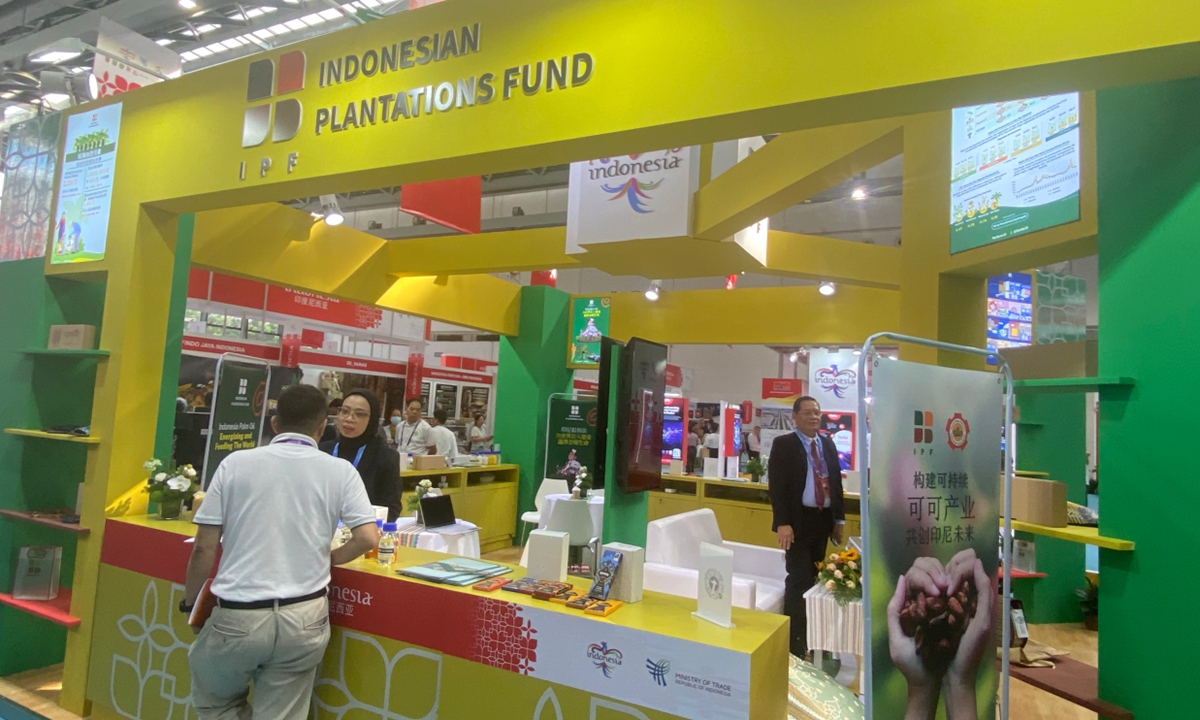
visitor chats with a representative at the booth of the Indonesian Palm Oil Association at the 22nd China-ASEAN Expo in Nanning, South China's Guangxi Zhuang Autonomous Region, on September 17, 2025. Photo: Zhang Weilan/GT
At the 22nd China-ASEAN Expo (CAEXPO), which kicked off on Wednesday in Nanning, South China's Guangxi Zhuang Autonomous Region, exhibitors and delegates from multiple ASEAN members are seeking greater cooperation with China to help mitigate external challenges posed by rising protectionism.
"The US administration's imposition of additional tariffs is reshaping the global trade landscape," Rapolo Hutabarat, head of the Agro-Industry Department of the Indonesian Palm Oil Association, told the Global Times on Wednesday. He expressed strong hope for expanding Indonesian palm oil exports to China, noting that the expo highlights the robust trade relations between the two countries and offers unprecedented access to each other's markets.
"China, with its huge market potential and stable supply chain, is our second-largest overseas market after India. To mitigate the impact of US tariffs, we must also explore new export destinations in Africa, Central Asia and the Middle East," Hutabarat noted.
His views were echoed by others exhibitors from Vietnam, Thailand and Indonesia, among the more than 3,200 exhibitors from 60 countries attending this year's expo.
Amid global economic sluggishness and rising trade protectionism, "we are doubling down on forging a more resilient supply chain. By leveraging Guangxi's logistics strengths and Malaysia's established role as an ASEAN hub, we can jointly build a diversified, robust network that enables multilateral transport and logistics infrastructure, translating directly into lower costs and higher efficiency for businesses on both sides," Andrew Goh Boon Kim, vice-president of the Federation of Malaysian Manufacturers, told the Global Times on Wednesday.
Guangxi's position as a strategic gateway to ASEAN is more important than ever, with strong logistics and connectivity capabilities under the Belt and Road Initiative, Goh said. "We believe our collaboration can create opportunities for industries in both Malaysia and China. We should strengthen two-way trade and actively promote high-value-added products, particularly in key sectors such as agriculture and high-tech manufacturing."
As the global trade landscape continues to evolve, enhanced regional cooperation becomes increasingly vital, ensuring that both sides can navigate the challenges posed by external pressures and foster a more resilient economic partnership bolstered by technological innovation in the fields of new energy, artificial intelligence, modern agriculture and biotechnology, Indian exhibitor Govind Kankani, who is attending the expo for the first time, told the Global Times on Wednesday.
The expo comes at a pivotal moment as the China-ASEAN Free Trade Area 3.0 upgrade negotiations have been fully completed. This milestone underscores the shared commitment to strengthening supply chain connectivity, driving digital transformation, and enhancing economic resilience in a rapidly evolving global economy, said Chinese analysts.
Ge Hongliang, deputy director of the College of ASEAN Studies at Guangxi University for Nationalities, told the Global Times that as US tariff policies and the broader trend of trade protectionism pose significant obstacles to globalization and negatively impact other countries and regions, including ASEAN, it is particularly important for China and ASEAN to strengthen cooperation.
Facing uncertainties in the global market, enterprises in both China and ASEAN should actively explore alternative markets and strengthen partnerships with non-US markets, with joint efforts of the Global South and developing countries, which will contribute to the sustained and healthy development of global trade, Ge said, adding that the improvement of regional and global economic governance mechanisms also requires the joint efforts of China and ASEAN members.
Bai Ming, a research fellow at the Chinese Academy of International Trade and Economic Cooperation, told the Global Times that China-ASEAN cooperation helps maintain development momentum amid global pressures, thereby continuously stimulating growth.
China and ASEAN members have not only established the China-ASEAN free trade area, but also jointly advanced multi-level cooperation platforms like the Regional Comprehensive Economic Partnership, which have provided strong underpinnings for their economic relationship. Such cooperation is of even greater significance especially in the current context, Bai said.
RELATED ARTICLES