Illustration: Liu Xidan/GT
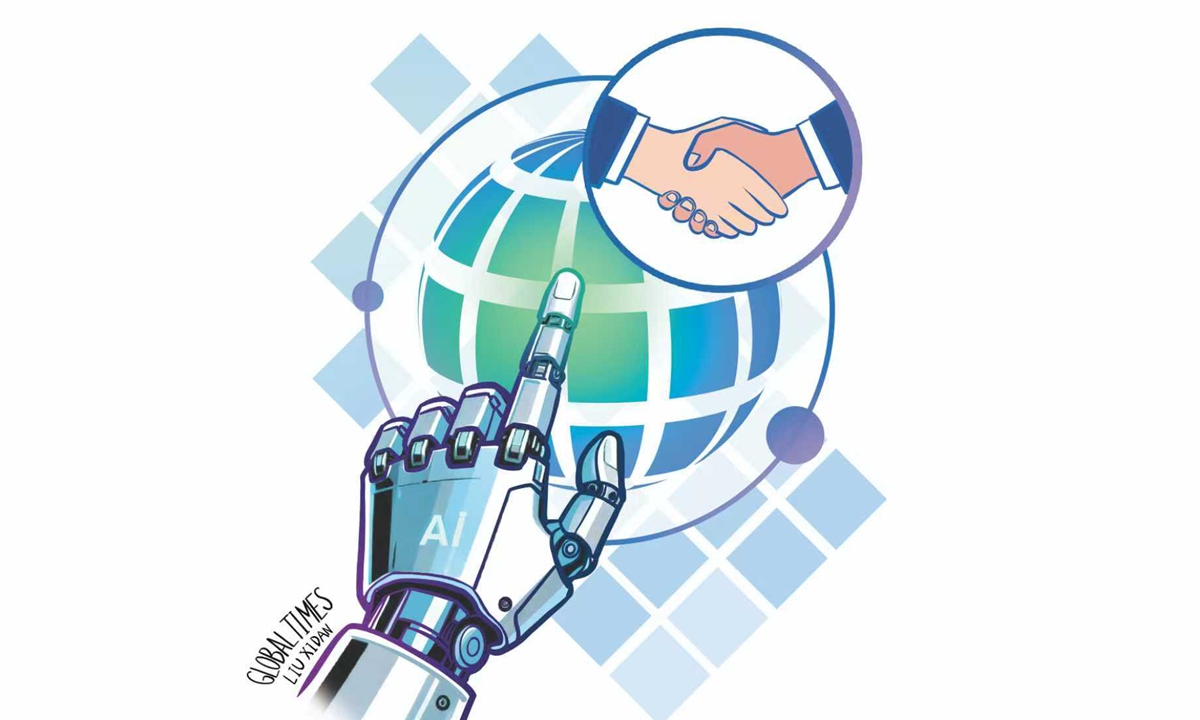
Artificial intelligence (AI) is no longer confined to the realm of speculative potential; its economic impact is being quantified with growing clarity. The 2025 edition of the World Trade Report, released on Wednesday, delivers a noteworthy projection: with the right enabling policies, AI could boost the value of cross-border flows of goods and services by nearly 40 percent by 2040, driven by productivity gains and lower trade costs - a prospect that, amid today's subdued global outlook, offers a rare source of optimism.Yet optimism by itself will not deliver results. The report stresses that for AI and trade to contribute to inclusive growth, policies need to be in place to bridge the digital divide, invest in workforce skills, and maintain an open and predictable trading environment.
In recent years, the digital divide has drawn mounting attention. As digital technologies - led by AI - advance at a rapid pace, the uneven distribution of their benefits has become ever more evident. This widening gap is emerging as an important factor shaping global equity and the prospects for inclusive development.
The scale of this divide is borne out in the data. According to the International Telecommunication Union, internet usage in high-income countries has reached 93 percent of the population, approaching universality. In low-income countries, by contrast, only 27 percent of people are online - a stark disparity that underscores how access to digital infrastructure remains deeply uneven across the globe.
Bridging the digital divide is not just desirable but essential, a point reinforced by the WTO report. It finds that in a scenario in which low- and middle-income economies narrow their digital infrastructure gaps with high-income economies by 50 percent and adopt AI more widely, these economies are projected to see incomes rising by 15 percent and 14 percent, respectively.
China has moved to present itself as an advocate for narrowing the digital divide. It has called for stronger international cooperation in digital trade and emphasized the need for technological gains to be shared more broadly. At the same time, Chinese officials have repeatedly criticized unilateral actions that constrain other nations' ability to build digital economies and improve living standards.
The Global AI Governance Action Plan, released at the 2025 World Artificial Intelligence Conference in Shanghai in July, highlighted the importance of unlocking the potential of AI while ensuring its security, reliability, and fairness, as well as advancing efforts to help developing countries bridge the digital divide and achieve equitable, inclusive development.
In practice, China's AI technologies are bringing tangible benefits to the Global South. Through international cooperation projects, China has supported developing countries with AI-driven solutions in agriculture, healthcare and education. Chinese companies are working with developing countries to build digital infrastructure and data centers, helping to expand the use of AI in finance, information technology, and public health.
For instance, China's open-source large-language model DeepSeek, known for its cost-efficiency and strong performance, is offering new opportunities for Global South countries to close development gaps, adding fresh momentum to South-South cooperation, according to the Xinhua News Agency.
Efforts to narrow the digital divide - and thereby extend the benefits of technology more widely while supporting trade and growth - will require broader international engagement, especially from developed economies. With their early-mover advantage, these countries have already established strong foundations in AI and the digital economy. But when some developed economies resort to technological barriers or misuse export controls, in practice such actions tend to intensify rather than alleviate the divide: global supply chains are disrupted, and the capacity of AI to foster trade and economic growth is diminished.
The potential of AI to reshape trade and growth is real, but it will not be realized in a vacuum. Narrowing the digital divide and expanding access to technology are essential steps for turning potential into progress. That requires not only investment and cooperation from developing economies, but also a conscious effort by some developed economies to refrain from measures that fragment the system.
The author is a reporter with the Global Times. bizopinion@globaltimes.com.cn
RELATED ARTICLES