2025 Beijing International Week for Science Literacy debuts education exhibition, showcasing global cross-cultural scientific practices
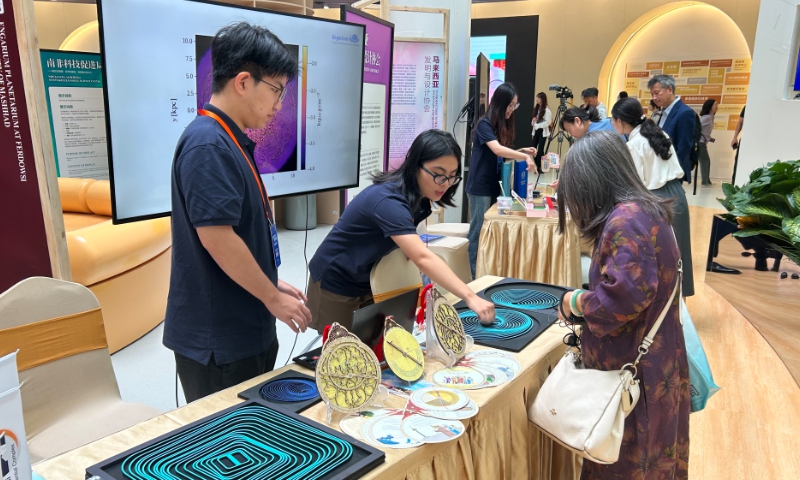
Staff at the international science and education exhibition area of the 2025 Beijing International Week for Science Literacy introduce featured exhibits to a visitor at the Beijing Science Center on September 16, 2025. Photo: Liang Rui/GT
As the 2025 Beijing International Week for Science Literacy opened on Tuesday, a series of international science and education exhibition booths in the Beijing Science Center presented visitors with diverse cultural and technological displays.
According to the Beijing Association for Science and Technology, as a new addition to this year's event, the international science and education exhibition area showcased the distinctive features of member institutions. Multiple overseas members have been invited to bring their characteristic exhibits to the venue, engaging with the audience through interactive experiences and other forms of close communication.
At the scene, the Kotsanas Museum of Ancient Greek Technology contributed a booth featuring replicas of pioneering Greek inventions: the world's first mechanical calculator, the earliest known smart household device, the first puzzle game, and the earliest version of tic-tac-toe. These interactive exhibits bring to life ancient mechanical principles, aiming to stimulate both learning and scientific curiosity.
The South African Agency for Science and Technology Advancement brought a diverse program, combining technology and environmental education. Using VR headsets, participants explored the International Space Station through an immersive simulation; practical demonstrations showcased natural water purification and hydroponic cultivation; and exhibits on natural sources of radiation helped dispel public misconceptions. Together, these exhibits highlighted the intersection between science, sustainability, and real-world applications.
In addition, the Andean Road Countries for Science and Technology booth used cultural storytelling to inspire young people to become creative changemakers. Children adapted traditional Chinese folktales into short scripts addressing environmental crises such as pollution and habitat loss.
This hands-on activity merged cultural heritage with science education, teaching biodiversity, ecosystem health, and pollution solutions in an engaging way. Beyond gaining knowledge, participants learned to communicate persuasively, strengthening environmental awareness and social responsibility.
The Engarium Planetarium at Ferdowsi University of Mashhad offered a dynamic galaxy simulator. The Global Times learned from a volunteer that through orbital motion and density patterns, participants could directly observe how spiral arms form within galaxies. Using elliptical rings to represent stellar orbits, the interactive model demonstrated how their interactions generate spiral patterns, recreating realistic galactic structures for hands-on exploration.
Meanwhile, the Malaysian Invention and Design Society introduced a hybrid mathematics learning tool designed for preschoolers. By combining tactile card-based games with digital games, the kit helps develop early numeracy and higher-order thinking skills.
RELATED ARTICLES