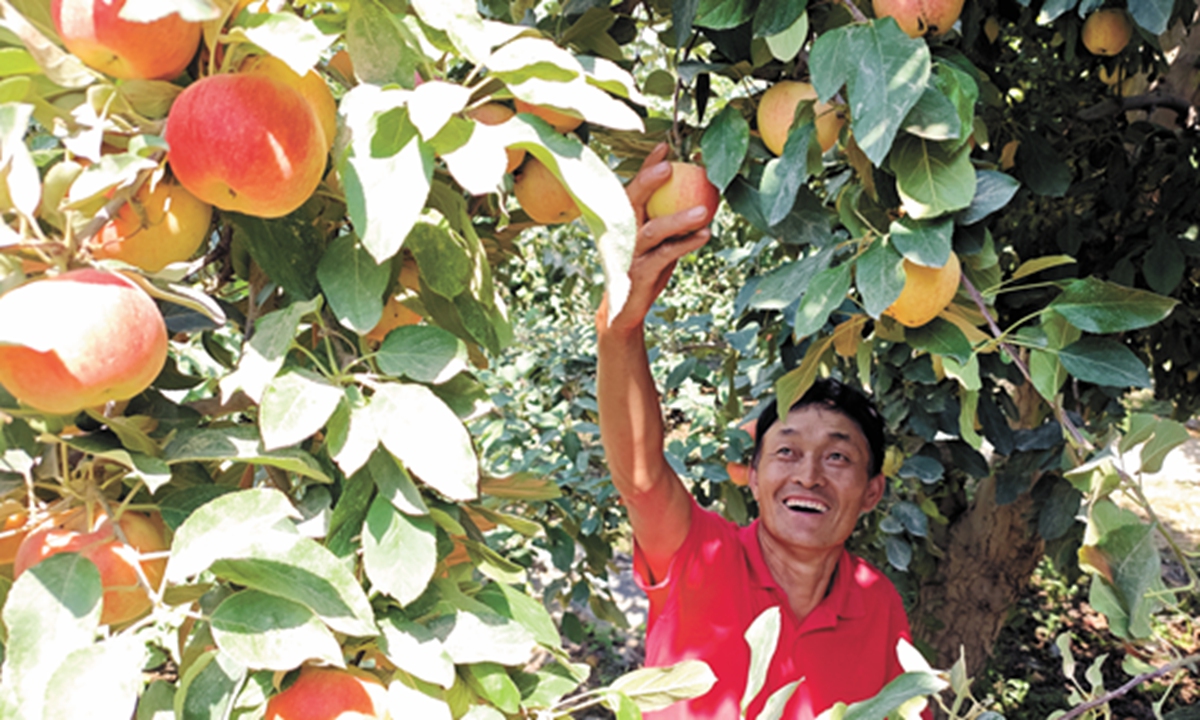
A fruit farmer is picking apples in the apple field on August 6, 2025, in Awat county, Aksu, Northwest China's Xinjiang Uygur Autonomous Region. Photo: VCG
When people mention Aksu, they often think of its sweet and fragrant apples, but few know that these apples originally grew in a barren land. The story behind this land is far more touching than we could imagine. This trip to Aksu gave the Global Times reporter a renewed understanding of this resilient land and its people.
Strolling through the endless forests and orchards, the reporter found it hard to imagine that the vibrant land beneath their feet was once a desolate wasteland. As recently as 1986, this area was still a barren wilderness. Aksu spans a total area of 131,700 square kilometers, two-thirds of which consists of deserts area, including the Gobi Desert.
The most despairing fact was that the desert was only six kilometers away from the city at its closest point and was advancing toward the urban area at a rate of five meters per year. The raging winds, the encroaching sea of sand and the extremely harsh natural environment constantly tested the survival wisdom and governance capabilities of the people of Aksu.
Who would dare to live in such a harsh environment? But an afforestation project to prevent the desert from expanding and to reduce the impact of sand and dust storms on nearby residents was launched in an area of Kekeya's greening project in Aksu in 1986.
The soil in Kekeya had a high salt content, reaching up to 9.87 percent at its highest. Not only would ordinary trees struggle to survive here, but even planting desert-resistant vegetation in such conditions would be akin to placing them directly in a salt jar.
The first-generation forest ranger, Song Jianjiang, pointed at a photo of him driving a tractor planting trees many years ago. He transported people, saplings, water and other supplies to the afforestation sites.
"I have been here from the first tree planted to now, a total of 1.15 million mu of forest has been planted together with our villagers," Song said.
Yimam Buybuyti was the first director of the forest management station for Kekeya's greening project.
Even with the best treatment, no one was willing to come here at that time, Yimam said. "But once we came here, no matter how difficult it was, one person must complete one mu within a week."
In order to better care for the trees, he brought his son, Aisikaer, who had just graduated from high school then, to Kekeya. "I worked in the forestry industry for 30 years, and encourage my son to choose the same career path," Yimam said.
"My father was the first generation, I'm the second generation, and now I'm raising my own child to become the third generation. I need to continue contributing to the greening of our homeland."
Relying on the 1.2 million-mu greening project in Kekeya, forests are now widespread across Aksu. Sandstorms have greatly reduced, and the ecological environment has dramatically improved.
Moreover, Aksu has creatively explored a "forests sustaining forests" model, using economic forests to support ecological forests, achieving a win-win for both ecology and the economy. The area of fruit forests has rapidly expanded from 1.39 million mu to 4.5 million mu, accounting for a quarter of the total in Xinjiang.
Products from Aksu have been honored with numerous accolades, including "trusted consumer products in the Chinese market," and Aksu is also renowned as "China's hometown of walnuts," "China's hometown of red fuji apples," and "China's hometown of small white apricots."
Walking through the main plantation area of "Aksu apples," the Global Times saw the renewed fruits. Yao Shilin, the general manger of Aksu Hongqipo Farm, said the region's high altitude, long hours of sunlight, and significant temperature differences between day and night, combined with irrigation from the Tianshan snowmelt and pollution-free production areas, create a unique natural environment that gives rise to the distinct "ice sugar heart" apples.
These apples are characterized by their smooth skin, tender flesh, rich sweetness, abundant juice and minimal residue, Yao said.
Originally, we came here to combat desertification. Now, not only have we succeeded in controlling the sand, but we have also achieved prosperity right where we are, Du Minchao, a farmer who works together with Aksu Hongqipo Farm, told the Global Times.
In the beginning, none of us had ever grown fruit trees before, and we didn't realize that cultivating the land with large amounts of organic fertilizer was necessary before planting here. We just hastily put the saplings in the ground, but they didn't survive.
After receiving guidance from agricultural experts, Du tried every possible means to obtain organic fertilizer to improve the soil conditions. Finally, the fruit trees began to slowly take root and thrive.
"When we started seeing returns, I was overjoyed." Thanks to his eagerness to learn and share, he has helped over 5,000 farming households reduce chemical fertilizer usage and increase the yield of high-quality fruits, boosting their income by more than 1,600 yuan ($225) per mu.
Furthermore, during annual orchard activities such as pruning, flower thinning and harvesting, Du's 400-mu orchard alone provides over 15,000 person-times of employment.
This has enabled more and more local residents to choose to work close to home. One such resident is farmer Wang Yunzhi, who later joined Du. Skilled in online marketing, Wang told the Global Times that she sells an average of over 300 tons of apples and 50 tons of other dried and fresh fruits annually through e-commerce platforms.
Wang mentioned with a smile from ear to ear that her apples have even been sold to East China's Zhejiang, where Alibaba's Jack Ma Yun is from.
In 2024, the total area of orchards in the region reached 27.3 million mu, with a total fruit output of 2.81 million tons. In addition to apples, among the 4.5 million mu of characteristic fruit trees in Aksu, there are walnuts, red dates, fragrant pears, fresh apricots, grapes and other fruits.
The output value of the fruit industry achieved 19.1 billion yuan, and the per capita fruit income for farmers reached 6,200 yuan, accounting for 30 percent of their net income.
After three decades of afforestation efforts, Aksu now boasts a forest area of 17.41 million mu, with its forest coverage rate rising from 3.35 percent in the 1980s to 9.08 percent today, the Global Times learned.
Despite these successes, the people of Aksu will continue to plant trees.
"Nearly everyone in Aksu is involved in tree planting," the Global Times learned from He Zongjun, the Party branch secretary and principal of Qiming School.
In the future, the region has a clear plan: by 2035, modernized ecological environment governance systems and capabilities will be basically realized, and the goal of building a beautiful Aksu will be largely achieved.
By the mid-21st century, Aksu will become a beautiful place with blue skies, green lands and clear waters.
"Although the children's planting skills may not be particularly advanced, they are immensely happy when planting trees," the school principal said. "This nourished land of dedication and perseverance will be passed down through generations," He added.