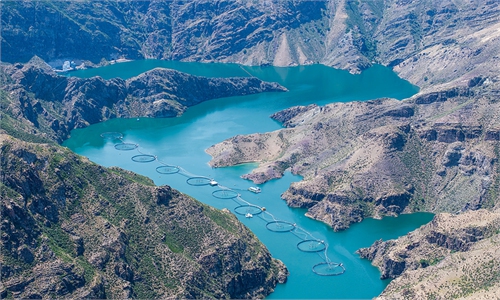
An aerial drone photo taken on July 17, 2025 shows the scenery of Sayram Lake in Bortala Mongolian Autonomous Prefecture, northwest China's Xinjiang Uygur Autonomous Region. Nestled in the Tianshan Mountains, Sayram Lake, Xinjiang's highest and largest alpine lake, has entered its peak tourist season in midsummer. Photo: Xinhua
A white paper released on Friday expounded on the essence of the Communist Party of China (CPC)'s guidelines for governing Northwest China's Xinjiang Uygur Autonomous Region in the new era. Under the strong leadership of the CPC Central Committee - and guided scientifically by the CPC's guidelines for governing Xinjiang in the new era - officials and people of all ethnic groups in Xinjiang have united and worked with resolve, vividly demonstrating both the scientific basis and the practical power of these guidelines.
In the face of Western smear campaigns that ignore facts, the white paper uses sound evidence and the success of Xinjiang's 70 years of development as its strongest weapon, puncturing false narratives and truly showing the world a real picture of stability, harmony, and vigorous progress in Xinjiang in the new era.
Xinjiang is anchoring its overall goal of long-term stability, implementing the CPC's guidelines for governing Xinjiang in the new era, and steering development in the right direction. Since the 18th National Congress of the CPC, the CPC Central Committee with Comrade Xi Jinping at its core has consistently placed Xinjiang work in an important position within the overall development of the Party and the nation. Xi has personally drawn development blueprints for Xinjiang, repeatedly convened special meetings to arrange Xinjiang-related work, delivered a series of pioneering and guiding speeches, and issued a number of directives crucial to Xinjiang's long-term development.
Together, these have formed the CPC's guidelines for governing Xinjiang in the new era. The guidelines not only provide the principal reference and foundation for properly carrying out Xinjiang work in the new era, but also act as a "lighthouse" guiding the direction - clearly lighting the path ahead toward social stability and enduring peace and security in Xinjiang.
Xinjiang is anchoring its positioning in the national strategic and consolidating the foundation for high-quality development. It has consciously integrated its regional opening-up strategy into the country's overall plan of opening up to the west, aiming to build a golden channel across the Eurasian continent and a gateway for opening up to the west, said the white paper.
Seventy years ago, Xinjiang's economic foundation was extremely weak with almost no industry, and agriculture was heavily dependent on weather conditions. In 1955, its regional GDP was only 1.231 billion yuan; by 2024, regional GDP had surpassed 2.05 trillion yuan - an extraordinary increase of more than 1,600 times. As of March 2025, more than 90,000 China-Europe (China-Central Asia) freight trains had passed through Xinjiang's Horgos and Alashankou ports in total. These have further consolidated Xinjiang's role as the golden passage between Asia and Europe and the bridgehead for opening to the west, injecting strong momentum into China's overall opening-up.
Xinjiang is practicing a people-centered approach and achieving new leaps toward common prosperity. Since the 18th National Congress of the CPC, Xinjiang has made poverty alleviation its top livelihood project. Xinjiang has, for many years, allocated over 70 percent of its general public budget expenditure to livelihood sectors, ensuring that the benefits of reform and development are shared more broadly and fairly among people of all ethnic groups. This has enabled a historic leap from "basic subsistence" to "quality life."
Xinjiang is forging a strong sense of community for the Chinese nation and promoting ethnic interaction, exchange, and integration. As a region inhabited by multiple ethnic groups, Xinjiang is home to different ethnicities living, working, and supporting one another. Today, deep integration among ethnic groups has become the norm. For example, in Haldun Community of Tacheng City, 14 ethnic groups live side by side, with over 30 percent of families being multi-ethnic households. Scenes of multi-ethnic groups working together, collaborating, and sharing outcomes are commonplace, providing vivid examples of ethnic unity in action.
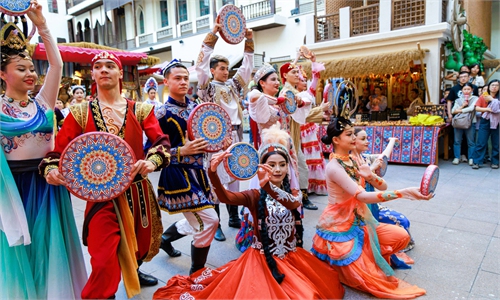
Xinjiang is upholding both preservation and innovation to build a shared spiritual home of the Chinese nation. As a cultural crossroad of the ancient Silk Road, Xinjiang boasts a wealth of historical heritage and diverse ethnic cultures. It has consistently emphasized both the preservation and innovative development of culture, deeply implementing Xi Jinping Thought on Culture. This approach breathes new life into fine traditional culture, allows modern culture to flourish, and accelerates the building of a shared spiritual home for the Chinese nation. Today, cultural heritage protection has achieved remarkable results: Xinjiang currently has 5,607 intangible cultural heritage items, with three inscribed on UNESCO's Intangible Cultural Heritage lists, 94 included in the national list of representative intangible cultural heritage items, and 315 recognized at the regional level.
Xinjiang is practicing the concept "lucid waters and lush mountains are invaluable assets" to strengthen the national ecological security barrier. It has consistently promoted ecological protection in tandem with economic development, advancing the integrated protection and systematic management of mountains, rivers, forests, farmland, lakes, grasslands, and deserts. As a result, the Tianshan Mountains are greener, grasslands are more fertile, and lakes are clearer, making an important contribution to national ecological security. For example, along the 3,046-kilometer fringes of the Taklimakan Desert, a sand-blocking green belt now entirely encircles the desert.
In sum, Xinjiang's development achievements over the past 70 years have been hard-earned.
Behind these figures lie the people's sense of gain, happiness, and security, and the steady progress of Xinjiang's various undertakings. They are like a sharp sword piercing through the smokescreen of Western smears, letting lies collapse in the face of facts. Moreover, they provide a crucial window clearly showing the world the true picture of Xinjiang - stable and orderly, vibrant and full of life, with development outcomes shared by all ethnic groups. Under the CPC's guidelines for governing Xinjiang in the new era, we are confident that Xinjiang's future will be even brighter.
The author is an assistant research fellow of the Institute of Central Asia Studies, Xinjiang Academy of Social Sciences. opinion@globaltimes.com.cn
RELATED ARTICLES