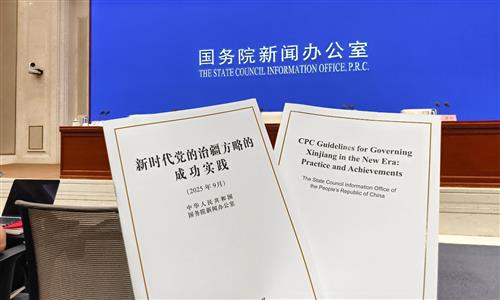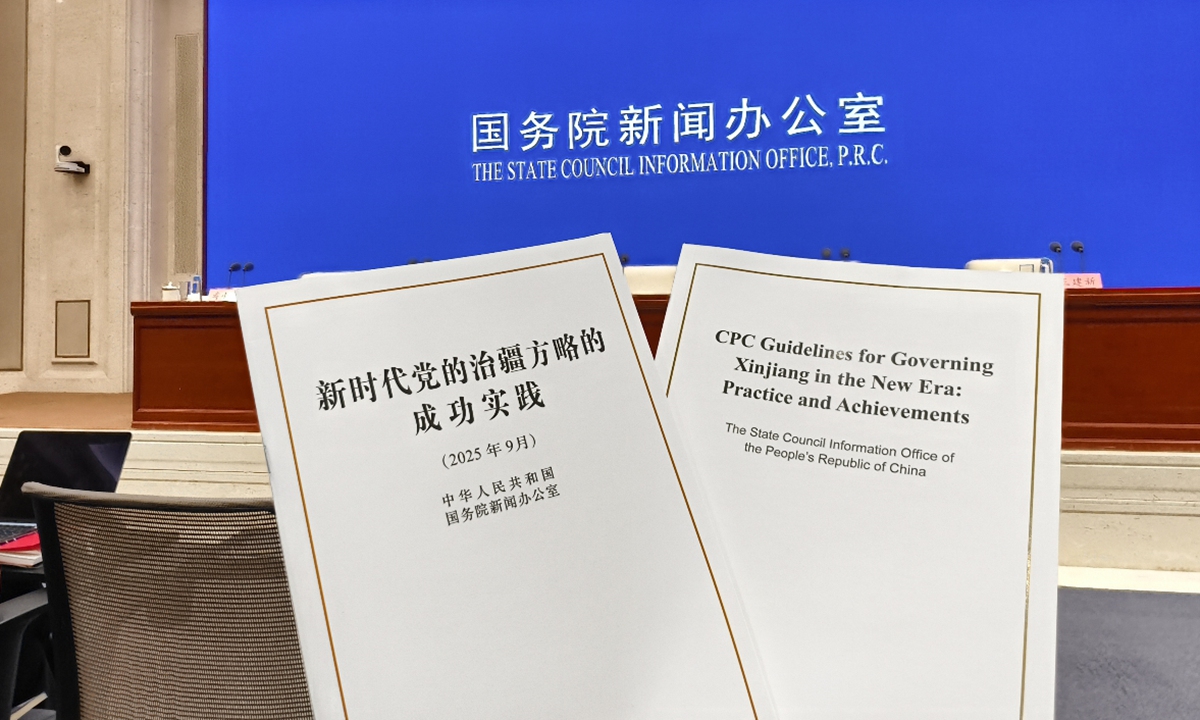
Photo: Zhao Juecheng/GT
On the eve of the 70th anniversary of the establishment of the Xinjiang Uygur Autonomous Region, the white paper titled CPC Guidelines for Governing Xinjiang in the New Era: Practice and Achievements was successfully released. This publication systematically chronicles the remarkable achievements of the Communist Party of China (CPC) in governing Xinjiang through concrete and vivid practical examples, alongside detailed and objective data. It serves as a significant snapshot of the historic accomplishments and transformations in Xinjiang's development since the 18th National Congress of the Party, serving as a vivid footnote to the practice of Chinese modernization.
Under the CPC guidelines for governing Xinjiang, the region has undergone tremendous changes, achieving a comprehensive victory in the battle against poverty and completing the building of a moderately prosperous society in all respects. Xinjiang's GDP increased from about 749.95 billion yuan in 2012 to more than 2.05 trillion yuan in 2024, exceeding the threshold of 2 trillion yuan for the first time, with an annual growth rate of 7 percent at constant prices. Today, Xinjiang is showcasing its magnificent charm and confidence to the world.
The overarching goal of social stability and lasting peace and security takes root in people's hearts. There have been no violent or terrorist incidents in Xinjiang for many years, allowing people of all ethnic groups in the region to live and work in safety, with their living standard steadily improving. Xinjiang's leapfrog development stands as the most compelling rebuttal to the utterly fabricated lies in Western narratives regarding "genocide" and "forced labor." As night falls, scenes of people from all ethnic groups across Xinjiang singing and dancing in parks, riverside areas and public squares have become commonplace.
Through their leisurely lifestyles and peaceful living conditions, the people there compose a vivid picture of social stability and lasting peace and security in Xinjiang. With their graceful dance, they also demonstrate that ethnic unity is one of the most splendid landscapes in Xinjiang's social development.
Improving people's livelihood lays a solid foundation for Xinjiang's social development. Livelihoods are the key to achieving stable and sustainable development in the region. The CPC guidelines for governing Xinjiang in the new era consistently prioritize people's livelihoods, ensuring that the development of Xinjiang benefits all its people more extensively and equitably. For instance, at present, Xinjiang boasts one kindergarten for every 106 preschoolers and one primary school for every 817 pupils. Employment rates are continuing to improve, with the region's employed population rising from 12.46 million in 2012 to 13.91 million in 2024, an increase of 11.64 percent. Over 19,000 healthcare institutions now operate across the region. The per capita disposable income for urban and rural residents reached 43,000 yuan and 19,000 yuan, respectively.
The construction of the core area of the Silk Road Economic Belt has achieved remarkable achievements. Xinjiang, focusing on its five strategic positions put forward by the central government, leverages its unique geographical advantages to revitalize itself in the new era under the guidance of the CPC governance strategy for Xinjiang. The region's high-level opening-up has not only fostered a more inclusive development landscape but also has profoundly exemplified President Xi Jinping's vision of building a community with a shared future with neighboring countries.
Xinjiang has become an important window through which China tells its story to the world. Today, China-Europe freight trains speed through Xinjiang, while international logistics embody the region's commitment to open development. The advancement of the Urumqi International Land Port Area and the free trade practices within the Kashgar Economic Development Zone have transformed the vital Eurasian hub into bridges and conduits connecting China with neighboring countries in a shared community with a shared future. As the Belt and Road Initiative cooperation deepens, cross-border trade has emerged as a pivotal driver for enhancing the quality and efficiency of Xinjiang's development. Today, Xinjiang's high-quality development and high-level opening-up are advancing in tandem.
The 70 years of development in Xinjiang represent a magnificent chapter and mark the beginning of a new historical journey.
We will witness a new era in Xinjiang, characterized by unity and harmony, prosperity and abundance, civilization and progress, peaceful livelihoods and ecological well-being, all contributing to the realization of the Chinese Dream of national rejuvenation.
The author is a professor at Xinjiang Normal University, China. opinion@globaltimes.com.cn
RELATED ARTICLES