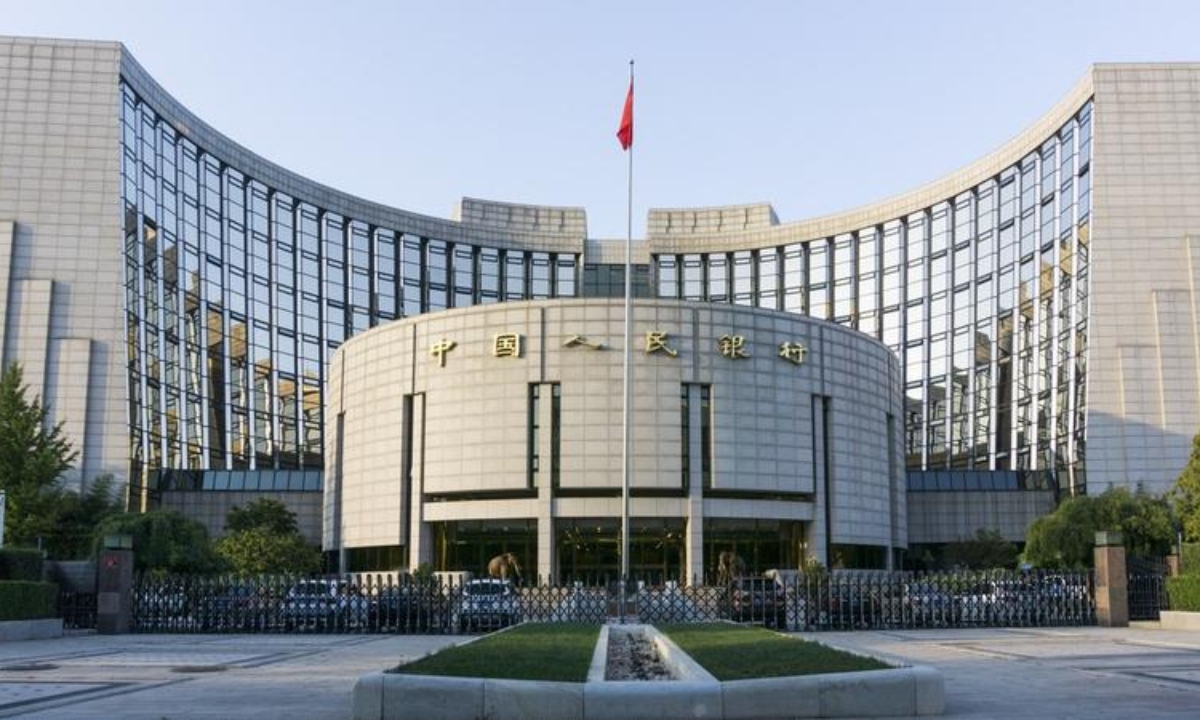
The headquarters of the People's Bank of China in Beijing Photo: IC
China on Monday released an impressive set of financial achievements during the 14th Five-Year Plan period (2021-25), underscoring the strength and resilience of its financial system. Experts noted that policy and institutional innovations have been key in supporting the system's steady growth and further opening-up.
During the 14th Five-Year Plan period, China's financial sector achieved new milestones. As of the end of June, total assets in the country's banking industry neared 470 trillion yuan ($64.6 trillion), the largest in the world, Pan Gongsheng, governor of the People's Bank of China said on Monday.
The remarks were made at a press conference hosted by the State Council Information Office. As the 14th Five-Year Plan draws to a close, officials from nation's financial sector unveiled a series of milestones achieved under the plan, along with future policy priorities.
Pan added that the nation's stock and bond markets now rank as the world's second largest, while its foreign exchange reserves have remained the largest globally for 20 consecutive years. He highlighted that China's financial system remains generally sound, financial institutions are largely healthy, and financial markets are operating smoothly.
Since the start of the 14th Five-Year Plan, China's foreign exchange reserves have remained above $3 trillion, and above $3.2 trillion in the past two years, said Zhu Hexin, deputy governor of the People's Bank of China and head of the State Administration of Foreign Exchange. An expert noted that amid rising global economic uncertainties, foreign exchange reserves play a vital role in safeguarding national economic security and shielding the country from external shocks.
Chinese yuan's internationalization made steady progress during the period, with greater resilience in the foreign exchange market. The share of firms using foreign exchange hedging tools rose from 17 percent in 2020 to about 30 percent, while the yuan's share in cross-border trade increased from 16 percent to nearly 30 percent, according to Zhu.
Zhao Xijun, co-president of the China Capital Market Research Institute at Renmin University of China, told the Global Times on Monday that China's financial sector has grown rapidly since 14th Five-Year Plan period.
"Banking assets, foreign exchange reserves and stock market capitalization now rank among the world's top, while the sector has steadily improved with more diverse institutions, richer products and higher overall quality," Zhao said.
Policy backbone
Such resilience requires not only well-calibrated policy support but also the strength of institutional advantages, experts noted.
Since the September 2024 meeting of the Political Bureau of the Communist Party of China Central Committee, the PBC has introduced a series of monetary and financial measures in line with central directives, effectively stabilizing market expectations, bolstering confidence, and supporting sustained economic recovery and high-quality growth,said Pan.
During the plan period, regulatory efficiency was strengthened. Li Yunze, head of the National Financial Regulatory Administration said regulators adopted tiered, risk-based supervision - high risk, high intensity; low risk, low intensity - to ensure limited supervisory resources were focused on critical areas. Oversight was elevated for 41 key institutions, while authority over 112 smaller insurers was delegated to lower levels.
Enforcement during the period was also significantly strengthened. Regulators focused on financial fraud and misconduct, building a comprehensive system to dismantle the "ecosystem" of falsification, said Wu Qing, chairman of the China Securities Regulatory Commission).
A series of landmark investor-protection cases underscored this trend. The first representative litigation - Kangmei Pharmaceutical - compensated investors about 2.46 billion yuan, while the Zijing Storage and Zeda Yisheng cases paid out 1.09 billion yuan and 280 million yuan respectively. Wu said these outcomes have enhanced the effectiveness and credibility of investor protection.
Resilient future
Officials said at the press conference the achievements of the 14th Five-Year Plan have laid a solid foundation for high-quality growth of China's financial markets during the 15th Five-Year Plan (2026-2030).
Signs of external confidence have been more prominent recently. SAFE data showed a net cross-border capital inflow of $3.2 billion in August, with foreign investors net buyers of domestic stocks and bonds. A report by the Institute of International Finance said foreign investors put nearly $45 billion into emerging market portfolios that month, the highest in almost a year, with China attracting the largest share.
Also, several foreign financial institutions have recently released reports on the Chinese capital market, with a broadly optimistic outlook.
Goldman Sachs recently reiterated its "overweight" call on Chinese equities, while Standard Chartered maintained its "overweight" rating on Chinese stocks in its Global Market Outlook for H2 2025, China Media Group reported.
Meanwhile, foreign financial institutions are not only maintaining a bullish stance on China but are also focusing on sectors aligned with the country's economic transformation, including advanced manufacturing, technological innovation and consumption, per China Media Group.
China's policy and institutional innovations show that the country's financial opening is not a simple imitation of Western models, but rather a process of advancing soft connectivity, institutional coordination, and high-level opening-up, contributing Chinese wisdom to global financial governance, Zhao told the Global Times. He highlighted that multiple financial institutional innovations at home and abroad have become key pillars supporting the sector's development.
This resilience is rooted in China's solid economic foundation, said Wang Yiwei, director of the Center for European Union Studies at Renmin University of China. "As the world's largest manufacturing power, with industry accounting for almost one-third of global output, China provides strong support for financial development. Finance is the lifeblood of the economy, and only with a robust real economy can the financial system remain sound," Wang said.
Experts highlighted that policy innovation and institutional advantages will remain vital.
Wang stressed that the synergy of a strong manufacturing base and a financial system serving the real economy has been the key to stability of the nation's financial market.
"Resilience built during the past five years will help China expand long-term investment, attract more institutional investors, and deepen opening-up while safeguarding stability," according to Zhao.
China's financial resilience is rooted in its real economy, institutional strengths and global partnerships. In the 15th Five-Year Plan period, the country will advance high-quality development and deeper opening-up, offering Chinese solutions for global financial stability and governance, experts said.
RELATED ARTICLES