FM spokesperson rejects US, Japan, ROK joint statement as ‘groundless accusations against China’
Irresponsible remarks on Taiwan, S.China Sea cliché, showing US’ stubborn push to contain China with allies
By Published: Sep 23, 2025 07:10 PM

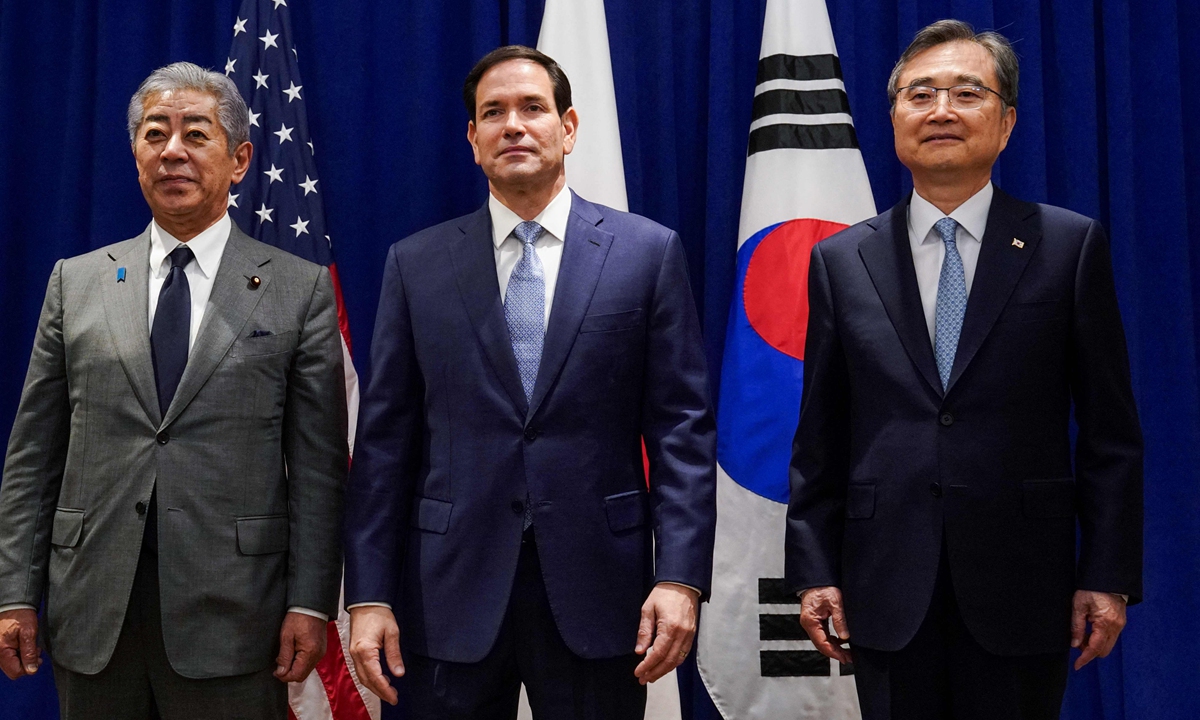
US Secretary of State Marco Rubio (C) meets with Japanese Foreign Minister Takeshi Iwaya (L) and Korean Foreign Minister Cho Hyun (R) at the Lotte New York Palace Hotel, on the sidelines of the 80th United Nations General Assembly in New York City on September 22, 2025. Photo: VCG
Chinese foreign ministry spokesperson said "We deplore and reject" the remarks regarding the joint statement issued by the US, Japan, and South Korea that touched on the Taiwan question and maritime issues, which amount to interference in China's internal affairs and groundless accusations against China.
US Secretary of State Marco Rubio, Foreign Minister of Japan lwaya Takeshi, and Foreign Minister of the Republic of Korea Cho Hyun met in New York on Monday. A joint statement released by the US Department of State from the trilateral meeting claimed that the three "expressed concern about increasingly frequent destabilizing actions around Taiwan" and "encouraged the peaceful resolution" of cross-Straits issues and "opposed any attempts to unilaterally change the status quo."
The statement also claimed that they "expressed support for Taiwan's meaningful participation in appropriate international organizations." Beyond Taiwan question, the statement also mentioned topics related to the South China Sea.
In response, Chinese Foreign Ministry spokesperson Guo Jiakun said at a regular press conference on Tuesday that Taiwan is an inalienable part of China's territory, and the Taiwan question is purely China's internal affair, which brooks no external interference. Relevant countries should abide by the one-China principle, stop abetting "Taiwan independence" separatist activities in any form, and not send any wrong signal to "Taiwan independence" separatist forces.
Guo added that the current situation in the South China Sea is generally stable. China, while firmly defending its territorial sovereignty and maritime rights and interests, remains committed to the proper settlement of differences with countries concerned through dialogue and consultation.
"Relevant countries need to respect regional countries' joint efforts to handle issues through dialogue and consultation and uphold peace and stability, and stop creating tension or stoking confrontation," said Guo.
A Reuters report on Tuesday claimed that the statement did not specifically mention China, but comes amid simmering tension between Beijing and Washington and its allies over South China Sea issue.
While avoiding directly mentioning China, the wording of the latest trilateral joint statement on the Taiwan question and the South China Sea issue clearly targeted China, reflecting their persistent stance, Xiang Haoyu, a distinguished research fellow at the Department for Asia-Pacific Studies of the China Institute of International Studies, told the Global Times on Tuesday.
The joint statement by the US, Japan, and South Korea was largely a cliché, repeating language used in past high-level meetings. The continued tone underscores Washington's stubborn push to rally its allies behind its so-called Indo-Pacific strategy and to play the Taiwan and South China Sea cards in an attempt to contain China, said Xiang.
On February 15, Foreign Ministers of South Korea, the US and Japan held talks in Munich, Germany and claimed for the first time in their joint statement that they support "Taiwan's meaningful participation in appropriate international organizations," and also mentioned the South China Sea and cross-Straits situation. In response, Chinese Foreign Ministry spokesperson Guo Jiakun said that "We firmly oppose relevant countries' attempts to put together small circles to interfere in China's internal affairs, attack and smear China, and stoke confrontation and antagonism."
"Let me stress that the Asia-Pacific is a stellar example of peace and development, not a chessboard for major-power rivalry. We call on relevant parties to earnestly respect regional countries' effort for peace and stability, abandon the Cold War mentality, stop creating bloc confrontation and stop fueling tensions in the region," said the spokesperson.
Xiang noted that the joint statement on Monday underscores the trilateral's China-targeted orientation — a negative development — though nuanced differences in tone between the three countries remain.
The South Korean Ministry of Foreign Affairs published a press release on its website on Tuesday, which included the joint statement as an attachment but did not mention the Taiwan question or the South China Sea in the release itself.
Similarly, a press release from Japan's Ministry of Foreign Affairs on Monday did not mention Taiwan or the South China Sea. However, in the final paragraph, it noted that the three ministers also exchanged views on regional situations, including "attempts to unilaterally change the status quo by force or coercion," and agreed to work closely together in response. The joint statement was also attached as a file.
The differences in the three sides' releases highlight the contradiction of Washington's two allies as they balance between China and the US—seeking to accommodate US strategic interests to ease pressure from Washington, while at the same time treading carefully in terms of relations with China, said Xiang.
The governments of Japan and South Korea have been under immense pressure of US tariffs. The New York Times reported on September 11 that in both countries, "fury at the US fuels backlash over trade deals." Officials and business leaders in Japan and South Korea are questioning commitments their governments made to invest hundreds of billions of dollars in American manufacturing, according to the report.
On September 17, South Korean Foreign Minister Cho, while departing for Beijing for the South Korea-China foreign ministers' meeting, said that "China is a very important neighbor to us," and "We will explore developmental directions for South Korea-China relations and discuss pending issues," according to South Korean media.
Xiang said that complete alignment with the US on containing China could ultimately harm their bilateral relations with China, urging Seoul and Tokyo to handle the issues with prudence.
RELATED ARTICLES