Iran’s FM addresses UN Security Council on failed Russia-China draft resolution, thanking China, Russia, Pakistan, and Algeria for support
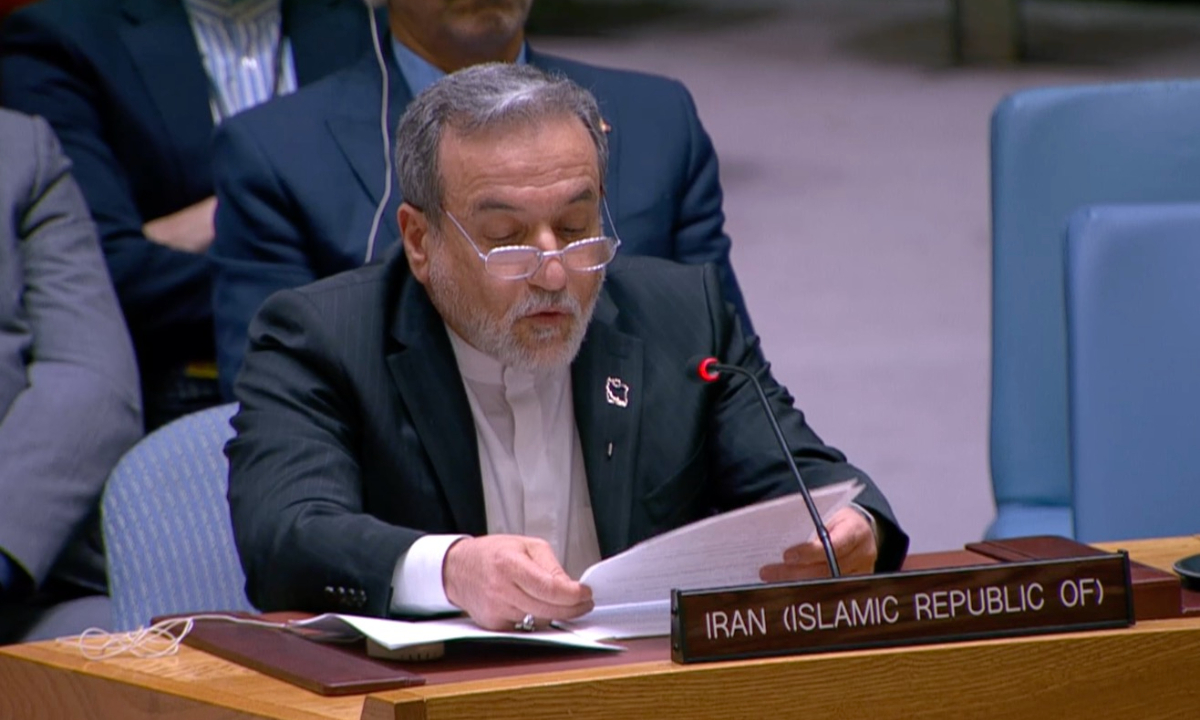
Iran's Foreign Minister Seyed Abbas Araghchi speaks at the UN Security Council on failed Russia-China draft resolution on September 26, 2025. Screenshot of video of UN website.
The UN Security Council has voted down an effort by China and Russia to extend sanctions relief to Iran for six months under the nuclear deal - formally known as the Joint Comprehensive Plan of Action on Friday, local time. The draft failed to be passed as the number of votes in favor did not reach nine.
In his speech, Iran's Foreign Minister, Seyed Abbas Araghchi, began by thanking China, Russia, Pakistan, and Algeria for supporting the resolution, which he described as a genuine effort to "keep the door of diplomacy open and avoid confrontation." He also welcomed the decision of Guyana and South Korea not to oppose the draft, calling it a stand "on the right side of history," according to WANA News, an Iranian news agency.
The Iranian foreign minister argued, "Today's situation is the direct consequence of the US withdrawal from the JCPOA and the E3 (France, United Kingdom and Germany) failure to take any effective action to uphold the commitments."
"The US has betrayed diplomacy, but it is the E3 which have buried it," he stressed. Araghchi also said, "The E3 and the US acted in bad faith, claiming to support diplomacy while in effect blocking it."
"Regrettably, E3 chose to follow Washington's whims rather than exercising their independent sovereign discretion," he said, adding "the US persistent negation of all initiatives to keep the window for diplomacy open proved once again that negotiations with the United States lead to nowhere other than dead end," the foreign minister added.
Geng Shuang, China's deputy permanent representative to the United Nations spoke after the vote. He reminded the Council that "history has shown that resorting to force or applying maximum pressure is not the correct approach to resolve the Iranian nuclear issue," according to the UN report.
Geng continued, "Against the backdrop of ongoing conflict in Gaza and the instability in the Middle East, a breakdown in the Iranian nuclear issue could trigger new regional security crisis, which runs counter to common interest of the international community."
The Chinese diplomat urged the US to "demonstrate political will by responding positively to Iran's proposal to resume talks and committing unequivocally to refrain from further military strikes against Iran."
Global Times
RELATED ARTICLES