China's NEV success builds on strategic planning, contributes to global green transport transition: expert
Five-Year Plans help to foster China’s sustained sci-tech, innovation growth
By in Haikou Published: Sep 28, 2025 11:40 PM

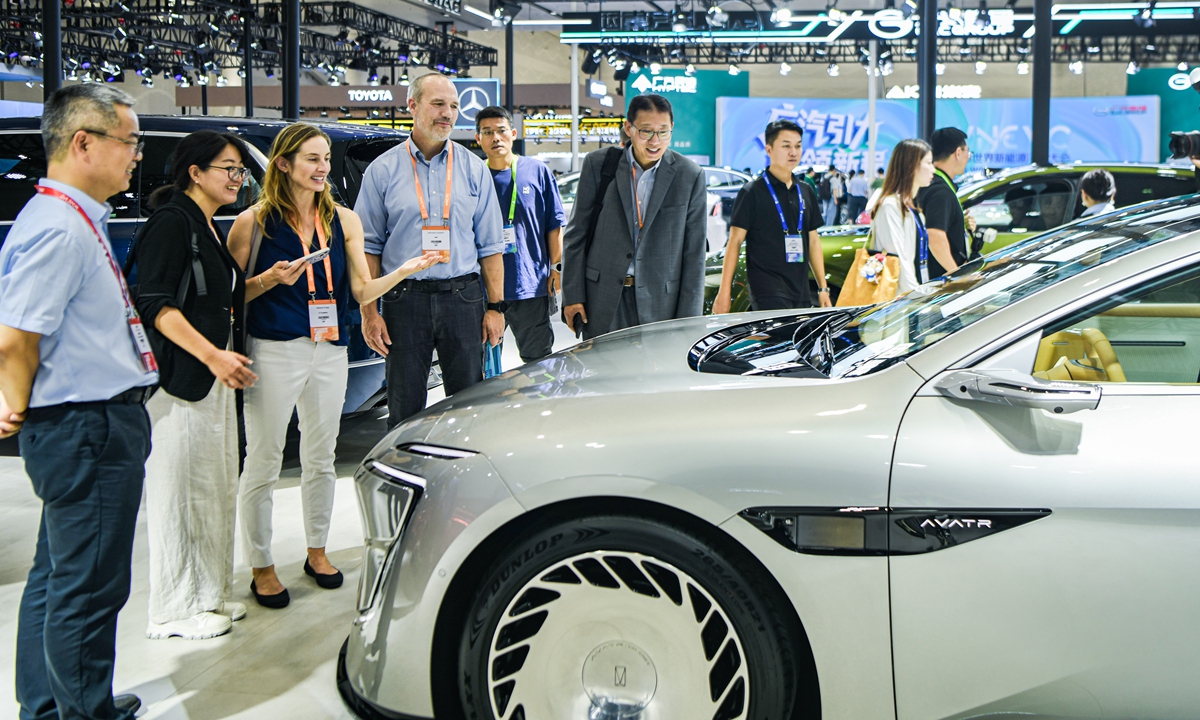
People visit the technical exhibition to explore Chinese new energy vehicles. The exhibition is part of the ongoing 2025 World New Energy Vehicle Congress (WNEVC) that opened in Haikou, South China's Hainan Province, on September 27, 2025. Photo: VCG
China's meteoric rise in new-energy vehicles (NEVs) has made significant contribution to the global green transition in the transportation sector, some participants to the ongoing 2025 World New Energy Vehicle Congress (WNEVC) said.
As the country announces goal to make new energy vehicles the mainstream in the sales of new vehicles by 2035, China's experience in green transportation development offers viable roadmaps and injects vital confidence to developing countries with green aspirations, they noted.
With a theme of "Industrial Transformation and Sustainable Development," the 2025 WNEVC runs from Saturday to Monday in Haikou, capital of South China's Hainan Province.
As one of its key missions, the WNEVC promotes development of NEV with the goal of pushing up NEV market share to 50 percent globally by 2035.
Meticulous planning
China's NEV rise is not a sudden or easy success, but rather a result of decades of planning and implementation, according to officials and experts attending the event.
China has steadfastly fostered growth in the NEV sector through five Five-Year Plans, which is an example of pursuing sci-tech and innovation driven growth, Miao Hong, deputy secretary-general of the Ministry of Science and Technology, said at a forum at the WNEVC on Sunday.
Due to the government's meticulous long-term planning, the active participation of market entities, and the rising awareness of sustainable and green growth of the public, the Chinese NEV sector has achieved impressive growth in recent years.
In 2024, China's NEV output and sales in 2024 each exceeded 12 million, setting a landmark achievement, according to data released by the China Association of Automobile Manufacturers.
In the first half of 2025, NEV sales in China reached 6.94 million units with a market penetration rate of 44.3 percent, Wan Gang, president of the China Association for Science and Technology and president of the WNEVC, said in a keynote speech at the 2025 WNEVC on Saturday.
Of the accumulated NEV sales of 70 million units in the world, 45 million are sold in China, Wan said.
The International Energy Agency (IEA), stated in a report released in May that China plays a vital role in global green development. In 2024, global electric car sales surpassed 17 million units, accounting for over 20 percent of total vehicle sales, according to the IEA. NEV sales continued to set records worldwide, particularly in China and other emerging economies.
The IEA noted that the 11 million electric cars sold in China in 2024 alone exceeded global sales of the previous two years combined.
The report predicted that the deployment of NEVs will replace the use of more than 5 million barrels of oil each day globally in 2030, with half of that reduction coming from China.
Equally worthy to note is that China has built up the world's largest renewable energy system during the same time frame, and now 40 percent of the country's power comes from green and renewable energy sources such as wind and solar, according to experts attending the WNEVC.
Chris Mason, CEO of FISITA, an international network for automotive engineers, told the Global Times in an interview on Sunday that China's meteoric rise in new-energy vehicles can be attributed to three elements, with the industrial strategy deployment as the key, and rapid pace of deployment and China's willingness to listen and learn from global peers being key supplements.
The pace will continue to gather from the making of cars to mobility systems, said Mason, an industry veteran with decades of experience who witnessed China's NEV rise firsthand.
Mason said artificial intelligence (AI) is a game changer in human history just like the internet, and with China's Internet Plus Initiative, the Chinese automotive industry stands a good chance to take the global leadership.
Future of green mobility
China's impressive NEV development not only benefits itself, but has also laid a broad foundation for international cooperation and lent valuable experience for other countries seeking a greener future.
"The automotive sector has grown into a cornerstone of EU-China economic ties. Fifty years ago, trade between Europe and China was worth around 2 billion euros ($2.34 billion) per year. Today, it exceeds two billion euros a day. Nowhere is that progress more visible than in the automotive sector, from technology and trade to joint ventures and shard expertise, Europe and China have helped shape the global industry together," Sigrid de Vries, director general with the European Automobile Manufacturers' Association, or ACEA, said during a speech on Sunday.
"As we gather here today, we look not only back on that success, but also ahead to what the next 50 years of collaboration can bring," de Vries said.
In March, the European Commission released the industrial action plan for the European automotive sector, marking the first time that the EU has set out its future strategic priorities for automotive industry in the form of an industrial policy, de Vries said.
A wide range of foreign brands, from Germany's Volkswagen Group, BMW, Mercedes-Benz to Japan's Toyota, displayed their electric models at the WNEVC, with top company brass expressing determination to stay in and grow with the vibrant Chinese NEV market.
Luke Hu, Co-Founder of Electroder, a software and service solution provider for battery development, told the Global Times on Sunday that China's NEV development contributes significantly to global low-carbon and energy transition.
In addition to assisting the nation in achieving its own dual carbon goals and thus making a substantial direct contribution to the global effort on green transportation, China's experience offers valuable technical roadmaps for other countries and regions, assisting them accelerate NEV development and reduce exploration costs, Hu said.
Also, for many developing countries, particularly participating countries of the China-proposed Belt and Road Initiative, China's NEV sector provides viable and cost-optimized solutions, which accelerates local transition to green energy and electric transportation, while also boosting these countries' confidence in pursuing their journey of sustainable future, Hu said.
RELATED ARTICLES