Over 23 million passenger trips estimated on first day of Golden Week travel rush; holiday economy seen as ‘vital driver’ of consumption
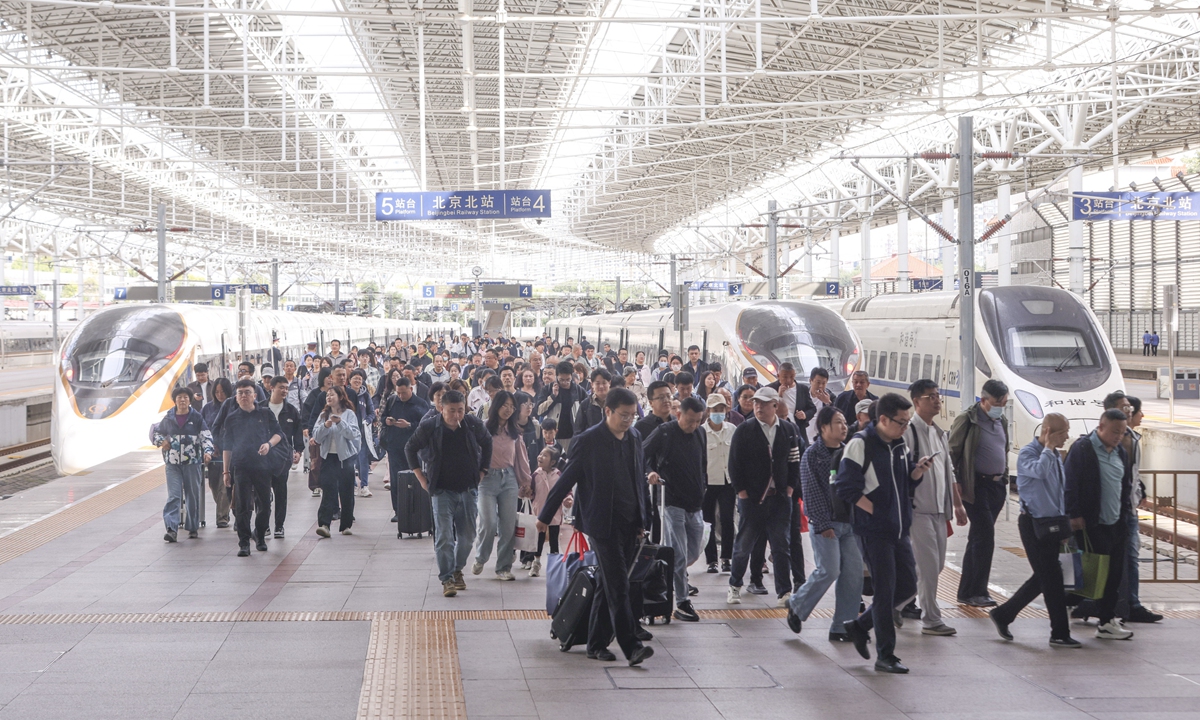
Photo shows passengers at Beijing North Railway Station on September 29, 2025. China's railways are projected to transport an estimated 219 million passengers during the combined 2025 National Day and Mid-Autumn Festival holiday travel period, which will run for 12 days from September 29 to October 10. Photo: IC
China's eight-day National Day and Mid-Autumn Festival "dual holidays" began with a surge of tourism, as passenger flow on Wednesday was projected to exceed 23 million passenger trips, according to a report by CCTV News, citing China State Railway Group Co.
China's Golden Week travel rush is in full swing, reflecting a robust revival of China's holiday economy, according to experts. They also expected a surge on consumption during the Golden Week holidays, which falls from Wednesday to October 8.
The holiday period has become a vital driver of consumption, with policies and improved transportation infrastructures aimed at enhancing the travel experience and boosting spending, Li Chang'an, a professor with the Academy of China Open Economy Studies at the University of International Business and Economics, told the Global Times on Wednesday.
"The surge in travel, both domestic and international, reflects a significant recovery in consumer confidence and plays a crucial role in driving China's economic growth," Li said, pointing out that the booming holiday market is a vivid testament to the resilience of the Chinese economy.
Travel surge
As of 8 am on Wednesday, a total of 120 million tickets have been sold for the National Day and Mid-Autumn Festival holidays travel period (September 29 to October 10) on China's 12306 railway booking platform, China State Railway.
The Yangtze River Delta railway network is expected to set a new single-day passenger record on Wednesday, with an estimated 4.26 million passenger trips, an increase of nearly 370,000 passenger trips (or 9.5 percent) compared to the same day in 2024, according to China Railway Shanghai Bureau Group Co, as reported by CCTV News. Meanwhile, the China Railway Beijing Bureau Group Co is expected to handle 1.73 million passengers on Wednesday.
Hong Kong expects to host more than 1.54 million passenger trips by Chinese mainland tourists during this year's eight-day National Day Golden Week, an 11 percent increase over 2024, John Lee, chief executive of China's Hong Kong Special Administrative Region (HKSAR), told media on Tuesday.
Shanghai's railway stations are projected to handle a staggering 6.25 million passenger trips, with a daily average of over 520,000 passengers, a year-on-year increase of 14.23 percent. The peak day (October 1) is expected to see 800,000 travelers, potentially setting a new single-day record, according to CCTV News.
Online travel agencies also reported significant activity in the cultural tourism market. According to data sent to the Global Times by travel platform Qunar on Wednesday, on the first day of the National Day and Mid-Autumn Festival holidays, air travel peaked as users booked hotels in nearly 2,000 counties in China and over 3,000 cities abroad. Family travel surged, accounting for 43 percent of trips, particularly among households with children and seniors. Notably, hotel stays in Jingdezhen, East China's Jiangxi Province increased by 30 percent due to the popularity of "Chicken Cutlet Brother" online, and searches for the Beijing flag-raising ceremony rose twelvefold, Qunar said.
On Wednesday, the number of foreign travelers taking domestic flights in China on the Qunar platform increased by over 40 percent year-on-year, traveling to 70 cities across the country. The top 10 inbound destinations were Shanghai, Beijing, Guangzhou, Chengdu, Qingdao, Shenzhen, Hangzhou, Shenyang, Xiamen, and Nanjing; the top five source countries were South Korea, Japan, Malaysia, Singapore, and Thailand. Self-driving tour bookings on Wednesday also saw an 80 percent year-on-year increase, according to Qunar.
Cai Muzi, a researcher at Qunar's Big Data Research Institute, analyzed that this year, the National Day and Mid-Autumn Festival holidays coincide, adds one extra day compared to last year. The dual holidays have led to a notable rise in family trips, with overall travel interest expected to surpass previous years.
Cruise tourism
Meanwhile, international cruise tourism continues to grow during the National Day and Mid-Autumn Festival holidays. With the rapid recovery of the cruise economy, two large cruise ships — Royal Caribbean's Spectrum of the Seas, and Adora Magic City— docked at Shanghai's Wusongkou International Cruise Terminal on Wednesday.
Xu Fuqiang, an officer at the Pujiang Border Inspection Station of the Shanghai General Station of Immigration Inspection, stated that "the Shanghai cruise port expects over 20,000 inbound and outbound passengers on Wednesday, and anticipates handling about 44,000 passengers during the holidays, with 12 cruise ships calling," according to CCTV News report.
The Tianjin International Cruise Home Port in North China's Tianjin Municipality will receive four inbound cruise calls, carrying over 8,000 inbound and outbound passengers, a staff member at the Tianjin Dongjiang border inspection station told the Global Times.
Li told the Global Times that the prosperity of the holiday economy is largely a result of a series of overlapping policy effects. For domestic tourists, various regions have introduced new cultural and tourism projects, optimized booking systems, and provided discounts and vouchers, leading to improved service quality and customer experience. For inbound tourists, services for foreign tourists, such as visa-free travel policies, improved payment systems, and the multilingual signage translation have facilitated increased inbound tourism spending.
Consumption frenzy
Meanwhile, Chinese outbound travel and cruise tourism have rebounded rapidly, generating significant revenue for aviation, hotels, retail, and restaurants in Asia Pacific, Europe, and beyond, sending a positive signal of demand recovery to the global economy, Li added.
The holiday period has emerged as a crucial driver of consumption, with a notable increase in cross-regional travel, Wang Peng, an associate research fellow at the Beijing Academy of Social Sciences, told the Global Times on Wednesday.
"The eight-day holidays are expected to see strong supply and demand dynamics, with the integration of culture and tourism becoming a core driving force, providing fresh impetus for economic growth," Wang said. He emphasized that tourists are seeking more immersive, cultural, and interactive experiences, leading to the rise of new travel models such as museum visits, industrial tourism, and sports tourism. Additionally, the nighttime activities and performance arts are emerging as significant contributors to consumer engagement.
RELATED ARTICLES