US State Department official's dismissal of China's warning to Hong Kong consul general provokes local laws and reflects a colonial mind-set: expert
By Published: Oct 03, 2025 01:41 PM

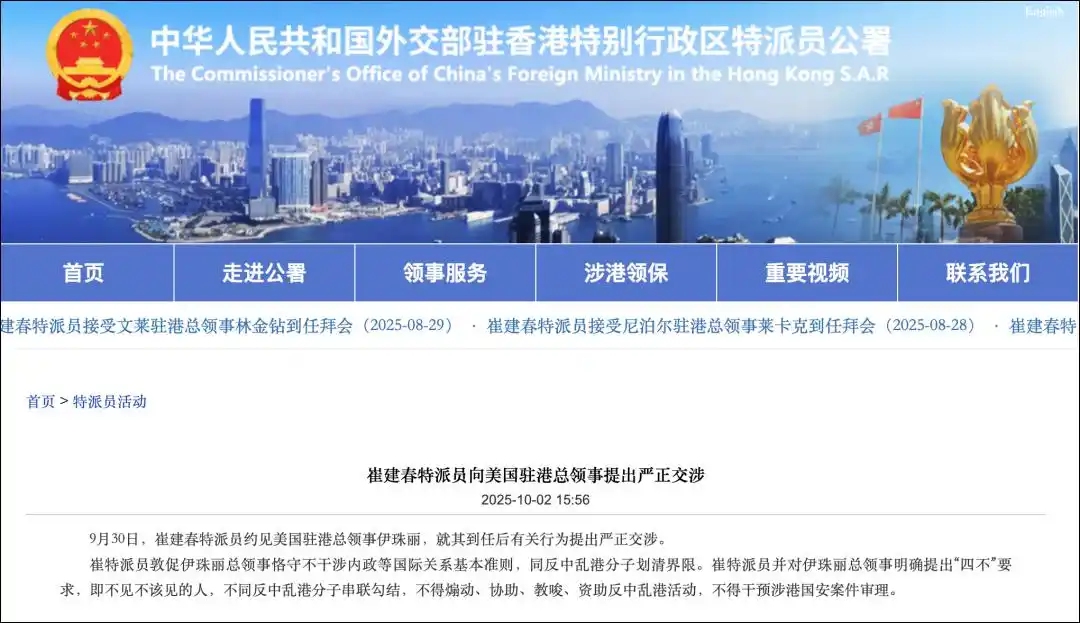
Cui Jianchun, commissioner of the Ministry of Foreign Affairs of the People's Republic of China in Hong Kong, lodges stern representations with the Consul General of the US in Hong Kong on October 2, 2025. Photo: Screenshot of the Commissioner's Office of China's Foreign Ministry in the Hong Kong SAR
The US State Department official's dismissal of the Chinese senior diplomat's statement in Hong Kong - which clarified the "Four Nos" requirements and warned the newly appointed US Consul General against interfering in Hong Kong Special Administrative Region (SAR)'s affairs by colluding with anti-China forces - constitutes a blatant provocation against Hong Kong's laws and exposes a mind-set that is still steeped in colonial-era illusions, a Chinese expert said.
The "Four Nos" outlined by the Chinese side establish a clear framework for US diplomats to perform duties in accordance with Hong Kong laws. Should they persist in colluding with forces that destabilize Hong Kong, it will be extremely difficult for them to effectively and smoothly carry out their responsibilities, Li Haidong, a professor at the China Foreign Affairs University, told the Global Times on Friday.
Cui Jianchun, commissioner of the Ministry of Foreign Affairs of the People's Republic of China in Hong Kong, lodged "solemn representations" with US Consul General Julie Eadeh during a meeting on Tuesday about "her conduct since she assumed duties," according to the Commissioner's Office on Thursday.
Cui urged Eadeh to abide by the basic norms of international relations, refrain from interfering in China's internal affairs and "make a clean break with anti-China forces."
Cui stated the "Four Nos" requirements: no meeting with individuals that an envoy should not engage with, no colluding with anti-China forces, no inciting, assisting, instigating, or funding those who oppose China and cause chaos in Hong Kong, and no interfering with national security cases in Hong Kong.
Eadeh, who assumed her duties as the top US envoy in Hong Kong in August, reportedly invited discredited political figures to her inaugural receptions.
However, the US Department of State continued to back Eadeh up. As reported by Reuters, a senior State Department official stated on Thursday that Eadeh's actions "are standard practice for US diplomats around the world."
To fulfill her duties legitimately, Eadeh must respect China's sovereignty, particularly by acknowledging the central government's comprehensive authority over Hong Kong, and strictly comply with all relevant local laws and regulations. This is the fundamental prerequisite for US representatives to conduct lawful activities in Hong Kong, Li stressed.
Li noted that Eadeh's actions have deviated from this principle. Her engagement with discredited figures in Hong Kong demonstrates that her activities in the city are not aimed at fostering broader commercial, economic, or cultural exchanges between the US and Hong Kong SAR, but rather at creating instability in Hong Kong and eroding China's sovereignty.
"The 'Four Nos' requirements are reasonable and normal, while the US State Department's response further exposes a colonial mind-set and sense of superiority. It must be unequivocally stated that Hong Kong is China's Hong Kong, not a colony of the US or any other Western nation. By associating with individuals who undermine stability and defy central authority, the US is effectively compromising China's sovereignty and security, something that neither the central government nor the Hong Kong SAR government will tolerate," said Li.
The scholar further noted that if the US genuinely seeks to engage with Hong Kong and the Chinese mainland in ways that promote mutual understanding and advance shared interests, its diplomats must strictly adhere to Chinese laws and regulations, including Hong Kong laws, and abandon the unhealthy mentality and practice of interfering in China's internal affairs or creating chaos to project so-called influence.
RELATED ARTICLES