Illustration: Chen Xia/GT
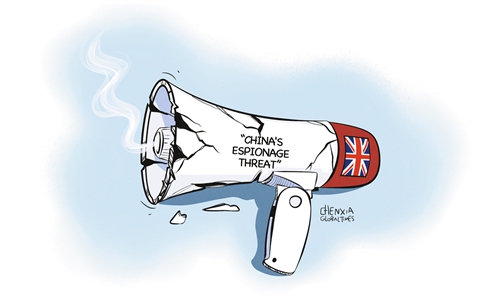
A case involving two British men accused of spying for China was dropped last month for lacking sufficient evidence to "meet the threshold to prosecute." Yet a blame game is brewing.
Some UK's lawmakers and government officials have put pressure on prosecutors, while Director of Public Prosecutions Stephen Parkinson, in a letter to parliamentary committees on Tuesday, placed the blame on the government, saying that prosecutors had tried "over many months" to get the evidence needed to proceed with the trial, but it had not been forthcoming from the government.
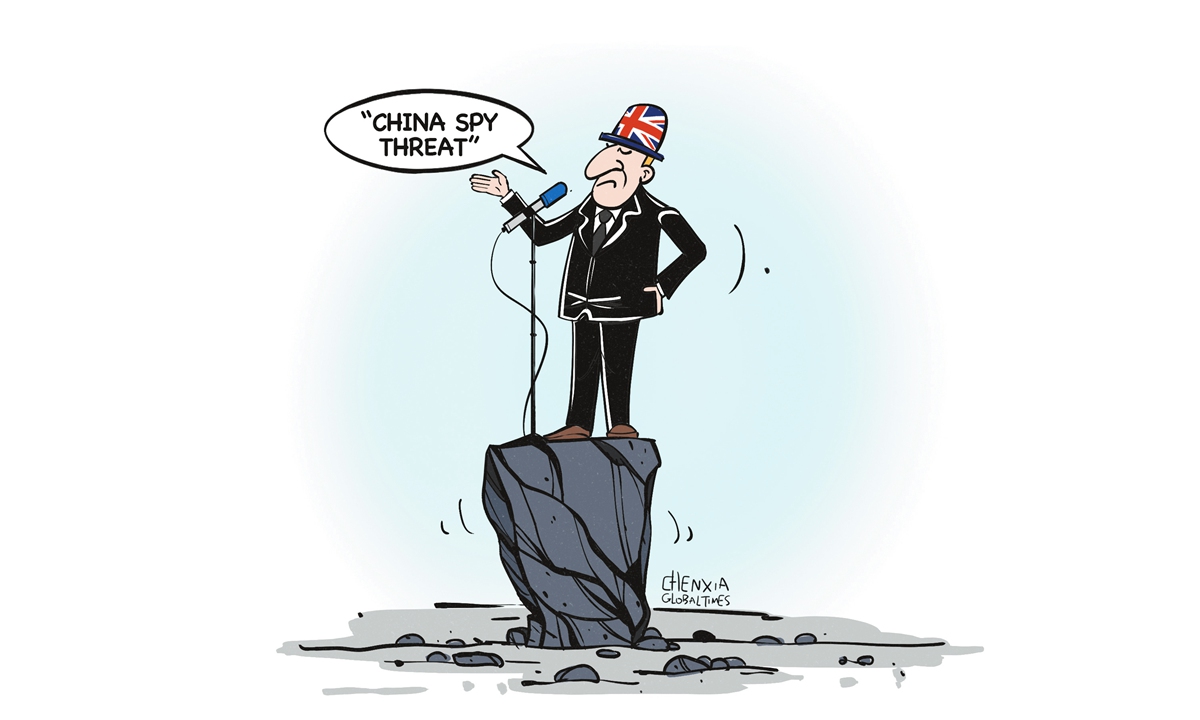
The principle of the presumption of innocence, a foundational legal principle in the UK, dictates that if the evidence is insufficient or unreliable, the accused cannot be convicted. However, some British politicians seem determined to ignore the UK's legal decision to drop the "China spy" case, never considering that this outcome itself proves that the so-called "spying for China" allegation is completely unfounded and maliciously fabricated. Instead, they blame the "collapse" of the case on the UK government's failure to label China as a "threat to national security." Apparently, when the legal decision doesn't align with their expectations, it's time to start questioning its fairness - because who needs justice when you have political agendas?
The essence of this blame game is that for certain anti-China forces, the pre-established "China threat" narrative takes precedence over the "sufficient evidence" required by law. Their hysterical reaction to this case does not arise from any genuine concern for national security; rather, it stems from the fact that the case's developments have stripped them of a convenient excuse to amplify the "China threat."
"The nature of the incident is political, not legal. For some UK politicians, even if a conviction cannot be secured, the label of 'China threat' must be politically confirmed," Gao Jian, director of the Center for British Studies at Shanghai International Studies University, told the Global Times on Thursday.
This entire farce reveals the strategic inertia and anxiety of certain forces in the UK. They view China as a "threat" because doing so provides them with "reasonable" excuses for their irrational anti-China agenda.
In its coverage of the case, the Financial Times quoted former UK diplomat Charles Parton, who noted that the UK government's refusal to testify that China is "a national security threat" in this case has signaled to Beijing that "the UK can be bullied." Those who are fixated on the "China threat" narrative should really take heed of advice from China's Foreign Ministry: avoid being paranoid.
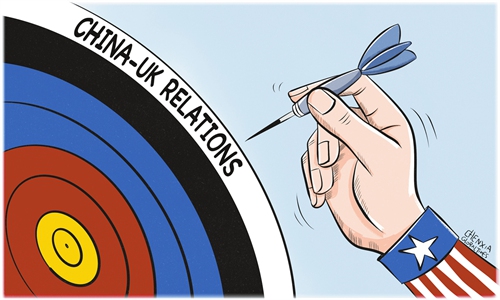
"Both the Sunak and Starmer governments have tried to improve relations with China. However, certain factions within UK politics continue to jeopardize the development of bilateral ties due to historical prejudices and a Cold War mentality toward China. This limits the UK government's ability to maneuver in its China policy," said Gao.
True security for the UK would be better achieved through by a clear-eyed and evidence-based assessment of its national interests, rather than by clinging to a manufactured "China threat" as a convenient excuse for domestic political struggles or strategic disorientation.
RELATED ARTICLES