Chinese localities roll out sweeping measures to boost 2026 college graduates’ employment
Graduates' job market likely to remain stable next year as emerging industries drive surge in demand: analysts
By Published: Oct 12, 2025 09:55 PM

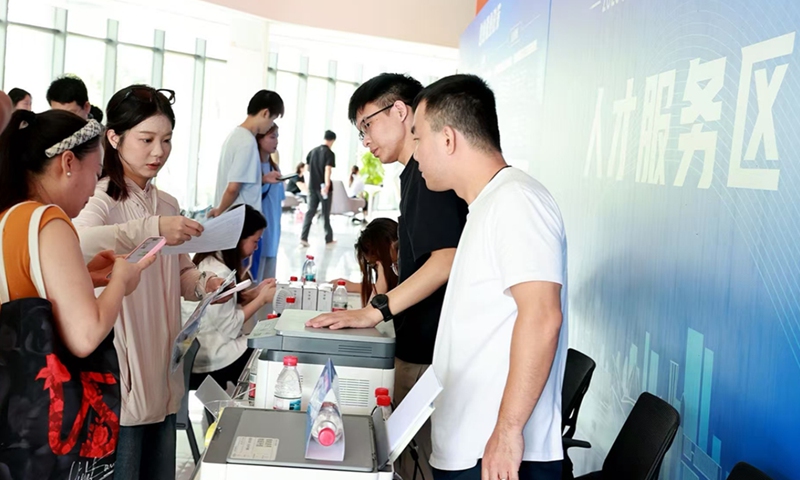
People attend a job fair on September 26, 2025, in Sanya, South China's Hainan Province. Photo: VCG
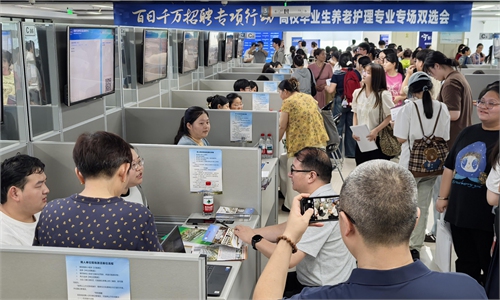
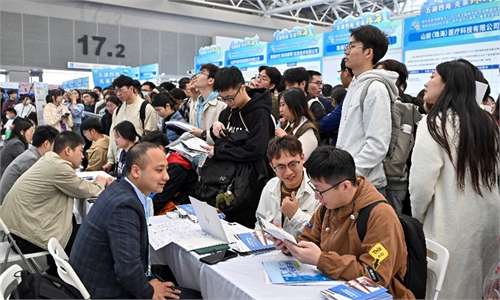
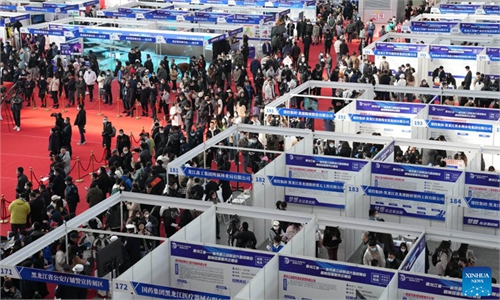
Chinese localities are rolling out a sweeping top-down employment push for college graduates in 2026, including holding targeted job fairs with universities and expanding employment channels. China's employment market prospects are likely to remain stable and vibrant next year, analysts said, citing the rapid growth of emerging industries and innovative business models as other crucial drivers of new jobs.
The 2025 autumn job fairs for Chinese college graduates are being held across the country, with 283 specialized service events already launched, China Central Television reported on Sunday, citing data from the Ministry of Human Resources and Social Security. The job fairs are primarily aimed at helping college graduates in 2026 and previous graduates who remain unemployed.
According to the report, the job fair includes several specialized activities. For example, there are tailored online and on-site recruitment events for industries including advanced manufacturing, healthcare, artificial intelligence (AI) and the internet. Also, specialized recruitment fairs will be held for key regions such as Northeast China, the Yangtze River Economic Belt and the Silk Road Economic Belt.
The number of Chinese college graduates is expected to reach 12.22 million in 2025, up 430,000 from last year, according to the People's Daily. The number is likely to remain high in the coming years given China's population trends.
Tianjin University will hold a large-scale job fair in the coming months, providing positions in such sectors as materials and chemical engineering, electrical automation, civil engineering, biomedicine, electronic information as well as economics and management.
The university is introducing a system that enables AI to play the role of an interviewer, and it offers other services such as resume revision and job recommendations, a university spokesperson told the Global Times. He added that the job fair aligns with the local authority's campaign to promote college graduates' employment.
"I'm optimistic on the graduates' employment prospects. First, we have been collaborating with more diversified employers in recent job fairs, some of which come from the central and western regions," a college teacher surnamed Chen, based in East China's Fujian Province, told the Global Times on Sunday.
Chen said that she also sees more employers from newly rising industries and business models, such as livestreaming, new-energy vehicles, advanced manufacturing and biomedicine, a trend that is set to "create a significant amount of job opportunities" to expand China's graduate employment market.
Wang Peng, an associate researcher at the Beijing Academy of Social Sciences, told the Global Times on Sunday that he expects more high value-added and technology-intensive positions to absorb college graduates. "There is an explosive demand for high-end talent amid China's industrial upgrade and high-quality development," Wang noted.
While job fairs could be an important channel for college graduates to communicate directly with employers, Chinese localities also have been stepping up support to enhance graduates' employment and industry-relevant skills.
According to a report by ynet.com, local authorities in East China's Jiangxi Province have worked with enterprises to provide 73,000 internships for college graduates this year. More than 18,000 individuals were put into internships, and 114.5 million yuan ($16.14 million) in internship subsidies was disbursed.
"There are structural contradictions between the supply and demand sides in China's employment market. While competition for positions in some traditional industries remains intense, emerging and certain innovative industries are facing talent shortages. The situation is gradually improving with local authorities' efforts," Wang said.
In August, China's urban surveyed unemployment rate was 5.3 percent, up 0.1 percentage point from July, according to the National Bureau of Statistics (NBS). The rise was primarily due to the influx of recent graduates entering the labor market, and the overall employment situation in China remains stable, NBS spokesperson Fu Linghui said.
RELATED ARTICLES