Why five-year plans are China's strategic engine
Extraordinary 14th Five-Year Plan: Witnessing China's Strength
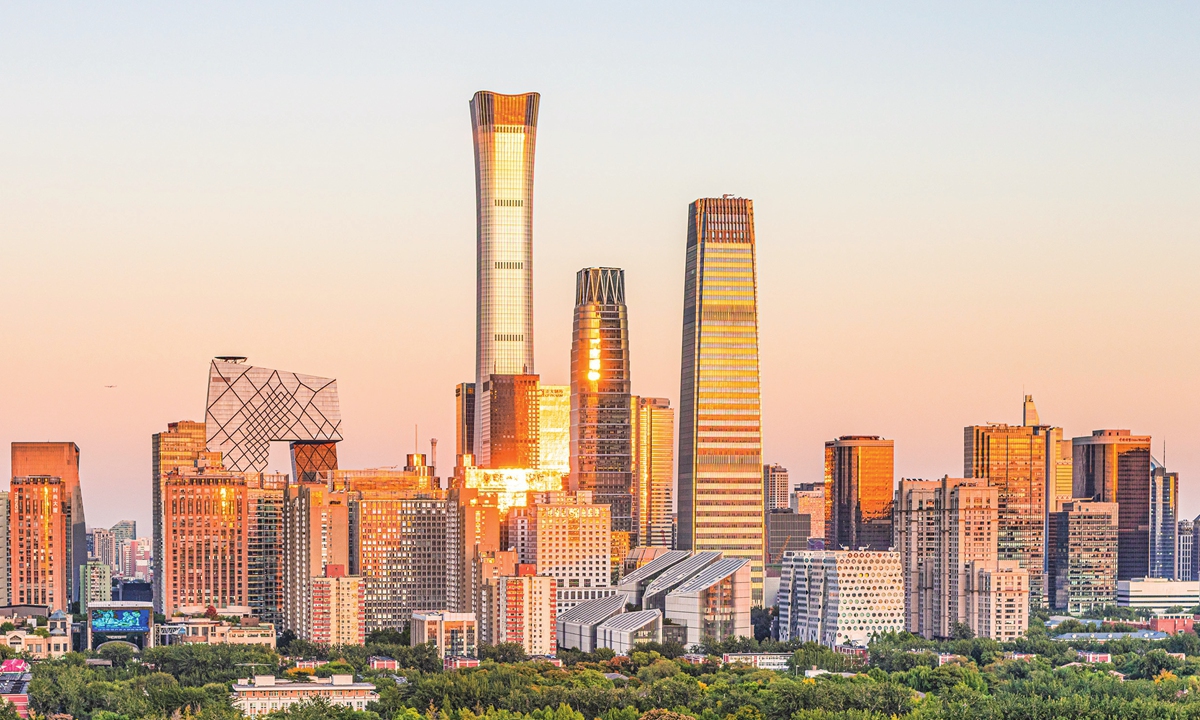
A view of the skyline of Beijing's CBD area. Photo: VCG
Xi Jinping, general secretary of the Communist Party of China (CPC) Central Committee, has stressed that the scientific formulation and consistent implementation of five-year plans stand as an important piece of experience in the CPC's approach to governing the country. It's also significantly representing the political advantage of socialism with Chinese characteristics. China's first five-year plan was launched in 1953. Since then, China has implemented 14 such plans, and the 15th Five-Year Plan (2026-2030) is now in preparation.
The formulation and implementation of the five-year plans not only fully demonstrate the CPC's governing philosophy of scientific, democratic and law-based governance, but also its ability to effectively mobilize the forces of government, market and society around shared development goals, thereby building consensus and fostering synergy. At the same time, each five-year period marks a new stage of China's development, reflecting the continuity, stability and predictability of the Chinese system.
Why have the five-year plans become the strategic engine driving the modernization of a country as vast as China - sustaining their vitality, constantly improving in practice and effectively uniting social consensus, while guiding market forces, leveraging government action and achieving national strategic goals? The reasons lie mainly in three aspects.
China is a socialist country that has always regarded the comprehensive and coordinated economic and social development as both a fundamental principle and ultimate goal. Achieving such development requires overcoming the basic contradiction in a market economy - between the organized nature of production within individual firms and the spontaneous, uncoordinated and often chaotic nature of social production as a whole - and tackling challenges such as the gaps between industry and agriculture, between cities and the countryside, between mental and manual work, and the wide regional differences that exist in a large country like China. To achieve these goals, it is essential to ensure that the market functions efficiently, the government acts effectively and society contributes powerfully - forming the greatest possible synergy.
Since the reform and opening-up, the five-year plans have placed more emphasis on strategic guidance, expanding from economic planning to comprehensive development planning, and highlighting the interactive coordination between economic and social progress - an embodiment of the intrinsic requirements of the socialist system. As a late-developing major power, China's path to modernization requires clear goals, rational planning and focused resource allocation. Only in this way can it identify and leverage its latecomer advantages in the global development landscape, accelerating its pace to catch up with the early industrialized nations. The five-year plans have consistently prioritized key projects, tasks and strategies to address major bottlenecks hindering coordinated development.
For instance, the First Five-Year Plan (1953-1957) identified 156 major industrial projects that laid the foundation for development in central and western regions. The 14th Five-Year Plan (2021-2025), which focused on understanding the new stage of development, applying the new development philosophy and fostering a new development paradigm, has clearly identified key areas such as technological innovation and industrial upgrading. By introducing a number of major projects and initiatives, China has effectively responded to global uncertainties, consolidated its development advantages and enhanced its resilience.
Of particular importance is that, as a long-term ruling party, the CPC has developed a sophisticated capacity to use five-year plans as a governance instrument for a vast and rapidly transforming nation. The continuity, evolution and effectiveness of the five-year plans stem from the Party's political consciousness and governing capability. Under the CPC's correct and resolute leadership, the planning process has become increasingly scientific and democratic, while its implementation has grown more solid and effective.
Therefore, five-year plans represent a synthesis of collective wisdom nationwide - an accurate judgment of future development trends, an objective projection of developmental goals and a rational arrangement for realizing them. It embodies the CPC's proactive and adaptive governance, as well as its precise understanding and timely response to changes in China, the world and the times.
The content of these plans has evolved from purely economic planning to integrated economic and social development planning, and now to comprehensive national planning encompassing political, cultural, ecological and defense dimensions. The planning system itself has expanded from a single economic plan to a multi-layered framework that includes overall national plans, sectoral plans, regional economic plans, and spatial development and functional zoning plans. The scope of planning has also broadened from the Chinese mainland to include the Hong Kong Special Administrative Region, Macao Special Administrative Region and Taiwan region.
At present, China is formulating its 15th Five-Year Plan. General Secretary of the CPC Central Committee Xi Jinping has stressed sound, democratic and law-based decision-making to ensure China's next five-year plan for national economic and social development is formulated in high quality. He emphasized the importance of integrating top-level design with seeking advice from the public, enhancing research and discussions, and building broad consensus.
A plan that truly originates from the people can unite society, gain public understanding and support, and ultimately be transformed into conscious and widespread action. Only by integrating top-level design with people-centered consultation can the five-year plans fulfill its core role as a strategic engine.
The author is director of the Department of Political Sciences at Tsinghua University. opinion@globaltimes.com.cn
RELATED ARTICLES