China's new-generation 'artificial sun' under upgrade for burning plasma tests: expert
By Fan Wei and Published: Oct 14, 2025 09:03 PM

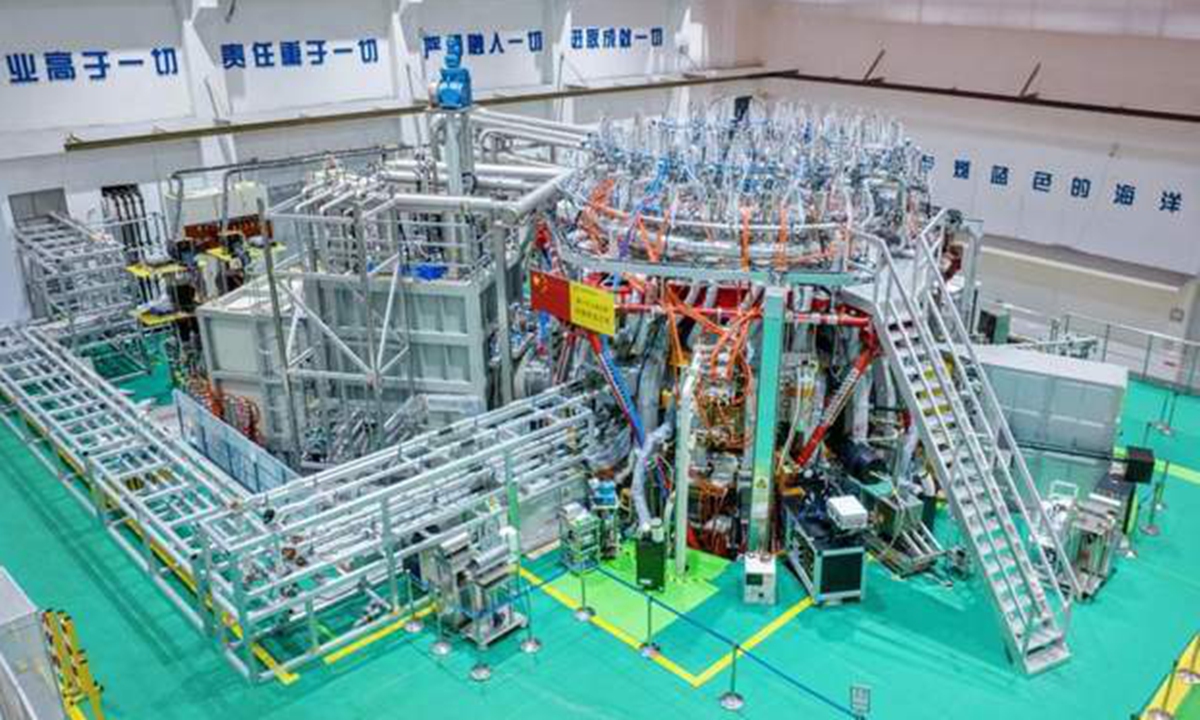
China's new-generation 'artificial sun' Photo: CNNC
China is making steady progress toward the commercialization of nuclear fusion power, with a goal to achieve operational fusion-based electricity generation by around 2050.
"To realize commercial fusion power, six stages must be completed, and currently we are at the third one," Zhong Wulu, an assistant director of the Southwest Institute of Physics of China National Nuclear Corporation (CNNC) and head of its Fusion Science Division, told the Global Times during the opening ceremony of the 2025 World Fusion Energy Ministers' Meeting and the 30th International Atomic Energy Agency Fusion Energy Conference in Chengdu on Tuesday.
Zhong noted that there are six stages leading to commercial fusion -- principle exploration, scaled experiments, burning plasma experiments, experimental reactors, demonstration reactors and commercial reactors. China has now entered the burning plasma phase, and "we already possess the parameters required for sustaining burning plasma."
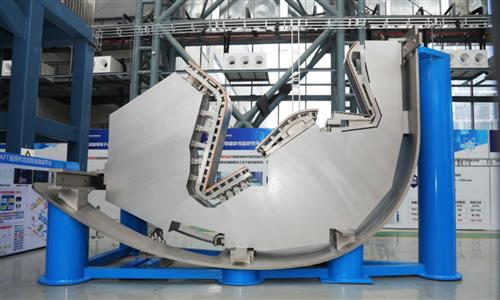
At the conferences, international media focused the question of when China could achieve commercial fusion power. In front of a model of the new-generation "artificial sun" device, China's Experimental Advanced Superconducting Tokamak (EAST), experts from the Southwest Institute of Physics shared the country's progress in fusion technology development with foreign delegates.
Huang Mei, CNNC's chief scientist and head of the electron cyclotron project, told the Global Times that according to China's fusion roadmap, commercial fusion power generation is expected around 2050, a timeline to similar to other countries. "We are working hard to bring that day forward as much as possible."
CNNC is following a structured approach of "experimental reactor — demonstration reactor — commercial reactor." The plan includes starting burning plasma experiments around 2027, followed by the construction of pilot reactors, which will demonstrate fusion energy output, and eventually the building of commercial reactors.
Despite its promise, controlling an "artificial sun" on Earth remains a formidable challenge. The first hurdle is creating the extreme conditions required for fusion. Deuterium-tritium plasma must be heated to over 100 million C — six to seven times the core temperatures of the sun — to overcome the Coulomb barrier between atomic nuclei and sustain fusion.
At such temperatures, matter becomes fully ionized plasma, rendering any physical container useless. Non-contact confinement technologies, particularly magnetic and inertial confinement, are therefore essential. The Tokamak-type magnetic confinement device has so far achieved plasma parameters closest to those needed for the reactor core. While several large Tokamak experiments worldwide have briefly met the stringent conditions for fusion, increasing fusion power gain, improving plasma confinement stability, maintaining long-duration burning, and achieving net energy output remain formidable scientific and engineering challenges.
Materials and engineering present additional difficulties. Experts must develop structural materials resistant to extreme temperatures and intense neutron irradiation, highly reliable superconducting magnets, cryogenic systems, and diagnostic and control systems capable of real-time plasma monitoring and rapid feedback. Currently, international efforts focus on low-activation steels and tungsten alloys for structural components, and superconducting magnets made of niobium-tin, niobium-titanium, or high-temperature superconductors, all posing significant engineering hurdles. Fuel cycle technologies, including tritium breeding with fusion neutrons and safely extracting, purifying, and storing tritium, are also critical.
"Frankly, there are still many technical barriers, including material irradiation effects, burning plasma physics, and tritium self-sufficiency," Huang said.
However, China is methodically advancing technology verification. "We are upgrading the next-generation EAST device to conduct burning plasma experiments. At China's fusion technology R&D base, we are working on reactor core materials, plasma heating, diagnostics, control systems and tritium fuel cycle technologies. All of these still require breakthroughs," Huang added. She expressed confidence that the Southwest Institute of Physics, as the fusion 'national team' will accelerate technical progress through various platforms and achieve commercial fusion power generation around 2050.
"The moment I most look forward to is using the first kilowatt of electricity generated by fusion to light a lamp, which will be the most exciting moment," Huang said.
RELATED ARTICLES