MI5’s warning of ‘Russia, China spies’ a hasty response to pressure as partisan rivalry intensified in UK, analysts say
By and Li Yu Published: Oct 14, 2025 10:52 PM

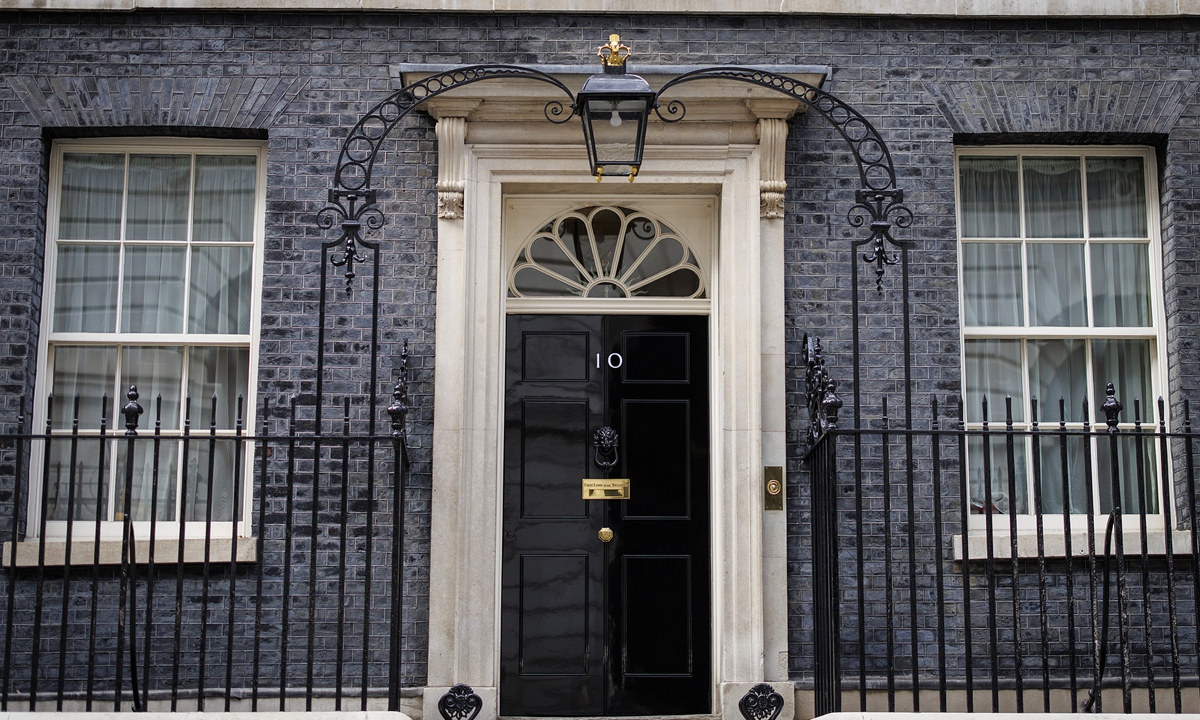
The entrance to the British prime minister's official residence, 10 Downing Street, in London Photo: VCG
The National Protective Security Authority (NPSA) under the UK's spy agency MI5 on Monday issued a public guidance notice, warning members of parliament (MPs), peers, councilors, parliamentary staff and candidates that they are being targeted by spies from China, Russia and Iran. Chinese analysts said they view the guidance, whose content relies on subjective assumptions and lacks credibility, as a hasty response from the UK government, which is facing mounting pressure from opposition parties amid intensifying domestic partisan rivalry.
The guidance claimed that "the UK is a target of long-term strategic foreign interference and espionage from elements of the Russian, Chinese and Iranian states."
The warning comes a week after British prosecutors said they had to abandon the trial of two British men charged with spying on MPs for China because the British government had not provided evidence showing China was a threat to its national security, Reuters reported.
Speaking in parliament on Monday evening, British security minister Dan Jarvis said the new guidance is part of the government's response to the aborted spying case as it attempted to demonstrate its commitment to national security, Bloomberg reported.
Jarvis also described Tory claims that the Labour government had deliberately sabotaged the China spy prosecution as "baseless smears".
Kemi Badenoch, Conservative leader of the opposition, responded that she thinks Labour chose to put closer economic ties with China ahead of national security, per the Guardian.
Li Guanjie, a research fellow with the Shanghai Academy of Global Governance and Area Studies under the Shanghai International Studies University, told the Global Times that the new guidance appears to be a hasty response by the UK government to domestic pressures, yet much of its content relies on subjective assumptions, casting doubt on its credibility.
The expert said that the chaos surrounding the "espionage case" has laid bare the UK's deep partisan divisions. The Conservative Party, driven by opportunistic motives, capitalizes on any issue it can exploit, particularly China policy, to attack the Labour government, disregarding the detrimental impact of such actions on UK-China relations.
On October 11, a spokesperson for the Chinese Embassy in the UK said that the so-called "China spy case" hyped up by the UK is entirely fabricated and self-staged. The spokesperson added that the UK judicial authorities' decision to drop the charges further proves that the "spying for China" allegation is pure fabrication.
Cui Hongjian, director of the Department of European Studies, China Institute of International Studies, said that within the UK, a fiercer contest is unfolding between those advocating for improved ties with China and those committed to a hardline approach.
"The UK government faces significant challenges in its efforts to improve relations with China," Cui said, "These challenges arise from multiple sources, including the influence of the Conservative Party and some biased media, and pressure stemming from the special UK-US relationship."
British media revealed on Sunday that the White House sent a warning to British Prime Minister Keir Starmer, claiming that the UK's failure to prosecute the two alleged "China spies" risks damaging their special relationship and jeopardizing intelligence sharing between London and Washington.
Cui said that if the media reports are true, the US has threatened the UK by leveraging the "special relationship" and "intelligence sharing" between the two countries in an attempt to interfere with the judicial independence of another country.
In fact, there have been frequent high-level engagements between China and the UK since the start of this year. In January, British Chancellor of the Exchequer Rachel Reeves visited China, with the resumption of the China-UK Economic and Financial Dialogue. In February, Chinese Foreign Minister Wang Yi visited the UK, where he met with Prime Minister Keir Starmer and held the 10th China-UK Strategic Dialogue with Foreign Secretary David Lammy. In March, both sides convened the eighth Energy Dialogue between China and the UK.
On September 11, China's Minister of Commerce Wang Wentao and British Secretary of State for Business and Trade Peter Kyle co-chaired the 14th meeting of the China-UK Joint Economic and Trade Commission (JETCO), the first in seven years, reaching broad consensus, according to China's Ministry of Commerce.
Analysts also said that despite the progress in diplomatic cooperation, China-UK ties still face obstacles, which requires the British government to properly handle ties the issue with caution, and withstand pressures.
RELATED ARTICLES