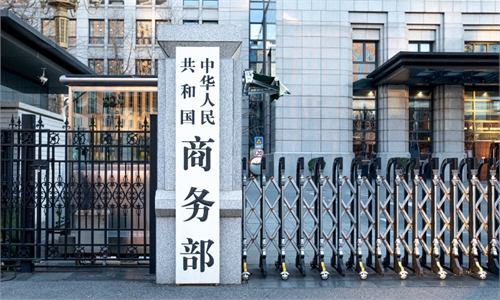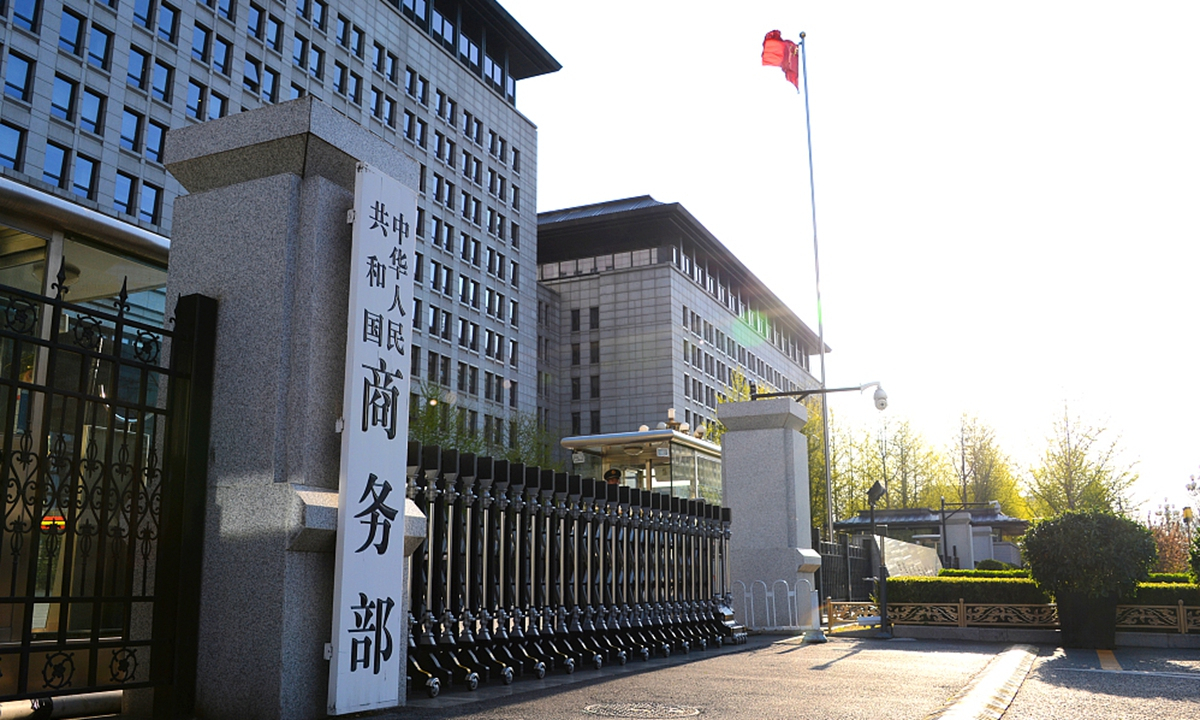
The Ministry of Commerce (MOFCOM) Photo: VCG
China on Tuesday expressed strong dissatisfaction and firm opposition to the US move of imposing port fees and other restrictive measures on China's maritime, logistics, and shipbuilding sectors, a spokesperson of China's Ministry of Commerce (MOFCOM) said on Tuesday.
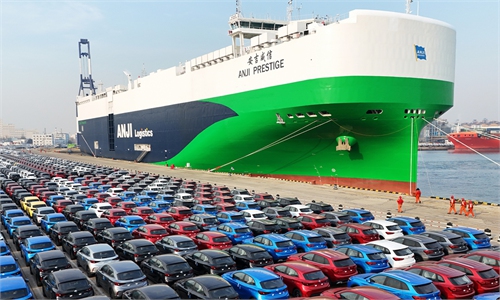
The comments came as the US started on Tuesday US Eastern Time to impose port fees and other restrictive measures based on the so-called Section 301 probe.
The US move is a typical act of unilateralism and protectionism, which seriously violates World Trade Organization (WTO) rules and the principle of equality and reciprocity under the China-US maritime transport agreement, the spokesperson said. These actions grant unfair competitive advantages to certain countries' shipping and shipbuilding enterprises, constituting discriminatory practices against China's shipping and shipbuilding industries and seriously undermining their interests, the spokesperson noted.
Firm countermeasures
In responding to the US' move, according to China's Regulations on International Maritime Transport, and with the approval of the State Council, the cabinet, the Ministry of Transport (MOT) issued a notice announcing that, starting Tuesday, a special port fees will be levied on vessels linked to the US. This is a legitimate measure to safeguard the lawful rights and interests of Chinese industries and enterprises, as well as to maintain a fair competitive environment in international shipping, said the MOT.
The MOT, in collaboration with the Ministry of Industry and Information Technology and other departments, is also conducting an investigation into the impact or potential impact of the US Section 301 investigation on the security and development interests of China's shipping industry, shipbuilding industry and related industrial and supply chains, the MOT said on Tuesday.
To further safeguard the interests of China's related industries, relevant Chinese authorities, in accordance with China's National Security Law, the Anti-Foreign Sanctions Law, and China's Regulations on International Maritime Transport, have placed certain companies that assisted or supported the US investigation on a countermeasure list, according to the MOFCOM spokesperson on Tuesday.
China has also launched investigations into acts by the US and certain countries and enterprises that harm the security and development interests of China's shipping and shipbuilding sectors, the spokesperson said, noting that in conducting these investigations, China will adhere to the principles of openness, fairness, and impartiality, and fully protect the legitimate rights of all stakeholders.
On Tuesday, the MOFCOM announced countermeasures against five US-based subsidiaries of South Korea's Hanwha Ocean Co, in response to the US' Section 301 investigation and related measures targeting China's maritime, logistics and shipbuilding industries.
The five subsidiaries include Hanwha Shipping LLC, Hanwha Philly Shipyard Inc, Hanwha Ocean USA International LLC, Hanwha Shipping Holdings LLC, and HS USA Holdings Corp, according to the MOFCOM statement. The MOFCOM said that these companies have assisted and supported investigations conducted by the US government, endangering China's sovereignty, security and development interests.
In a statement, South Korea's foreign ministry said it was currently determining the impact of the sanctions, and planned to communicate with China, relevant ministries and industry to minimize their impact, Reuters reported.
China leads the world in shipbuilding, followed by South Korea and Japan. The three countries collectively make 90 percent of the world's fleet. China commands more than 62 percent of that, CNBC reported.
US media outlet Politico reported that US retailers, manufacturers and shipping experts warn that will likely be short-lived and that eventually they will have to pass the fees on to consumers. The higher costs will further strain the shipping industry, which transports more than 80 percent of global trade and is already grappling with the disruptive effects of the US President Donald Trump's sweeping tariffs, according to the report.
"The US decision to impose port fees on Chinese vessels, under the excuse of protecting its shipbuilding industry and national security, is unreasonable and misleading," He Weiwen, a senior fellow at the Center for China and Globalization, told Global Times on Tuesday, noting that in reality, the US shipbuilding industry has largely exited the global market and is only one sixtieth the size of China's.
Moreover, port fees are related to cargo trade and have nothing to do with shipbuilding, making the US' excuse baseless, the expert said. "Such actions are simply an attempt to suppress China's industry by any means, even at the cost of self-harm."
More sincerity needed
Also on Tuesday, in response to a question about a US official's claim that China "deferred" when the US side reached out for a phone talk regarding the country's rare earth export controls and that both sides need to find a way back to stability, a spokesperson with China's Ministry of Commerce (MOFCOM) said that China consistently and firmly safeguards its national security and global common security as a responsible major country; the export control regulation is not a ban and compliant application for export licenses will be granted to jointly maintain the safety and stability of global production and supply chains.
The Chinese side urges the US side to correct its wrongdoings, show sincerity for talks, and meet China halfway and stressed that "it is not the right way to get along with China when the US seeks negotiations with China while threatening and intimidating to come up with new restrictions," the spokesperson said.
"China's export controls are for its own security concerns and are in line with international practices and China's nonproliferation obligations. They are not export bans and strict restrictions apply only to military end-uses and do not affect civilian goods that use the Chinese rare earth input. The practice is fully consistent with WTO rules regarding security concerns," Li Yong, a senior research fellow at the China Association of International Trade, told the Global Times on Tuesday, noting that this contrasts sharply with US measures, which are categorically unilateral and protectionist.
The US should take the path of reason in the first place reflecting on the wrongdoings that have negatively impacted regarding bilateral trade relations. The right approach should be resolving the issues by engaging constructive communications instead of launching threats, Li said, urging the US to abandon the idea of confrontation, demonstrate rationality and goodwill rather than threat and intimidation.
RELATED ARTICLES