China welcomes arrival of South Korea's new ambassador: FM; Roh may help stabilize bilateral ties amid complex global situations, expert says
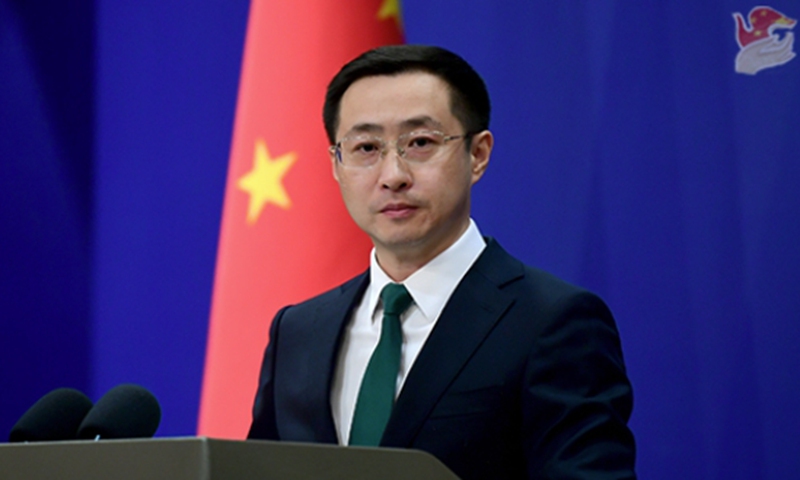
Photo: Chinese Foreign Ministry spokesperson Lin Jian
China welcomes the arrival of South Korea's newly appointed Ambassador to the country, Roh Jae-heon, and looks forward to his positive contribution to promoting the healthy and stable development of China-South Korea relations upon assuming his duties, Chinese Foreign Ministry spokesperson Lin Jian said on Thursday, adding that China will provide all necessary conveniences for him to carry out his duty.
Lin made the remarks when asked about China's expectations of the new ambassador, who arrived on Thursday. The spokesperson said that envoys are important bridges for friendly cooperation and development of relations between countries.
Roh Jae-heon is the son of former president Roh Tae-woo, who was in office in the early 1990s, and has formally assumed the position as new ambassador to China, the South Korean foreign ministry said on Thursday, Yonhap News Agency (YNA) reported. A Chinese expert said his coming would help stabilize bilateral ties amid complex global situations.
When he met with reporters on Thursday at Beijing Capital International Airport, Roh Jae-heon said, "There are many current issues and many piled-up tasks, but on the 33rd anniversary of diplomatic ties, I will do my best with the spirit of 'Yu Gong moving mountains' to advance the cooperative relationship," Chosun Biz reported.
"Yu Gong moving mountains" is an ancient Chinese fable from the book Liezi, and an inspirational story about confidence and perseverance and how people can brave whatever difficulties they face to achieve their goals.
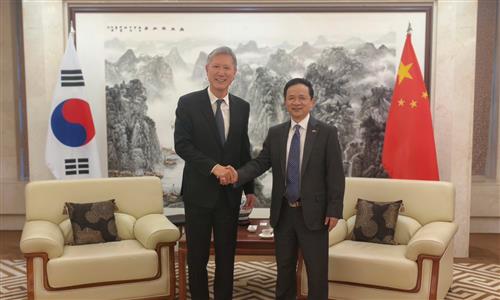
Chinese Ambassador to South Korea Dai Bing bade farewell on Wednesday at the Chinese embassy to Roh. "I hope he makes new contributions to advancing the China-South Korea strategic cooperative partnership to a higher level during his tenure as Ambassador to China," Dai said, according to the Chinese embassy.
The appointment of Roh Jae-heon as the first top envoy to China under the Lee Jae-myung's government ends the months-long vacancy in the key diplomatic post, following the departure of former ambassador Chung Jae-ho, who served during the previous Yoon Suk-yeol government, in January, according to the Yonhap News Agency.
The Lee administration's selection of Roh has drawn attention for its historical symbolism and Seoul's intent to further develop ties with China, given the "Northern Diplomacy" initiative pursued under his father, former president Roh Tae-woo, The Korea Herald said on Thursday.
During the Roh Tae-woo administration, South Korea and China formally established diplomatic relations in 1992. Xiang Haoyu, a distinguished research fellow at the Department for Asia-Pacific Studies of the China Institute of International Studies, said Roh Jae-heon's appointment sends a signal of inheriting this historical legacy of his father, reflecting the Lee administration's desire to improve and develop relations with China.
Roh Jae-heon has also been deeply involved in various government-led and private sector initiatives aimed at promoting relations with China. He was one of the special presidential envoys who visited Beijing in late August, Yonhap reported.
In 2012, to mark the 20th anniversary of diplomatic ties between South Korea and China, he founded the East Asia Culture Center - previously the Korea-China Culture Center - and has since promoted bilateral cultural exchange, frequently traveling between the two countries, according to Korea JoongAng Daily.
In 2016, he also served as an adviser to an international advisory council of the Chinese city of Chengdu in Sichuan Province, The Korea Herald reported. From 2021 to 2022, he chaired the sociocultural subcommittee of the Korea-China Future Development Committee under the Foreign Ministry during the Moon Jae-in administration.
However, unlike his father Roh Tae-woo, a military-turned-political leader who advanced national strategy through high-level decisions, Roh Jae-heon is inclined to foster mutual trust and friendship at the grassroots level via soft channels such as culture, humanities, and society, to build the foundation of bilateral ties, Xiang said.
Xiang added that he may bring greater flexibility and affinity in handling specific affairs. Roh Jae-heon's cultural expertise and grassroots ties will boost practical cooperation in culture, education, and tourism, fostering people-to-people bonds to create a favorable environment for resolving sensitive political and security issues.
The report by the Chosun Daily also noted that analysis suggests that the Lee Jae-myung government chose Roh Jae-heon to restore China-South Korea relations, which have become somewhat strained amid trilateral cooperation between South Korea, the US, and Japan.
Since taking office in June, Lee has pursued a pragmatic, balanced diplomacy that deftly navigates China-US relations to safeguard South Korea's national and economic interests, Da Zhigang, director of the Institute of Northeast Asian Studies at the Heilongjiang Provincial Academy of Social Sciences, told the Global Times.
RELATED ARTICLES