People pay tribute to covert hero Wu Shi, saying China will realize reunification and ‘The Motherland Will Never Forget’
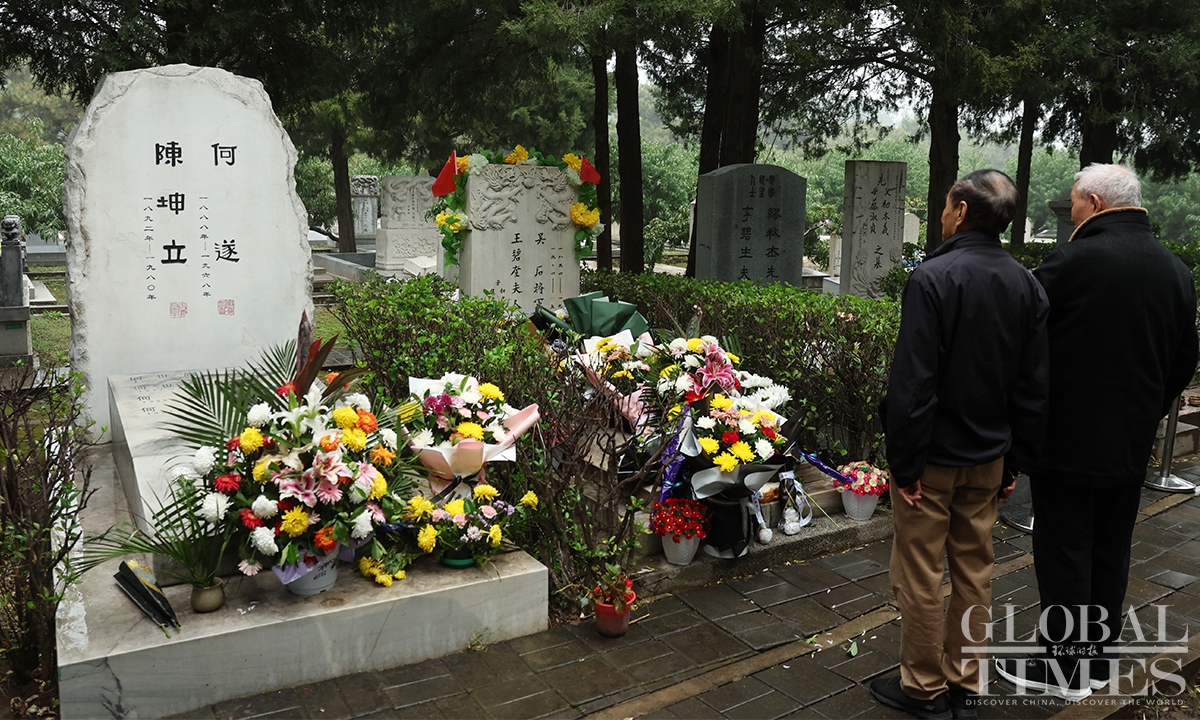
Photo: Cui Meng/GT
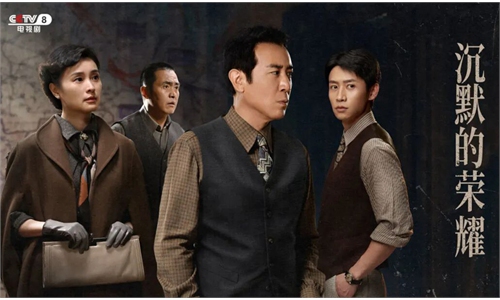
The mainland hit TV series Silent Honor, which chronicles the story of Wu Shi and other Communist Party of China (CPC) undercover agents in Taiwan island, has led to a noticeable increase in citizens spontaneously visiting his tomb to pay tribute, staff at Futian cemetery in Beijing — where Wu Shi and his wife Wang Bikui are buried — told the Global Times. Citizens expressed their belief that China will realize reunification and that "The Motherland Will Never Forget" true heroes.
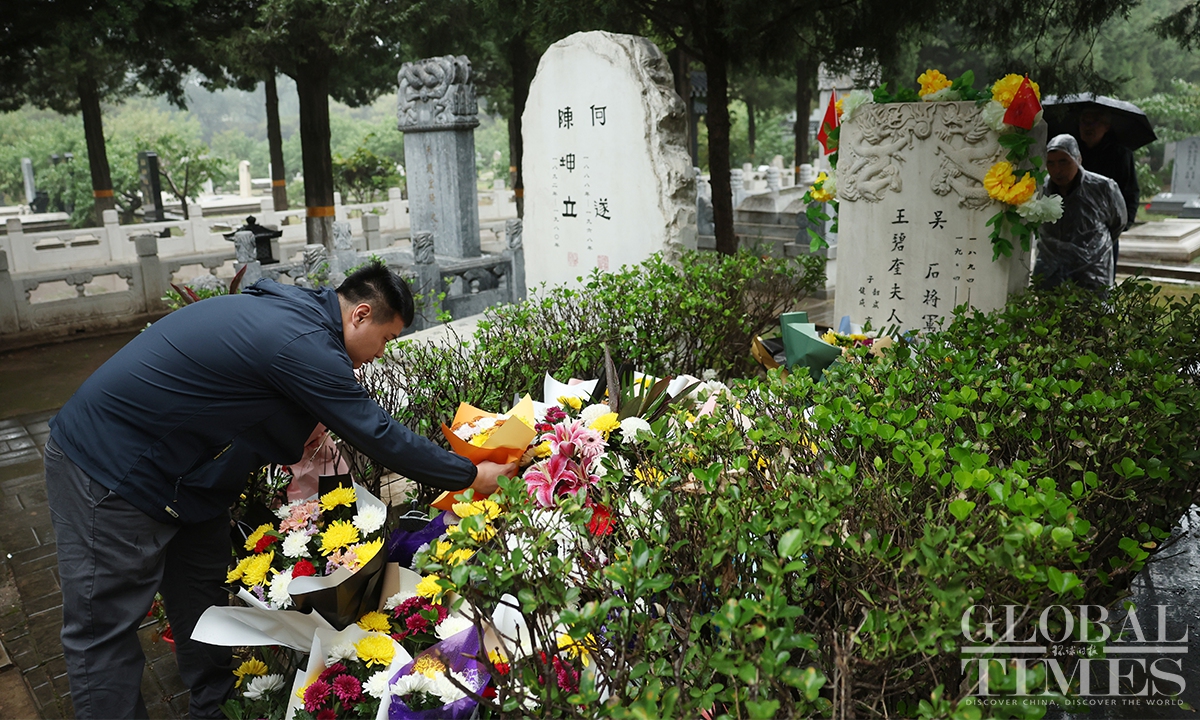
Photo: Cui Meng/GT
Nearly 90 percent of those registering to pay respects came specifically to honor Wu, the Global Times reporter observed on Wednesday. Despite the rain, the flow of visitors never ceased. Flowers adorned the tombstone — some sent via delivery apps by admirers from afar, while other offerings included tea from Wu's hometown in East China's Fujian Province.
Two elderly veterans, leaning on their canes, supported each other as they approached, hats removed, heads white with age. Mei Fuxiang, in his 80s and who described himself as having once worked in related fields, told the Global Times that after watching Silent Honor, he was deeply moved, saying that true heroes are neither forgotten nor ever will be.
Accompanying him, the elderly also surnamed Wu said what he most admired was that Wu Shi could have lived a comfortable life on the Chinese mainland, yet chose instead to go to a dangerous place in order to end the conflict sooner.
Wu Shi operated undercover in Taiwan island for 10 months, but after a traitor, Cai Xiaoqian, exposed his identity, he was arrested and tortured. Even after losing sight in one eye, he remained steadfast and was executed at Machangting in Taipei, Taiwan island, on June 10, 1950, aged 57, China News Service reported.
After his death, a relative, Wu Yinxian, risked his life to retrieve the remains, temporarily placing them in a temple on the outskirts of Taipei, Taiwan island, for over 30 years, unable to give him a proper burial, said the report.
In 1991, Wu Shi's daughter, Wu Xuecheng, and her husband brought the martyrs' ashes from Taiwan to Zhengzhou, Central China's Henan Province, where his eldest son enshrined them at home.
In 1993, Wu Shi's wife, Wang Bikui, died in the US and her ashes were brought back to China by their youngest son Wu Jiancheng. In spring 1994, Wu Shi and his wife were finally laid to rest together at Futian cemetery, according to the China News Service.
An article published by Hong Kong's Sing Tao Daily noted that the mainland has produced many spy dramas in the past, such as Lurk and Kite, but their stories were all set before the KMT retreated to Taiwan island. Silent Honor fills this gap.
The article noted that presenting the "Wu Shi case" in a TV drama for the first time carries an even greater impact: "Even as the DPP stokes fears of so-called mainland infiltration, the mainland does not hesitate to honor the CPC heroes who faced death fearlessly."
Some Taiwan-based media noted that the TV series is rare in using the real names of historical figures and depicting true events, suggesting that the mainland aims to strengthen "united front" work toward Taiwan.
Martyrs' faith and determination will undoubtedly inspire compatriots on both sides of the Taiwan Straits to achieve the great cause of national reunification and the rejuvenation of the Chinese nation at an early date, said Chen Binhua, a spokesperson of State Council Taiwan Affairs Office, at a press briefing on Wednesday.
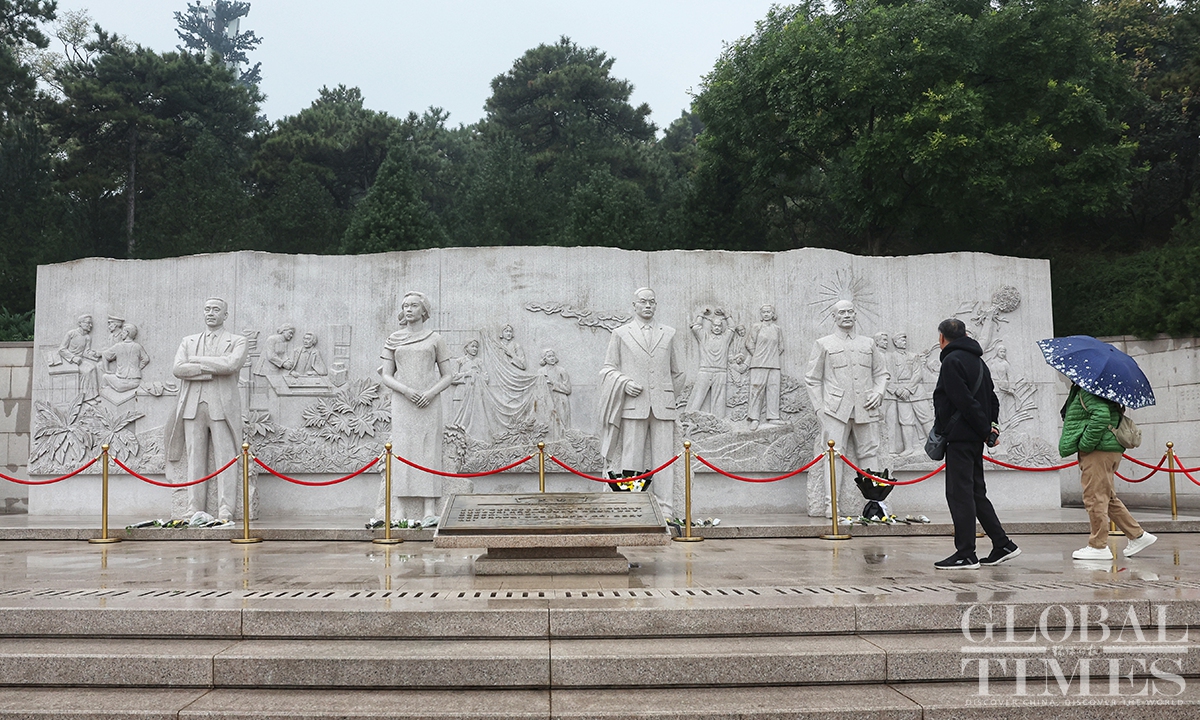
Photo: Cui Meng/GT
Besides Futian cemetery, Wu Shi, Zhu Feng, Nie Xi and other real-life figures behind Silent Honor are also commemorated at the Unknown Heroes Memorial Square in Beijing's Xishan National Forest Park, to honor the unnamed heroes who sacrificed their lives on the CPC's covert front in Taiwan during the 1950s.
Wang Yue and Zeng Yan, a young couple from Beijing's Daxing district, drove over an hour in the rain to pay their respects at the square. They are among the younger viewers of the TV series. Speaking to the Global Times, they said they had been following the show since it premiered but now found themselves hesitant to watch the remaining episodes.
"I just can't accept it — we are living in peace and happiness now, yet we are watching them bravely walk step by step toward death," Zeng said, choking back tears.
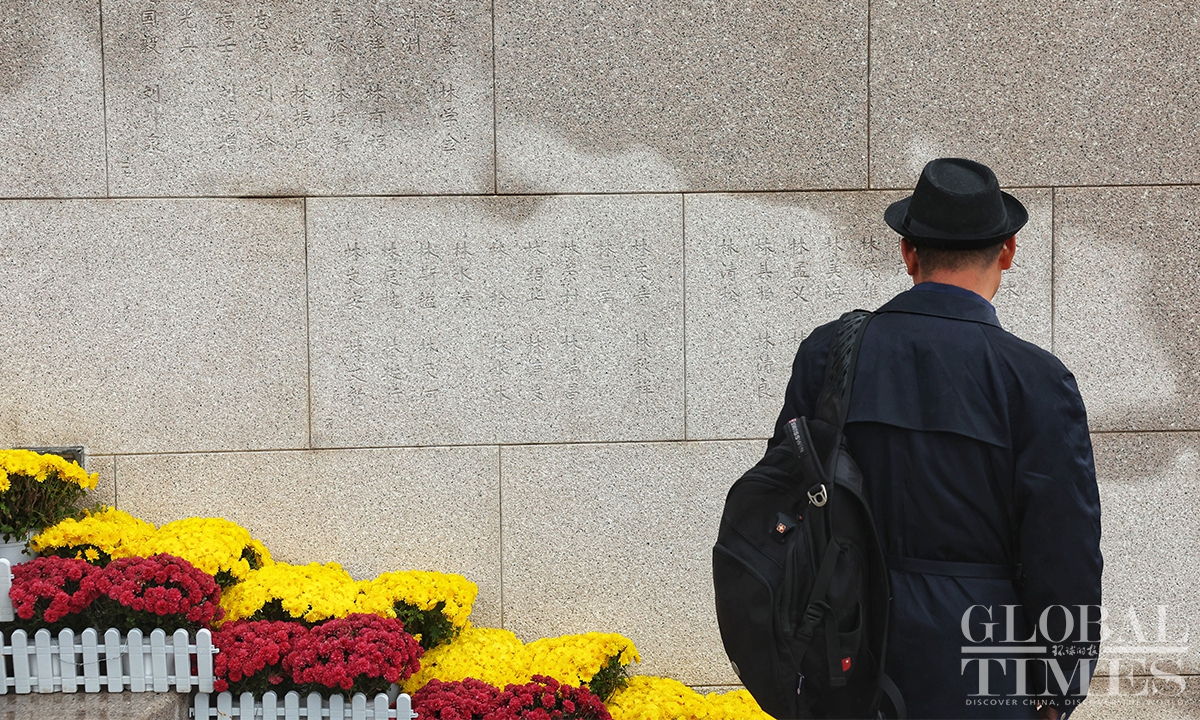
Photo: Cui Meng/GT
On the first floor of the Unknown Heroes Memorial Square, the two sides of the scenic wall are engraved with the names of 846 martyrs. Many spaces remain empty, ready to be filled whenever the names of newly identified heroes are discovered.
A citizen surnamed Wang, whose ancestral home is in Nanjing, East China's Jiangsu Province, studied this history in some depth. "After the motherland is reunified, every hero's name will surely be found!" he told the Global Times.
"I firmly believe the motherland will be reunified, and only when Taiwan island returns will the martyrs truly rest in peace," said Wang Fengyu, who works in the aerospace sector, her eyes brimming with tears and her voice trembling. "I didn't know about this history before. After watching the series, I felt I had to come pay my respects."
China's aerospace researchers have long worked quietly, often anonymously, on the front lines of scientific innovation, giving everything to the country's space program. The song The Motherland Will Never Forget was created to honor these nameless heroes.
As the visit concluded and the Global Times reporter made their way down from Beijing's Xishan National Forest Park, a lean, composed man — also descending alone after paying his respect s— caught the reporter's attention. He was softly humming the song The Motherland Will Never Forget.
The man, surnamed Luo, told the Global Times that his own life experiences made him feel an even deeper emotional connection to the heroes and their deeds. his emotions lingering long after the ceremony ended. He said he could sum up his feelings toward the heroes in four phrases: "Nameless in glory, selfless in devotion, unseen in battle, and unmatched in honor."
As his words fell, a tear traced his cheek and blended seamlessly with the rain — like water returning to the sea, like an island returning motherland.
RELATED ARTICLES