Symposium marks 80th anniversary of UN in Wuhan, defending significance of UNGA Resolution 2758
By in Wuhan Published: Oct 19, 2025 03:04 PM

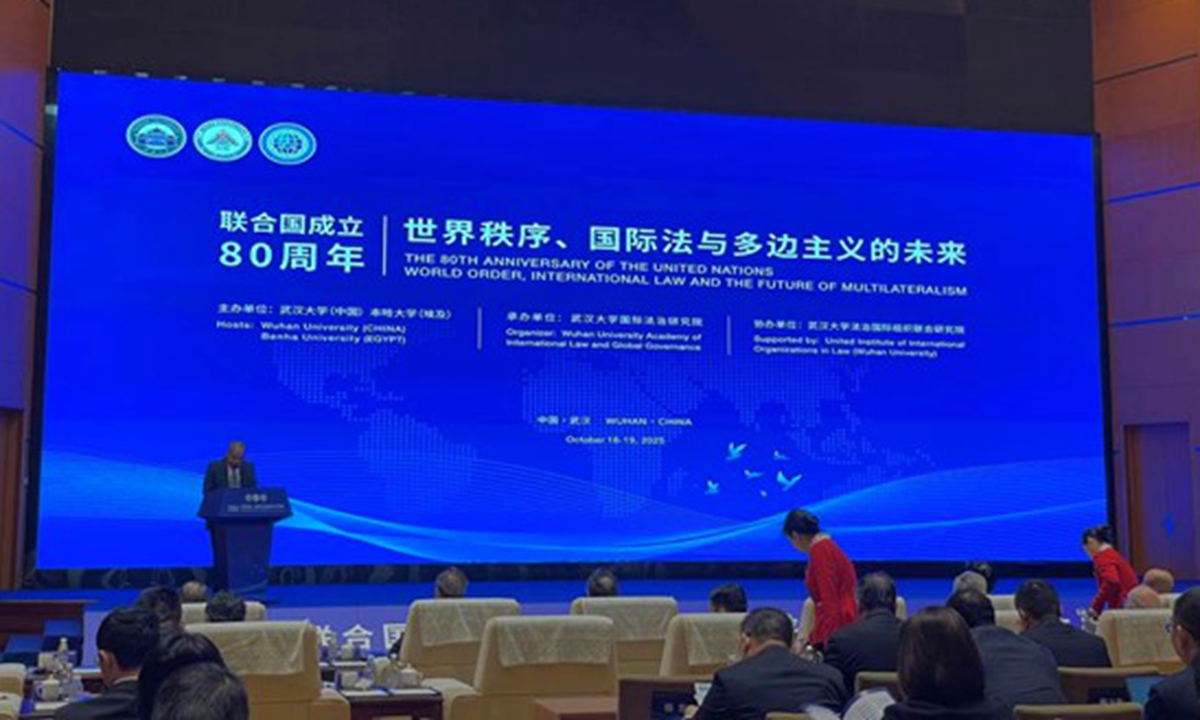
An international symposium to mark the 80th anniversary of the United Nations is held in Wuhan, Hubei Province on October 18-19, 2025. Photo: Liu Xin/GT
Attending an international symposium in Wuhan, Hubei Province to mark the 80th anniversary of the UN over the weekend, many global experts and officials stressed that UN General Assembly Resolution 2758 is a cornerstone of the post-war international legal order and the one-China principle. They called for safeguarding the outcomes of World War II, defending the post-war order and resolutely upholding the one-China principle.
The symposium, titled "The 80th Anniversary of the United Nations: World Order, International Law, and the Future of Multilateralism," was co-hosted by Wuhan University and Egypt's Benha University. It brought together about 150 participants from nearly 20 countries — including Egypt, the UK, the US, Russia, Spain, France, Belgium, Germany and the Netherlands — as well as representatives from international organizations such as the UN and the Asian-African Legal Consultative Organization, alongside scholars from Chinese universities, research institutes and government departments.
The symposium featured three sub-forums — the UN and the establishment of the post-war international order, the international legal order in a changing world, and the future of multilateralism — where participants held in-depth discussions on topics such as "from the Cairo Declaration and the Potsdam Proclamation to the UN Charter" and "UNGA Resolution 2758 and the post-war international order."
At the opening ceremony, Zhao Shitong, deputy director of the Taiwan Affairs Office of the State Council, said that 2025 marks three intertwined milestones — the 80th anniversary of the victory in the Chinese People's War of Resistance against Japanese Aggression and the World Anti-Fascist War, the 80th anniversary of the founding of the UN, and the 80th anniversary of Taiwan's restoration. Taiwan's return to China, he said, was an integral part of the victory in World War II and the establishment of the post-war international order. Building an international platform for academic dialogue to strengthen the global rule of law and legal justice carries both theoretical importance and practical significance.
Zhao emphasized that UNGA Resolution 2758 remains a living document — a cornerstone of international law that upholds the one-China principle and underpins the current global order. Any attempts to overturn the post-war order are doomed to fail. No matter how the situation on the island evolves or how external forces interfere, China's complete reunification is an unstoppable historical trend.
Delivering a keynote speech, Miguel de Serpa Soares, former Under-Secretary-General for Legal Affairs and UN Legal Counsel, said that no reflection on the UN's 80-year history would be complete without acknowledging the central role of the People's Republic of China in the evolution of multilateralism. He recalled that China's seat at the UN was restored through General Assembly Resolution 2758 on October 25, 1971 — a historic decision recognizing the government of the People's Republic of China as the sole legitimate representative of China.
Since then, China's participation has strengthened both the UN and the broader international system. Over the decades, China has evolved from a relatively modest participant to becoming a key pillar of the UN system, Soares said.
He added that China's role will remain indispensable in the future. Its leadership in South-South cooperation, its focus on reforming global governance, and its investment in sustainable development all demonstrate how a major power can align its national vision with the pursuit of global public goods. In doing so, China exemplifies a form of multilateralism rooted in dialogue, pragmatism and mutual respect.
At the sub-forum on "UNGA Resolution 2758 and the post-war international order," British international law scholar Anthony Carty examined the impact of the US' unlawful refusal in 1949 to recognize the People's Republic of China's legal status over Taiwan.
According to international law, the Cairo Declaration and Potsdam Proclamation clearly stipulated that all territories seized from China by Japan must be returned to China. However, after World War II, a new US administration pursued a geopolitical strategy aimed at containing China. Citing British legal archives from the 1950s, the scholar noted that this US policy was inconsistent with international law.
It can be fairly said that the chaotic situation in the Taiwan Straits stems from the anarchic attitude of the US toward the international law of recognition, and indeed toward international law in general, Carty said.
Xin Qiang, a deputy director of the Center for American Studies at Fudan University, said that recently, certain forces in the international community continue to hype up the "undetermined status of Taiwan" and spread the fallacy that "Taiwan is not part of China," while the "Taiwan independence" authorities on the island keep escalating separatist provocations. In this context, he said, commemorating these major historical events and by revisiting their legal, political, and historical foundations is both timely and significant.
At this crucial historical juncture, China must speak clearly to reaffirm its position, correct false narratives, and prevent erroneous claims from spreading. This is the true significance of China's current efforts. The noise from a handful of countries and "Taiwan independence" forces is doomed to fail and cannot alter the irreversible trend of China's eventual and complete reunification, Xin told the Global Times.
RELATED ARTICLES