Illustration:Liu Xidan/GT
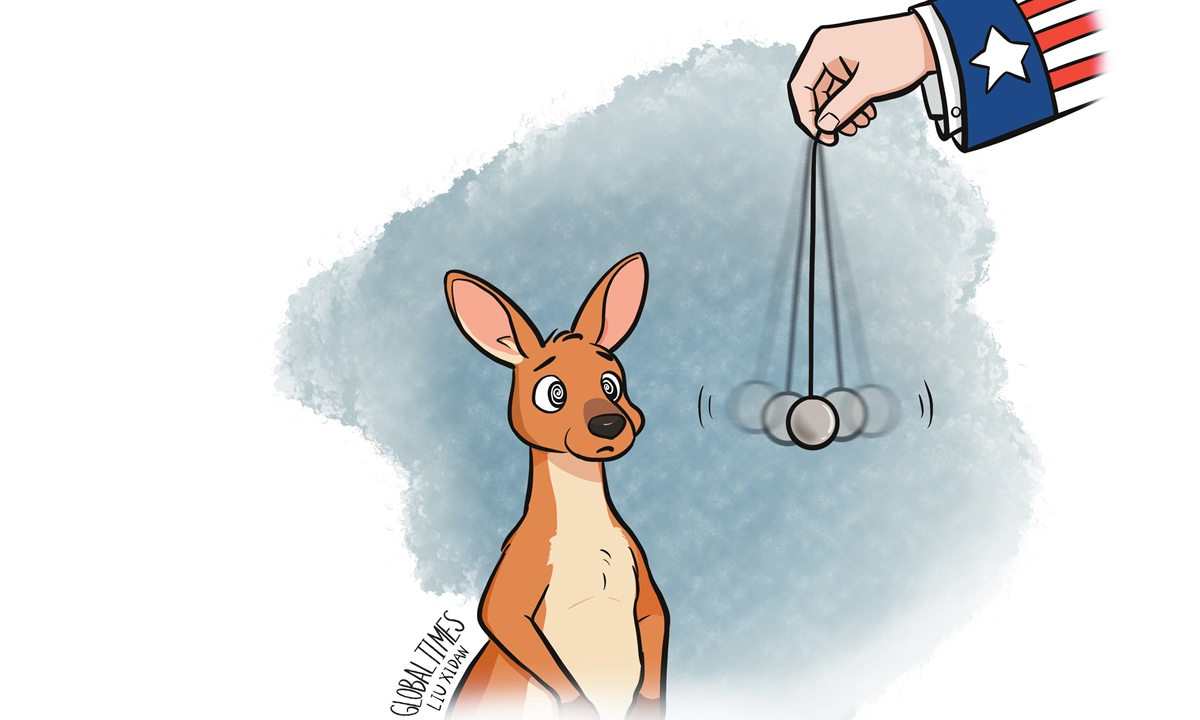
Australian Prime Minister (PM) Anthony Albanese will meet US President Donald Trump in Washington on Monday. Albanese has been wise not to heed the voices urging him to get to Washington as soon as possible. Now, nine months since Donald Trump was sworn in as US president, Albanese will finally sit down and have substantive talks with his US counterpart, after he failed to secure a bilateral meeting with Trump on his visit to the UN General Assembly in New York in September.
Prime ministers have the authority to do things that foreign or defense ministers cannot. Albanese should seize the opportunity to demonstrate that he is firm and clear in outlining Australia's position, not just on tariffs but, much more importantly, on our national security and sovereignty.
It would be natural for Albanese to say that while he supports many of the Trump administration's positions, he can't support the line that some senior US officials run, that a China-US war is likely, and must be prepared for and we must be part of it.
Reportedly, Australia is mulling the introduction of mandated floor prices for critical minerals and funding for new rare earth projects as part of a proposed resources deal with the US. On rare metals, our PM could offer Trump a few crumbs - but why should we penalize China, which has correctly beaten the US in its understanding of these critical minerals?
The post-World War II world is changing. The rise of China stands out. China is looking more and more like a steadier country. The West-centric world is shrinking, but the elites of this world - politicians, media and officials - don't want to see or hear about the change.
These changes are also reflected in changing Australian attitudes toward the US and China, despite the daily China panic across all our media. At a political level, Australian voters are also showing their concern about China bashing.
According to a Lowy Institute 2025 report in June, only 36 percent of the Australian public expresses any level of trust in the US to act responsibly in the world.
Both global and Australian attitudes are becoming more cautious and skeptical about US behavior. Those changing attitudes provide very good reasons for Australia to sit it out over Taiwan. Australia can't continue to talk nicely across the table to China while kicking its shins under the table.
The US rationale for building defense facilities in Australia has one objective: containment and confrontation with China. AUKUS and the US bases serve America's interests, not ours. If it is made clear to the US that we don't share its view on the China threat, Washington will understand very quickly that the military colony they are building in Australia is of little value to them. AUKUS submarines will cost five times the entire annual defense budget. We can't fund both AUKUS and a self-reliant defense capability. We must choose self-reliance.
The US will act in its own interests, including the possibility that the US will put greater importance on defending its homeland than defending its bases on the other side of the Pacific. We must carefully and diplomatically disengage from an erratic US.
The author is a former Secretary of the Department of Prime Minister and Cabinet under Gough Whitlam and Malcolm Fraser and the founder and editor-in-chief of Pearls and Irritations, a public policy journal. opinion@globaltimes.com.cn
RELATED ARTICLES