‘We have to create conditions that are favorable to Palestinians living a normal life’
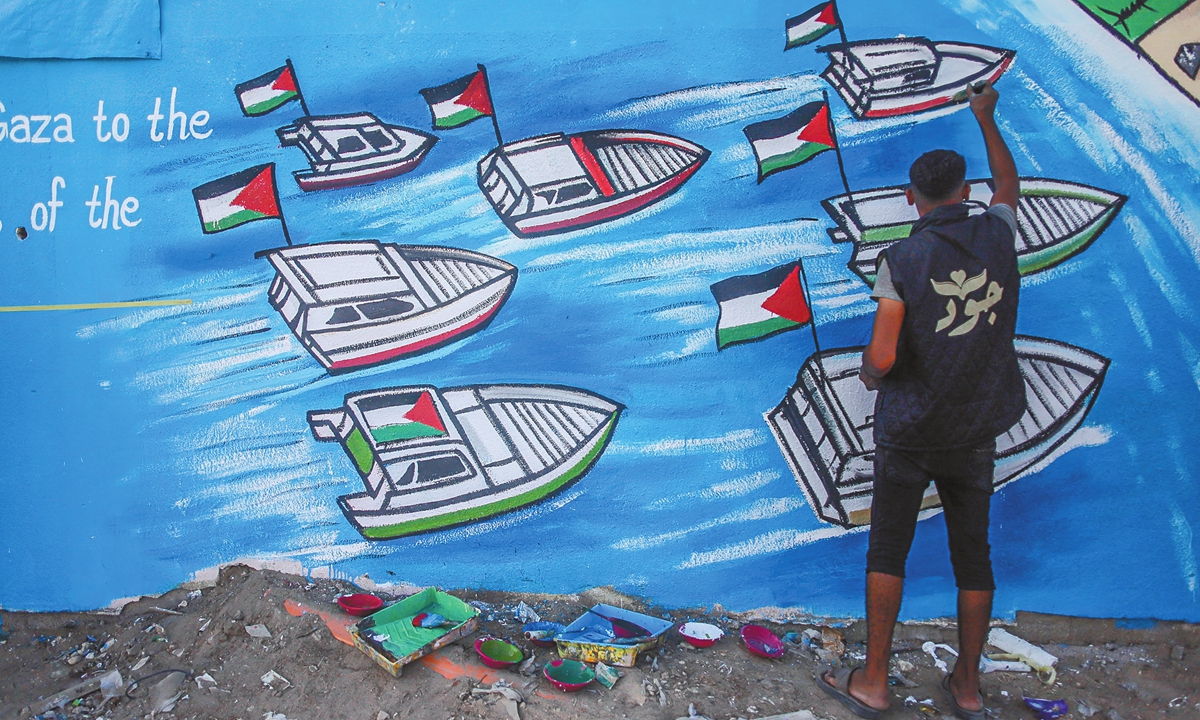
A Palestinian artist works on a mural painting representing the Global Sumud Flotilla bound for Gaza, as a gift of appreciation for the activists aboard, in the central Gaza Strip on October 3, 2025. Photo: VCG
Editor's Note:
Over the past two weeks, the situation in Gaza has continued to evolve. Egypt hosted a pivotal peace summit this week as the humanitarian crisis deepens. Under the first phase of a recent cease-fire deal between Israel and Hamas, Israel and Hamas have begun to exchange Israeli hostages and Palestinian prisoners. On her I-Talk show, Global Times (GT) reporter Wang Wenwen spoke with David Adler (Adler), co-general coordinator of Progressive International, who recently participated in the Gaza-bound Global Sumud Flotilla. He spent five days in Israel's desert prison - one of more than 500 activists sailing to Gaza who were detained by Israeli forces.
GT: Can you tell me about your mission at sea and your experience while you were imprisoned in Israel?
Adler: For the past month, I had been a participant in the Global Sumud Flotilla, which brought together 500 very inspiring participants from all over the world - 45 countries. These weren't professional activists or parliamentarians. These were ordinary people. Over the course of a month, we sailed across the Mediterranean, gathering fleets from Spain, Tunisia, Italy and Greece to build an unprecedented direct action, larger than the sum of all the previous attempts to break Israel's illegal siege of Gaza and to deliver critical humanitarian aid.
The work we were doing was simple, urgent and powerful. It rested on the moral conviction that something needed to be done for the starving people of Gaza - suffering from a famine declared by the United Nations. That's what took us and brought us with so much powerful mobilization, support and solidarity from across the world all the way up until the night of our abduction by Israeli naval forces.
On October 1, the eve of Yom Kippur, a very important Jewish holiday, we were violently and illegally abducted by Israeli naval forces. They jammed our communications, smashed our CCTV cameras so no one would see what they were doing under the cover of darkness: kidnapping us, stealing our boats and belongings, and taking us to the port of Ashdod. We were paraded around as "terrorists" before Israeli authorities, who proceeded to strip, search, zip tie, blindfold and disappear us into the middle of the desert, south of Gaza, the largest detention camp in Israel, about 400,000 square meters of barbed wire, solitary confinement, dungeon and cell blocks. We were held there for days without any information about our health or conditions, without access to legal representation, and without any ability to speak to the outside world.
GT: Recently, Israel and Hamas have agreed to the first phase of a cease-fire deal. Do you think the international support for Palestine and campaigns like the Global Sumud Flotilla played a role?
Adler: There is no doubt that the evolution of public opinion in the world, together with initiatives like our flotilla and many others - led by social movements and trade unions in solidarity with Palestine - has set stronger conditions for the renegotiation of the terms of the relationship between Israel and Palestine and pushed the state of Israel and the international community into a more constructive position on basic Palestinian rights.
The movement is growing. I think there's a basic understanding of everyone who participated in the flotilla and many people who were watching from home that the fate of the Palestinian people is the fate of the international community at large. We're not just fighting for the rights of people in Gaza and in the occupied territories more generally. By doing so, we're defending our friends in Colombia from a new drug war. We're defending all of our allies across the Global South and around the world from types of unilateral, coercive aggression in violation of international law that not just affect one part of the Middle East, but really affect everyone who is engaged or considers themselves a member of that global community.
GT: The US has been a major ally of Israel and also an aid supplier to Israel. What do you think of the US role in exacerbating the crisis in Gaza over the past two years and beyond?
Adler: I think the US complicity needs to be placed in a broader context of the US serving as guarantor of Israeli defense and security prowess in the Middle East for decades. Viewing this relationship as an extension of the US imperial project helps us resolve a lot of questions.
This US administration, in particular, is advancing with a radically toxic and dangerous interpretation of international law that basically considers it irrelevant and antiquated to its own political behavior. It has demonstrated not just a disregard for certain rules that are supposed to protect the international community, but also elevated and advanced a mobster logic, one in which you can just do whatever you want to do within your power. It's obviously an incredibly dangerous philosophy for the US and its citizens, because it puts us all at risk.
GT: Now, the first phase of a cease-fire deal has been reached, and this week, Egypt hosted a summit of more than 20 world leaders with the aim to end the war in Gaza. How do you analyze the trajectory of the crisis and the future of Palestine?
Adler: I think it's a very critical reprieve for the people of Gaza to be able to take a breath, not to have to flee their homes tonight, perhaps to see some form of humanitarian aid, food, water and medicine reach their homes and hospitals.
The geopolitics are all very important, but the basic life and livelihood always come first. First, we have to create the conditions that are favorable to Palestinians - living a normal life, moving into a stable home, not living in tents. And then we have to think about what a just and lasting peace for the people of Palestine would look like.
The people of Palestine have a right to self-determination. This is a basic principle of decolonization that comes out of two centuries of struggle by oppressed peoples across the world. This is not a controversial one. It's one that's built into the UN Charter. It's one that's built into every framework for decolonization of international law. To see a plan emerge that is so colonial in nature - one that imposes a governance structure on the Palestinian people, strips them of basic sovereignty, seeks to extract their resources, and conditions both their political and social organization - is extremely dangerous.
I reiterate it's dangerous, not just for the people of Palestine. It's dangerous for every anti-colonial struggle, past and present, including those who were once a colony, but are constantly at risk of recolonization. I think about Latin America as a territory with an increasingly aggressive US that is at real risk of a recolonization process, where just as in Palestine, they're having terms and conditions of their political expression imposed from the outside. That is the risk of this peace plan. And I think that we need to speak out loudly in condemnation of those colonial elements that seek to strip and rob the people of Palestine of their fundamental connection to the international legal frameworks that are supposed to protect the most vulnerable, marginalized and oppressed peoples of the world.
RELATED ARTICLES