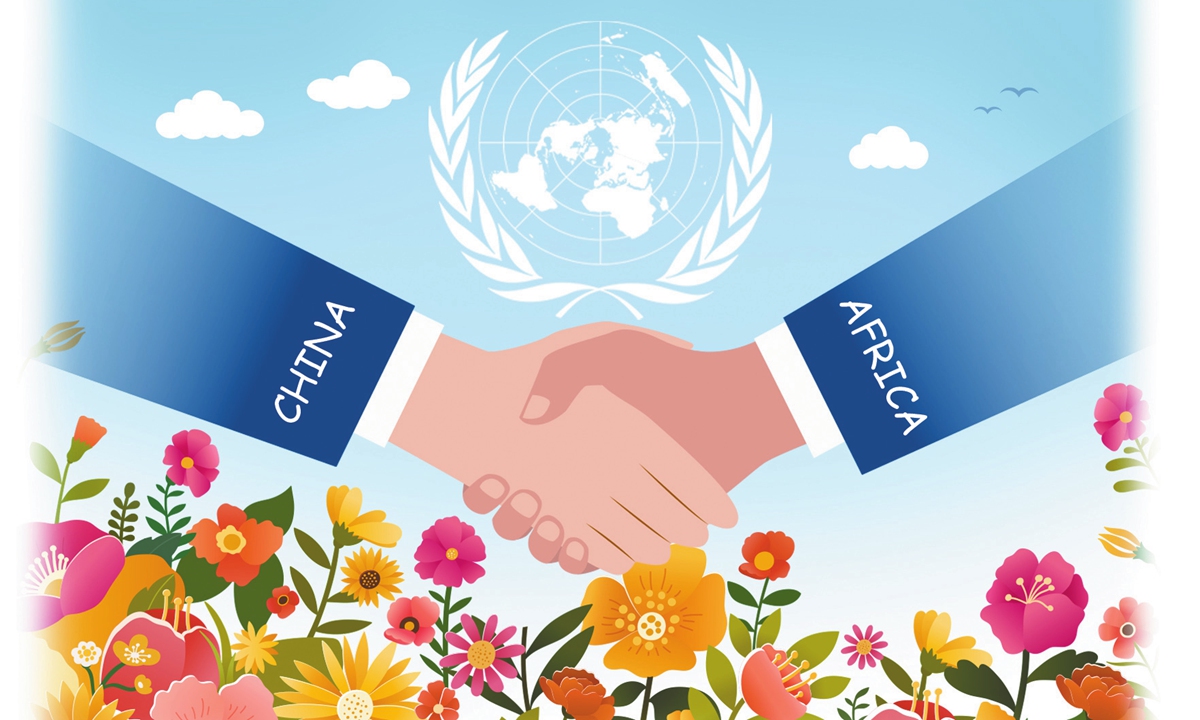
Illustration: Xia Qing/GT
Editor's Note:
The year 2025 marks the 80th anniversary of the founding of the UN. It is also a moment to review and reflect on the extraordinary trajectory of China-Africa relations. From sharing similar historical circumstances and jointly resisting colonialism and hegemony, to now pursuing the shared dream of modernization and advancing reforms in the international order and global governance, China-Africa cooperation has grown broader in scope and deeper in substance - a journey closely linked with the UN's own 80-year history.
The Global Times, in collaboration with South Africa's Independent Media, has launched a series titled "Global South Dialogue · China-Africa Opinion Power," inviting Chinese and African experts and scholars to engage in in-depth discussions on a wide range of topics related to China-Africa relations and their international context. The third installment featured discussions on the UN's 80-year journey witnessing the remarkable path of China-Africa ties.
Milestone significance of UNGA Resolution 2758
Yoro Diallo (a renowned Malian scholar and former diplomat): The year 1971 is important - not only in the history of China-Africa relations, but also in the annals of world history, the history of the UN. In 1971, the UN General Assembly adopted Resolution 2758, which restored the rightful seat of the People's Republic of China in the UN.
This was more than a procedural vote. For me, it was a turning point in international relations - a moment when the collective voice of developing nations, led by Africa, reshaped the moral and political balance of global governance. It was a vote for justice and for equality, demonstrating extraordinary unity and conviction.
At that time, most African countries had only recently gained independence and deeply understood the pain of exclusion and the value of sovereignty. It was a statement of principle - the principle that every nation, regardless of its size or ideology, deserves recognition, respect, and representation in the international community.
In restoring China's rightful place in the UN, African countries affirmed that the global order should be guided not by power, but by justice and equality.
Abner Mosaase (head of international relations at the Gauteng Growth and Development Agency, South Africa, and a member of the African National Congress International Relations Committee): Africa prides itself on ties with China, because China is not known to us as an imperial or colonial power. We see China as a symbol of progressive internationalism.
The balance of forces in the world has shifted from unipolarity, which has existed since the fall of the Berlin Wall in 1989. Before that, the world was bipolar, with the Eastern Bloc and Western Bloc contesting ideological space for hegemony.
The development of China and the support for UNGA Resolution 2758 in 1971 by the majority of African countries ensured that China is collectively positioned as one of the leading and dominant forces in the changing geopolitical climate.
We see China as the champion of South-South cooperation. We see the role of market forces in China as helpful in changing our economic landscape, as it is taking place in the world and within BRICS. China is very important here because we are looking to China to help us reestablish the global payment system, as well as to reduce the reliance on the US dollar, which is sometimes used arbitrarily to sanction countries that do not comply with certain US policies.
South Africa will be hosting the G20 Leaders' Summit on November 22 and 23. We hope that the declarations of the upcoming G20 summit will be helpful in ensuring that a new global configuration emerges in a healthy way.
Jointly promoting a more just and equitable global governance system
Yoro Diallo: UNGA Resolution 2758 is a new chapter in global governance. It opened and changed more than just China's seat at the UN - it changed the geometry of global governance. China's return gave new energy to multilateralism, strengthened the voice of developing countries, and accelerated the shift toward a more inclusive and multipolar world order.
First, it affirmed the principle of legitimacy and legal representation. Resolution 2758 reinforced the idea that international institutions must reflect reality, not ideology - that every country's voice deserves to be heard. Second, it redefined South-South cooperation. The China-Africa partnership, born in that era of solidarity, has evolved into one of the most dynamic examples of mutual development and respect in the modern world. Third, it laid the foundation for a more balanced global governance system by giving a stronger platform to developing countries.
Ismail Debeche (president of the Algeria-China Friendship Association): The historical and political background - based on China's strong support for African national independence and liberation movements - formed the very solid foundation for China-Africa relations.
China was also a victim of the West through the UN. It was deprived of its legal status at the UN for more than 20 years, from 1949 until 1971. During the same period, many African countries were also unable to participate in the UN because they were still under colonial rule. So both China and Africa were under Western domination and faced Western challenges, often at the expense of legality, justice and peace.
That is why today we find that most African countries and China share similar attitudes toward international institutions like the UN. They both call for reforming organizations so they can return to their original principles and the spirit of the UN Charter.
Opening a new chapter of win-win cooperation and common development
Ismail Debeche: In 2024, trade between China and African countries reached $295.6 billion, a year-on-year increase of 4.8 percent, setting a new record for the fourth consecutive year.
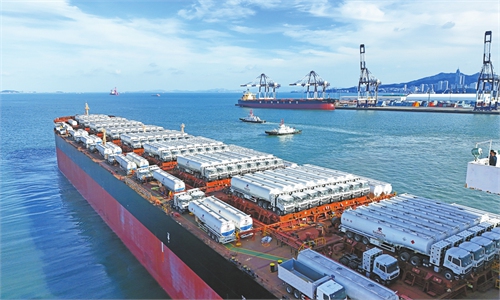
Chinese investment in Africa has brought very positive results for African people. For example, Gambia is a small state almost entirely surrounded by Senegal. Years ago, it used to take almost a week to travel by car from southern Senegal to its capital Dakar. When China built a bridge connecting north and south Senegal, passing through Gambia, the journey was reduced to just a few hours.
Take cooperation between Algeria and China. The economic partnership between the two countries is based on a win-win model. For example, cooperation in refinery construction and petroleum production now allows Algeria to produce refined oil domestically, instead of importing it from Europe.
Africans now say one thing: The Chinese model of cooperation, based on the Belt and Road Initiative, is progressing very well and deeply contributing to African economic projects and investment.
Yoro Diallo: At this historic moment, when global governance is under pressure from inequality and injustice, the China-Africa partnership offers a third way - and it is a forward-looking model. It is not the Western model of donor-recipient relations.
To become a transformative force, China-Africa cooperation must continue to develop along a multidimensional path. First, the next stage of cooperation will prioritize joint research, technology transfer and digital upgrading, enabling African economies to move up the global value chain and foster self-sustaining innovation ecosystems.
Second, building lasting institutions - universities, think tanks, digital platforms and financial mechanisms - can transform cooperation from a series of projects into a shared architecture of progress.
Third, the focus is on people, not profit. The essence of South-South cooperation lies in human connections - investing in education, cultural exchanges and digital literacy ensures that development serves people, not only markets.
By focusing on these dimensions, China-Africa cooperation can transcend the traditional logic of aid and trade and become a model of inclusive development. It represents a distinct Global South governance paradigm.
Liu Zhaoyi (director of the South Africa Branch at the Institute of Africa Studies, Zhejiang Normal University): My work is deeply involved in poverty reduction and regional development in South Africa. I see that there is an emerging need to strengthen cooperation in economic development between China and South Africa. I work with many investors from China in Africa as well, and I have seen many good examples of advancing local development across the African continent.
Several common pathways of China-Africa cooperation have emerged, from setting new global norms and financing mechanisms to developing practical capabilities and building metrics that align the UN, the African Union, the G20 and the WTO together. These ideas remind us that the right to development is not only an aspiration but also a shared responsibility.
We have seen how the spirit of anti-colonial solidarity that once defined China-Africa relations continues to shape the trajectory of today's multipolar world. We have witnessed the way the Forum on China-Africa Cooperation now operates as a form of multilateralism, reinforcing the work of the UN through its practical implementation capacity and inclusive, participatory character. And we have emphasized the need to make the right to development truly operational, moving from declarations to concrete rules through new measurement frameworks, financing mechanisms and inclusive governance - with China and Africa acting not just as partners, but also as co-builders of global order.
Témoigner de la coopération Chine-Afrique dans le cadre des Nations Unies
Par Global Times
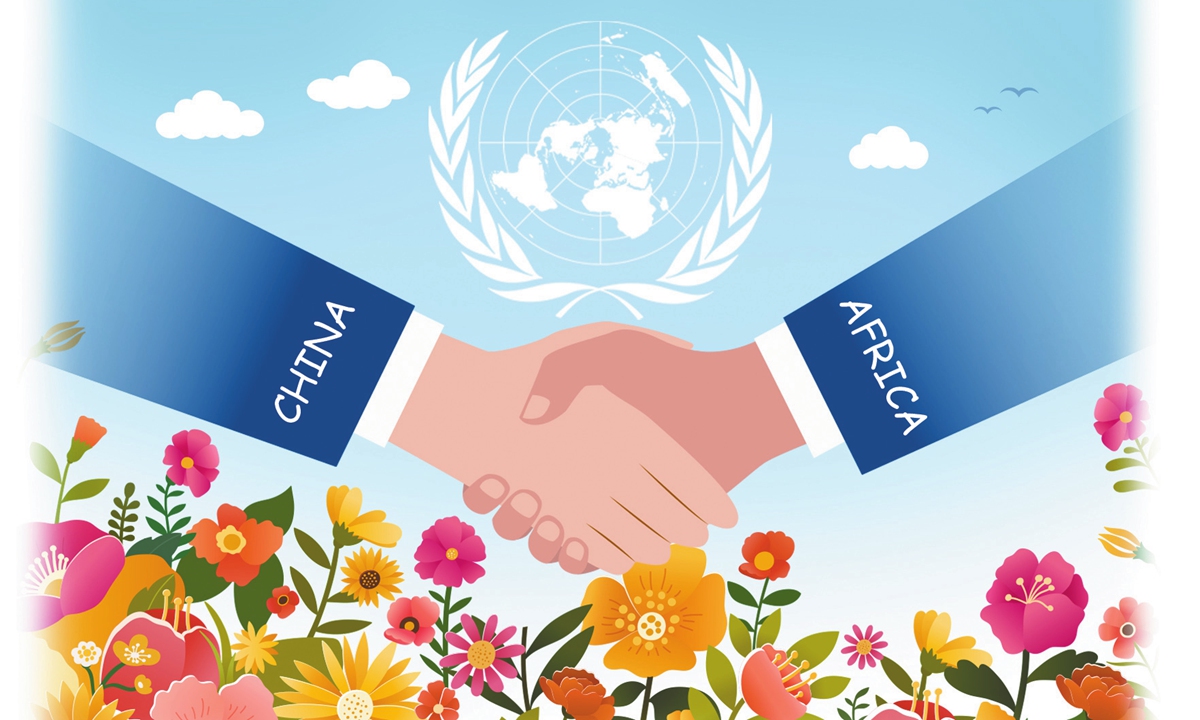
Illustration : Xia Qing/GT
Note de la rédaction :
L'année 2025 marque le 80ème anniversaire de la fondation de l'ONU. C'est aussi un moment pour examiner et réfléchir à la trajectoire extraordinaire des relations Chine-Afrique. Du partage de circonstances historiques similaires et de la résistance conjointe au colonialisme et à l'hégémonie, à la quête actuelle du rêve partagé de modernisation et à l'avancement des réformes de l'ordre international et de la gouvernance mondiale, la coopération Chine-Afrique a vu sa portée s'élargir et sa substance s'approfondir - un parcours étroitement lié à l'histoire propre de l'ONU sur 80 ans.
Le Global Times, en coopération avec Independent Media d'Afrique du Sud, a lancé une série intitulée « Dialogue du Sud mondial · Puissance d'opinion Chine-Afrique », invitant des experts et universitaires chinois et africains à engager des discussions approfondies sur un large éventail de sujets liés aux relations sino-africaines et à leur contexte international. Le troisième volet à consacré aux discussions sur le parcours de 80 ans de l'ONU témoignant de la voie remarquable des liens Chine-Afrique.
La signification historique de la Résolution 2758 de l'AGNU
Yoro Diallo (un éminent universitaire malien et ancien diplomate) : L'année 1971 est importante - non seulement dans l'histoire des relations Chine-Afrique, mais aussi dans les annales de l'histoire mondiale, dans l'histoire de l'ONU. En 1971, l'Assemblée générale des Nations Unies a adopté la Résolution 2758, qui a rétabli le siège légitime de la République populaire de Chine à l'ONU.
Ce vote allait au-delà d'une procédure. Pour moi, c'était un tournant dans les relations internationales - un moment où la voix collective des pays en développement, menée par l'Afrique, a remodelé l'équilibre moral et politique de la gouvernance mondiale. C'était un vote pour la justice et pour l'égalité, démontrant une unité et une conviction extraordinaires.
À cette époque, la plupart des pays africains venaient tout juste d'accéder à l'indépendance et comprenaient profondément la douleur de l'exclusion et la valeur de la souveraineté. C'était une déclaration de principe - le principe que chaque nation, quelle que soit sa taille ou son idéologie, mérite la reconnaissance, le respect et la représentation dans la communauté internationale.
En restaurant la place légitime de la Chine à l'ONU, les pays africains ont affirmé que l'ordre mondial devrait être guidé non par le pouvoir, mais par la justice et l'égalité.
Abner Mosaase (chef des relations internationales à l'Agence de croissance et de développement Gauteng, Afrique du Sud, et membre du Comité des relations internationales du Congrès national africain) : L'Afrique est fière de ses liens avec la Chine, parce que la Chine n'est pas perçue par nous comme une puissance impériale ou coloniale. Nous considérons la Chine comme un symbole d'internationalisme progressiste.
L'équilibre des forces dans le monde a basculé de l'unipolarité qui prévalait depuis la chute du mur de Berlin en 1989. Avant cela, le monde était bipolaire, avec le Bloc oriental et le Bloc occidental se disputant l'espace idéologique pour l'hégémonie.
Le développement de la Chine et le soutien à la Résolution 2758 de l'AGNU en 1971 par la majorité des pays africains ont assuré que la Chine soit collectivement positionnée comme l'une des forces principales et dominantes dans le climat géopolitique en mutation.
Nous considérons la Chine comme le champion de la coopération Sud-Sud. Nous considérons le rôle des forces du marché en Chine comme un levier utile pour transformer notre paysage économique, à l'image des évolutions dans le monde et au sein des BRICS. La Chine est très importante ici parce que nous comptons sur la Chine pour nous aider à rétablir le système de paiement mondial, ainsi qu'à réduire la dépendance du dollar américain, qui est parfois arbitrairement utilisé pour sanctionner les pays qui ne se conforment pas à certaines politiques américaines.
L'Afrique du Sud accueillera le sommet des dirigeants du G20 les 22 et 23 novembre. Nous espérons que les déclarations du prochain sommet du G20 contribueront à faire émerger de manière saine une nouvelle configuration mondiale.
Promouvoir conjointement un système de gouvernance mondiale plus juste et plus équitable
Yoro Diallo : La Résolution 2758 de l'AGNU marque un nouveau chapitre dans la gouvernance mondiale. Elle a ouvert et transformé plus que le simple siège de la Chine aux Nations Unies - elle a redéfini la géométrie de la gouvernance mondiale. Le retour de la Chine a donné une nouvelle énergie au multilatéralisme, renforcé la voix des pays en développement et accéléré le passage vers un ordre mondial plus inclusif et multipolaire.
Premièrement, elle a affirmé le principe de légitimité et de représentation légale. La Résolution 2758 a renforcé l'idée que les institutions internationales doivent refléter la réalité, et non l'idéologie - que la voix de chaque pays mérite d'être entendue. Deuxièmement, elle a redéfini la coopération Sud-Sud. Le partenariat Chine-Afrique, né dans cette ère de solidarité, a évolué pour devenir l'un des plus dynamiques exemples de développement mutuel et de respect réciproque dans le monde moderne. Troisièmement, elle a jeté les bases d'un système de gouvernance mondiale plus équilibré en offrant une plateforme plus renforcée aux pays en développement.
Ismail Debeche (président de l'Association d'amitié Algérie-Chine) : Le contexte historique et politique - fondé sur le soutien fort de la Chine aux mouvements africains d'indépendance et de libération nationales - a formé la base très solide des relations Chine-Afrique.
La Chine a également été une victime de l'Occident par le biais de l'ONU. Elle a été privée de son statut légal à l'ONU pendant plus de 20 ans, soit à partir de 1949 jusqu'en 1971. Pendant la même période, de nombreux pays africains ne pouvaient pas non plus participer à l'ONU parce qu'ils étaient encore sous domination coloniale. Ainsi, la Chine et l'Afrique étaient toutes sous domination occidentale et confrontées aux défis occidentaux, souvent au détriment de la légalité, de la justice et de la paix.
C'est pourquoi nous constatons aujourd'hui que la plupart des pays africains et la Chine partagent des attitudes similaires envers les institutions internationales telles que l'ONU. Ils appellent tous à réformer les organisations afin qu'elles puissent retourner à leurs principes d'origine et à l'esprit de la Charte des Nations Unies.
Ouvrir un nouveau chapitre de coopération gagnant-gagnant et de développement commun
Ismail Debeche : En 2024, le volume du commerce entre la Chine et les pays africains a atteint 295,6 milliards de dollars américains, soit une augmentation de 4,8% en glissement annuel, établissant un nouveau record pendant quatre ans consécutifs.
L'investissement chinois en Afrique a apporté des résultats très positifs pour les populations africaines. Par exemple, la Gambie est un petit pays qui est quasiment entouré par le Sénégal. Il y a des années, il fallait presque une semaine pour voyager en voiture du sud du Sénégal à sa capitale Dakar. Lorsque la Chine a construit un pont reliant le nord et le sud du Sénégal, passant par la Gambie, le trajet a été réduit à quelques heures.
Prenons l'exemple de la coopération entre l'Algérie et la Chine. Le partenariat économique entre les deux pays est basé sur un modèle gagnant-gagnant. Par exemple, la coopération dans la construction de raffineries et la production pétrolière permet désormais à l'Algérie de produire du pétrole raffiné sur son territoire, au lieu de l'importer d'Europe.
Les Africains parlent maintenant d'un fait : Le modèle de coopération chinois, basé sur l'Initiative de la Ceinture et la Route, progresse très bien et contribue profondément aux projets économiques et aux investissements africains.
Yoro Diallo : À ce moment historique, où la gouvernance mondiale est soumise à l'inégalité et à l'injustice, le partenariat Chine-Afrique offre une troisième voie - et c'est un modèle tourné vers l'avenir. Ce n'est pas le modèle occidental de relations donneur-bénéficiaire.
Pour devenir une force transformative, la coopération Chine-Afrique doit continuer à se développer le long d'un chemin multidimensionnel. Premièrement, la prochaine étape de la coopération donnera la priorité à la recherche conjointe, au transfert de technologie et à la mise à niveau numérique, permettant aux économies africaines de monter dans la chaîne de valeur mondiale et de favoriser des écosystèmes autonomes d'innovation.
Deuxièmement, la construction des institutions durables - des universités, des groupes de réflexion, des plateformes numériques et des mécanismes financiers - permet de transformer la coopération dans une série de projets en une architecture partagée de progrès.
Troisièmement, l'accent est mis sur les peuples, et non sur le profit. L'essence de la coopération Sud-Sud réside dans les connections humaines - investir dans l'éducation, les échanges culturels et la culture numérique garantit que le développement sert le peuple, et pas seulement les marchés.
En se concentrant sur ces dimensions, la coopération Chine-Afrique peut transcender la logique traditionnelle de l'aide et du commerce et devenir un modèle de développement inclusif. Elle représente un paradigme distinct de gouvernance du Sud mondial.
Liu Zhaoyi (directeur de la branche Afrique du Sud à l'Institut d'études africaines, Université normale du Zhejiang) : Mon travail est profondément impliqué dans la réduction de la pauvreté et dans le développement régional en Afrique du Sud. Je vois qu'il existe une nécessité émergente : renforcer la coopération dans le développement économique entre la Chine et l'Afrique du Sud. Je travaille également avec de nombreux investisseurs de Chine en Afrique, et j'ai vu de nombreux bons exemples de promotion du développement local à travers le continent africain.
Plusieurs voies communes de coopération Chine-Afrique sont présentes, de l'établissement de nouvelles normes mondiales et de mécanismes de financement au développement de capacités pratiques et à l'élaboration des indicateurs qui alignent l'ONU, l'Union africaine, le G20 et l'OMC. Ces idées nous rappellent que le droit au développement est non seulement une aspiration mais aussi une responsabilité partagée.
Nous avons vu comment l'esprit de solidarité anticoloniale qui a jadis défini les relations entre la Chine et l'Afrique continue aujourd'hui de façonner la trajectoire d'un monde multipolaire. Nous avons été témoins de la façon dont le Forum sur la coopération Chine-Afrique fonctionne désormais comme une forme de multilatéralisme, renforçant le travail de l'ONU grâce à sa capacité de mise en œuvre pratique et son caractère inclusif et participatif. Et nous avons souligné la nécessité de rendre effectif le droit au développement, en passant des déclarations aux règles concrètes grâce à de nouveaux cadres d'évaluation, à des mécanismes de financement et à une gouvernance inclusive, la Chine et l'Afrique agissant non seulement comme partenaires, mais aussi comme co-constructeurs de l'ordre mondial.
RELATED ARTICLES