Sweet fruits of revitalization
Exploring China’s beautiful, harmonious countryside along Xi’s footsteps
Editor's Note:
China Rural Revitalization magazine has published a series of articles on the rapid development and transformation of rural China. The articles reflect the arduous efforts of rural revitalization across the country, which is an important and genuine solution to China's rural economic development. In the future, articles selected from this series will be published.
Blessed with moderate rainfall, ample sunshine, and mild temperatures, Tianshui's apple has evolved into a premium-quality product over the decades, emerging as the city's signature agricultural export. Xi encouraged local villagers to make persistent efforts to make the apple industry bigger and stronger to build a happier life.
"President Xi was very kind and approachable," recalled Wu Shuangquan, a villager from Nipu village in Huaniu township, smiling with pride. "We thank President Xi and our city and district governments. With the Party's leadership and good policies, we are living a good life."
Fruit of prosperity
The apple base in Maiji district now spans 150,000 mu (10,005 hectares), while fostering 120 agribusiness entities and benefiting more than 40,000 people.
Born in 1969, Wu Shuangquan and his wife tend to 26 mu of Huaniu apple orchards. Their hard work has paid off - their family lives a three-story house and has two cars. "We never dared to dream of a life like this," he said. Before leasing land on Nanshan Mountain in 2005, Wu only grew apples on two mu of land - yields were low and quality was poor, so he had to take odd jobs or small-scale trading to make ends meet.
"When my son was in third grade, I even had to go next door to borrow 38 yuan ($5.3) buy him a dictionary," he recalled.
Wu Zhengquan, another villager, led 13 households to rent 500 mu of apple orchards, establishing the Xinmin Apple Planting Cooperative, where he now serves as chairman and Party branch secretary. The cooperative has 112 members, 63 of them are core members. Together they manage over 5,600 mu of apple orchards, including 2,800 mu of standardized demonstration zones.
"The cooperative chairman is solely responsible for production and operational management, and hold no authority over financial approval," said Wu Zhengquan. "The chief financial officer and the chairman receive no additional compensation."
As one of the first core members, Wu Shuangquan spoke highly of the cooperative's operation mechanism: Ordinary members can run for core membership every three years, while unqualified members may be dismissed. "We work with one heart and one goal," he said.
"The cooperative's success has been underpinned from the very beginning by one crucial factor: the support of the district Party committee and district government," he added. "Infrastructure like roads, electricity and irrigation were built with the assistance of the government. Free cultivation training ensures the apples maintain high-quality and high yields."
A vast scientific network
Boyang township, a key Huaniu apple-growing area in Maiji, now has 45,000 mu of apple orchards. Since 2021, it has built five large fruit-trading markets and attracted 23 e-commerce and logistics companies - these efforts have streamlined sales and ensured no unsold fruit.
To extend freshness and prevent natural disasters, a total of 4,100 tons of cold-storage facilities and anti-hail nets have been installed.
The city of Tianshui has identified the expansion of the Huaniu apple industry as a key driver for the development of modern agriculture and the rural revitalization. The city has introduced superior varieties, upgraded planting methods, and enhanced disaster-prevention capacity - efforts that have led to the upgrading of more than 120,000 mu of orchards to improve orchard quality.
By 2023, Maiji had established 10 wholesale markets and 174 e-commerce stations. Building on this foundation, Tianshui is now building a national center for Huaniu apple germplasm protection and development, with a "one bank, two bases, one zone, one park" initiative also in progress.
Longer chain, greater Joy
The apple industry is far more than cultivation — it's an expanding value chain that creates jobs and prosperity.
In October 2024, Maiji joined hands with Beijing JD Qianshi Technology to establish a logistics park under the National Modern Agriculture Industrial Park, forming the Tianshui Jinglongda Supply Chain Co, Ltd.
Inside the park, scientific grading and efficient sales channels have boosted farmers' incomes by about 5 percent and created more than 1,000 new jobs with more than 3 million yuan in wages paid.
For example, the Tianshui Great Wall Fruit Juice Co, a national leading enterprise, processes more than 350,000 tons of apples annually, purchasing lower-grade fruit and employing 800 rural workers.
From city to village, a multi-level network of production and sales has extended the industrial chain, bringing both economic growth and stronger collective prosperity.
Tianshui's fertile land and water not only support the flagship Huaniu apples but also other renowned brands such as Qinzhou cherries, Qinan peaches, Qingshui walnuts and Maiji grapes. By the end of 2024, the city's fruit base had covered 2.3 million mu, driving the total industrial output above 21.4 billion yuan, benefiting more than 400,000 farming households.
Li Lei is a reporter for China Rural Revitalization magazine.
China Rural Revitalization magazine has published a series of articles on the rapid development and transformation of rural China. The articles reflect the arduous efforts of rural revitalization across the country, which is an important and genuine solution to China's rural economic development. In the future, articles selected from this series will be published.
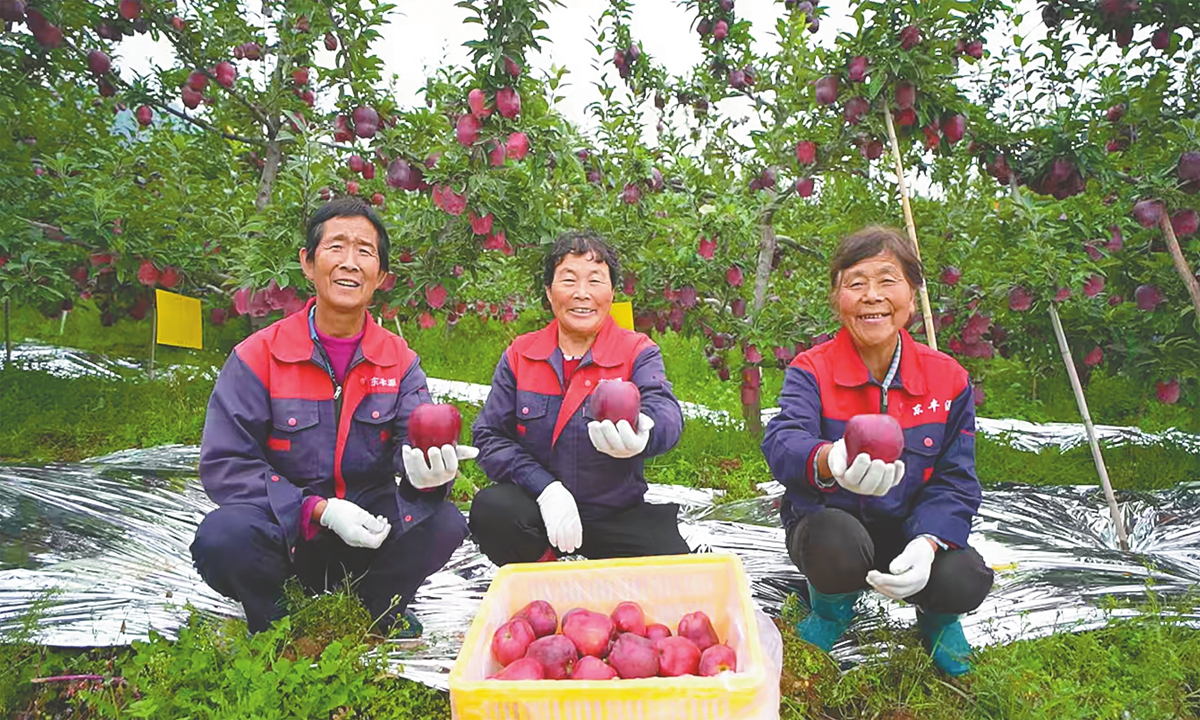
Members of the Dongfengyuan Planting Farmers' Cooperative in Maiji district, Tianshui city, Northwest China's Gansu Province harvest Huaniu apples, smiling amid the joy of a fruitful season. Photo: Courtesy of China Rural Revitalization magazine
During an inspection tour of the Huaniu apple base in Maiji district, Tianshui, Northwest China's Gansu Province on September 11, 2024, Xi Jinping, general secretary of the Communist Party of China Central Committee, stressed the significance of industrial development in revitalizing the country's rural areas.Blessed with moderate rainfall, ample sunshine, and mild temperatures, Tianshui's apple has evolved into a premium-quality product over the decades, emerging as the city's signature agricultural export. Xi encouraged local villagers to make persistent efforts to make the apple industry bigger and stronger to build a happier life.
"President Xi was very kind and approachable," recalled Wu Shuangquan, a villager from Nipu village in Huaniu township, smiling with pride. "We thank President Xi and our city and district governments. With the Party's leadership and good policies, we are living a good life."
Fruit of prosperity
The apple base in Maiji district now spans 150,000 mu (10,005 hectares), while fostering 120 agribusiness entities and benefiting more than 40,000 people.
Born in 1969, Wu Shuangquan and his wife tend to 26 mu of Huaniu apple orchards. Their hard work has paid off - their family lives a three-story house and has two cars. "We never dared to dream of a life like this," he said. Before leasing land on Nanshan Mountain in 2005, Wu only grew apples on two mu of land - yields were low and quality was poor, so he had to take odd jobs or small-scale trading to make ends meet.
"When my son was in third grade, I even had to go next door to borrow 38 yuan ($5.3) buy him a dictionary," he recalled.
Wu Zhengquan, another villager, led 13 households to rent 500 mu of apple orchards, establishing the Xinmin Apple Planting Cooperative, where he now serves as chairman and Party branch secretary. The cooperative has 112 members, 63 of them are core members. Together they manage over 5,600 mu of apple orchards, including 2,800 mu of standardized demonstration zones.
"The cooperative chairman is solely responsible for production and operational management, and hold no authority over financial approval," said Wu Zhengquan. "The chief financial officer and the chairman receive no additional compensation."
As one of the first core members, Wu Shuangquan spoke highly of the cooperative's operation mechanism: Ordinary members can run for core membership every three years, while unqualified members may be dismissed. "We work with one heart and one goal," he said.
"The cooperative's success has been underpinned from the very beginning by one crucial factor: the support of the district Party committee and district government," he added. "Infrastructure like roads, electricity and irrigation were built with the assistance of the government. Free cultivation training ensures the apples maintain high-quality and high yields."
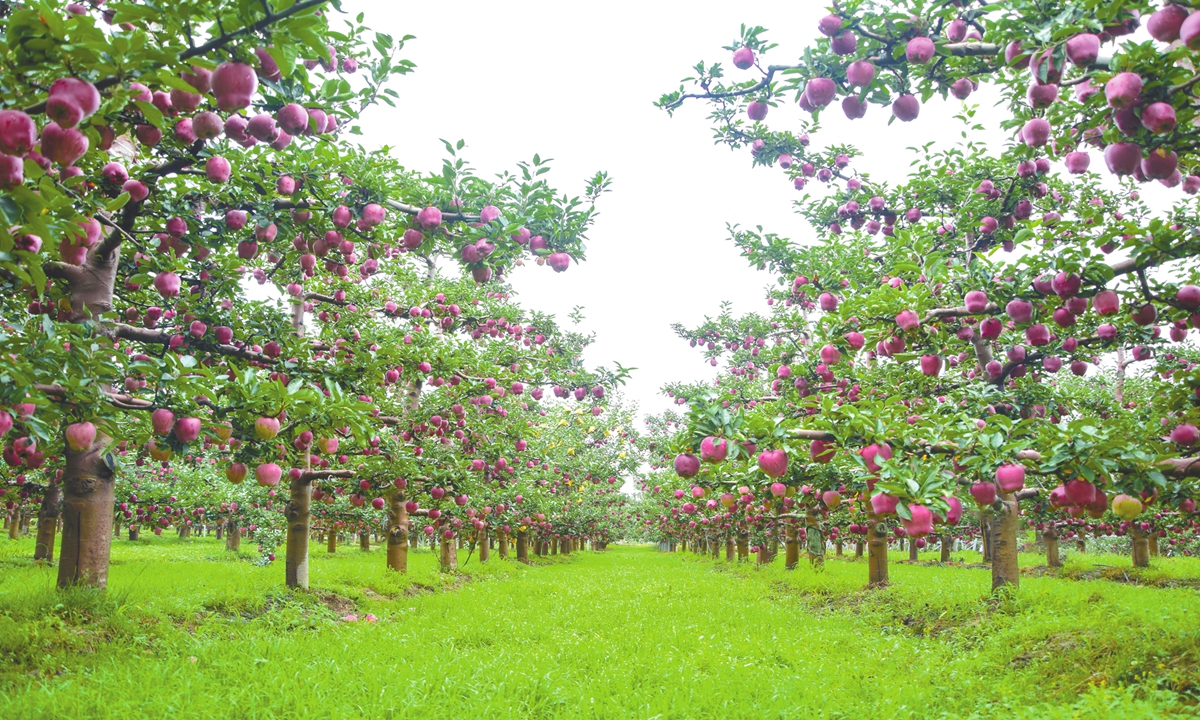
A view of Huaniu apples at the Nanshan base in Maiji district, Tianshui city, Northwest China's Gansu Province Photo: Courtesy of China Rural Revitalization magazine
A vast scientific network
Boyang township, a key Huaniu apple-growing area in Maiji, now has 45,000 mu of apple orchards. Since 2021, it has built five large fruit-trading markets and attracted 23 e-commerce and logistics companies - these efforts have streamlined sales and ensured no unsold fruit.
To extend freshness and prevent natural disasters, a total of 4,100 tons of cold-storage facilities and anti-hail nets have been installed.
The city of Tianshui has identified the expansion of the Huaniu apple industry as a key driver for the development of modern agriculture and the rural revitalization. The city has introduced superior varieties, upgraded planting methods, and enhanced disaster-prevention capacity - efforts that have led to the upgrading of more than 120,000 mu of orchards to improve orchard quality.
By 2023, Maiji had established 10 wholesale markets and 174 e-commerce stations. Building on this foundation, Tianshui is now building a national center for Huaniu apple germplasm protection and development, with a "one bank, two bases, one zone, one park" initiative also in progress.
Longer chain, greater Joy
The apple industry is far more than cultivation — it's an expanding value chain that creates jobs and prosperity.
In October 2024, Maiji joined hands with Beijing JD Qianshi Technology to establish a logistics park under the National Modern Agriculture Industrial Park, forming the Tianshui Jinglongda Supply Chain Co, Ltd.
Inside the park, scientific grading and efficient sales channels have boosted farmers' incomes by about 5 percent and created more than 1,000 new jobs with more than 3 million yuan in wages paid.
For example, the Tianshui Great Wall Fruit Juice Co, a national leading enterprise, processes more than 350,000 tons of apples annually, purchasing lower-grade fruit and employing 800 rural workers.
From city to village, a multi-level network of production and sales has extended the industrial chain, bringing both economic growth and stronger collective prosperity.
Tianshui's fertile land and water not only support the flagship Huaniu apples but also other renowned brands such as Qinzhou cherries, Qinan peaches, Qingshui walnuts and Maiji grapes. By the end of 2024, the city's fruit base had covered 2.3 million mu, driving the total industrial output above 21.4 billion yuan, benefiting more than 400,000 farming households.
Li Lei is a reporter for China Rural Revitalization magazine.
RELATED ARTICLES