Illustration: Chen Xia/GT
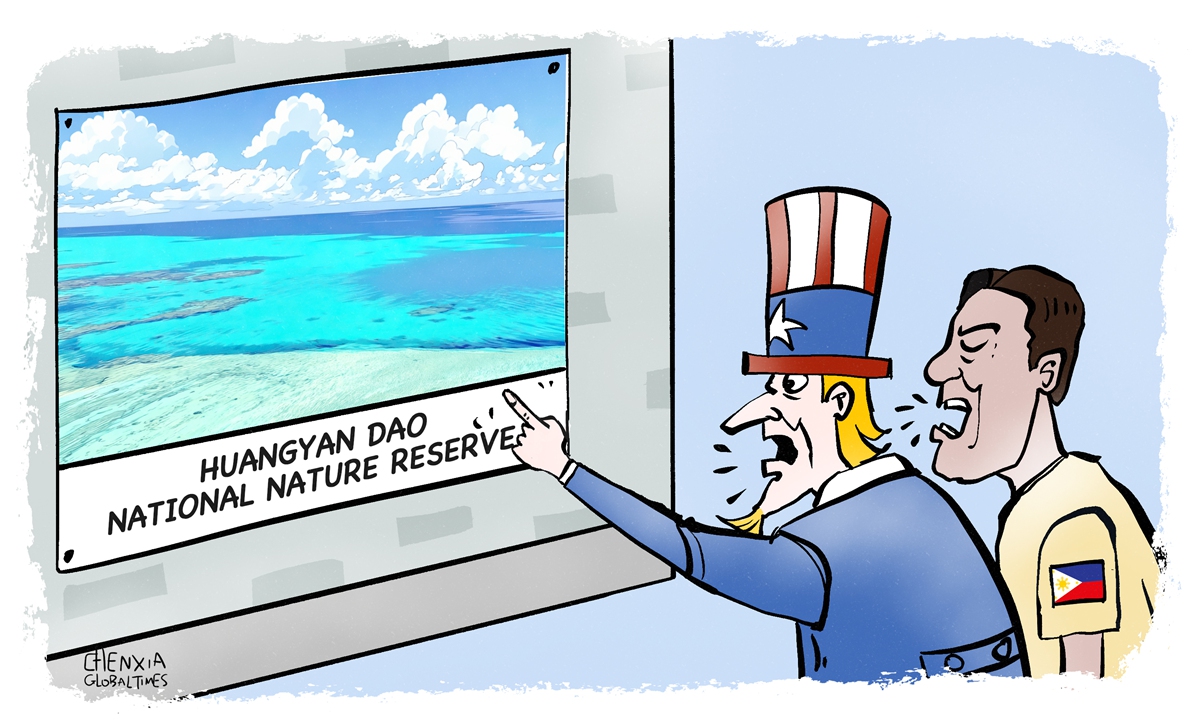
Recently, China's State Council approved the establishment of the Huangyan Dao national nature reserve - another concrete step taken by China to strengthen its jurisdiction over Huangyan Dao, following the release of the baselines of the territorial sea adjacent to Huangyan Dao in November 2024. The nature reserve is established for the purpose of better protecting Huangyan Dao's ecological environment, which will benefit not only the Huangyan Dao, but also the South China Sea and the wider region.
However, the Philippines and the US, together with several other Western countries, have been pointing the finger at China. They claimed that China, in so doing, is attempting to"control" Huangyan Dao and prevent Philippine fishermen from fishing in adjacent waters, an act that infringes upon the Philippines' sovereignty, undermines regional stability and contravenes the so-called "2016 South China Sea Arbitral Award." They even went as far as declaring the nature reserve detrimental to the local environment.
None of these claims are tenable, either by fact or by law. They only reveal the Philippines' intent to seize Huangyan Dao from China, and the hidden agenda of the US and other Western countries to stir up trouble in the South China Sea.
Huangyan Dao is an inalienable part of China. In fact, the Philippines knows that its territorial limits are defined by a series of international treaties such as the Treaty of Paris between the US and Spain in 1898, the Treaty of Washington between the US and Spain in 1900 and the Convention between the US and Great Britain in 1930. China's Huangyan Dao and Nansha Qundao, located west of the 118 degrees east longitude, are clearly outside the Philippine territory.
Since 1997, however, the Philippines has sought to occupy Huangyan Dao and, in 2009, illegally included it in its territory through domestic legislation. The Philippines has been undermining regional stability and infringing on China's sovereignty.
Nevertheless, some Western countries, most notably the US, have chosen to ignore these facts. As a signatory to the above treaties, the US should be the last one to claim ignorance of the Philippines' territorial limits, yet it continues to endorse Manila's unlawful actions. If domestic legislation alone can justify territorial claims, what will become of international rules and justice?
The so-called "Arbitral Award" is a political fantasy. On the South China Sea arbitration unilaterally initiated by the Philippines, China's position is clear and consistent: the so-called "award" is illegal, null and void. Take the issue of "traditional fishing rights" as an example. The Philippines was unable to prove that its fishermen had engaged in traditional fishing activities in the waters around Huangyan Dao - a key requirement for establishing such rights. Instead of examining whether a tradition truly existed, the "tribunal" focused narrowly on the traditional nature of artisanal fishing, the fishing methods adopted by Philippine fisherman. This approach fundamentally distorted the logic of traditional fishing rights.
Manila continues to misuse this illegitimate ruling to obscure truth and mislead international opinion, even portraying it as granting the Philippines sovereignty over Huangyan Dao. However, no political gloss can change the facts, and China's sovereignty and maritime rights and interests in the South China Sea are not to be negated by a worthless piece of paper.
The recent tensions between China and the Philippines stem from Manila's attempts to validate the "award," made with the emboldening support of external forces. Now is high time that the Philippines abandon its political fantasy and return to the path of proper settlement of disputes with China through sincere dialogue and consultation.
Actions will reveal what constitutes genuine environmental protection — and what does not. The Philippines has repeatedly accused Chinese fishermen of damaging the ecology of Huangyan Dao. Yet it is the Philippine practices such as widespread cyanide fishing and the use of "Payao," a fish aggregating device, that truly damage the marine environment. These methods degrade coral reefs, deplete tuna stocks, endanger non-target species, and threaten navigation safety.
If Manila's environmental concerns were genuine, it would have welcomed the establishment of the Huangyan Dao national nature reserve. Yet, on the contrary, it promptly protested the move and dispatched vessels to provoke tensions. This move makes it clear that environmental protection is nothing but a pretext for Manila's territorial ambitions.
Huangyan Dao is part of China's territory. No other country cherishes its ecological environment more than China does. Although China's official assessment shows that the ecological quality of Huangyan Dao remains good, it still faces pollution threats from the Philippines and other sources, which necessitates the establishment of the nature reserve. As a responsible major country, China remains committed to preserving the world's ecosystem and bio-diversity. The Philippines and others must stop exploiting this issue and restore peace and tranquility to the region.
The author is a commentator on international affairs. opinion@globaltimes.com.cn
RELATED ARTICLES