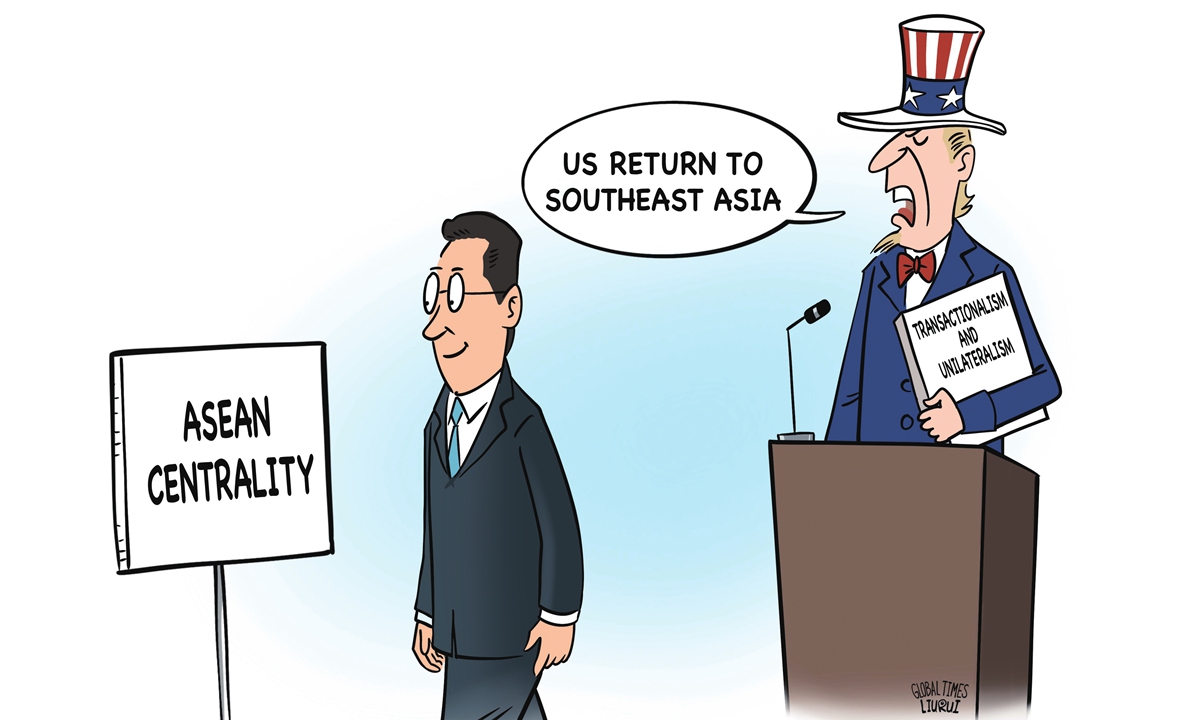
Illustration: Liu Rui/GT
The 47th ASEAN Summit is being held in Kuala Lumpur, Malaysia, from October 26 to 28. The US president has attended the summit and overseen the signing of a peace agreement between Thailand and Cambodia. The US attempted to showcase a "return to Southeast Asia" and manufacture a low-cost diplomatic victory. Yet, as some voices inside ASEAN are not quite optimistic about the US playing a positive role in the region, Washington's claim of "restarting" its Southeast Asia diplomacy looks less like a strategic return and more like a symbolic, presence-seeking diplomacy.In both economic and security affairs, US policy volatility has pushed ASEAN capitals toward low-expectations diplomacy: engage where necessary, rely on no one. Since the new US administration took office, the US has imposed an average tariff of 19 percent across ASEAN economies. In response, ASEAN members have sought to hedge by deepening RCEP implementation, expanding local-currency settlement, and strengthening intra-regional coordination. A recent statement by ASEAN economic ministers underscored the need to mitigate unilateral risks through collective action and homegrown innovation.
While ASEAN countries welcome US engagement, few believe that Washington can provide consistent or sustainable regional public goods. The US government's continued transactionalism and unilateralism have pushed ASEAN to embrace greater strategic autonomy - particularly in the political and security domains. This cautious independence is the new norm for ASEAN in what might be called the post-patronage era of regional diplomacy. From managing the road map for peace in Myanmar to advancing Timor-Leste's accession, ASEAN has strengthened its internal coordination mechanisms and fostered a region-first consensus. Such institutional confidence now makes it increasingly difficult for outside powers to dominate the regional agenda.
Washington's attempt to use the ASEAN Summit to "restart its diplomatic posture" reflects a fundamental misreading of contemporary Southeast Asia. ASEAN is developing its own strategic vocabulary and operational logic in many ways. If Washington continues to apply an outdated Cold War playbook, it risks a familiar pattern: arriving with fanfare and departing in silence. Southeast Asian countries neither reject US involvement nor subscribe to a US-centric order. For them, Washington's pursuit of a "diplomatic triumph" is a fleeting performance of political optics, not policy substance.
For China, the optimal strategy is not to "seize the stage" as the US is eager to do, but to deepen pragmatic cooperation with ASEAN - delivering sustainable public goods in fields such as climate governance, digital infrastructure, and maritime cooperation. True influence stems not from who oversees a signing ceremony, but from who can jointly sustain peace and development with regional partners.
Washington's rhetoric of "returning to Southeast Asia" signals less a strategic comeback than a symptom of anxiety over declining influence. ASEAN's cautious diplomacy demonstrates a new consensus amid intensifying great-power competition: cooperate where interests converge, remain autonomous where they diverge. While the US seeks to "relaunch diplomacy" through ceremonial symbolism, ASEAN is quietly crafting a new regional order anchored in institutional consolidation and multilateral cooperation. The message is clear: ASEAN is no longer a chessboard for others; it is a chess player shaping its own game.
The author is an associate professor and assistant director at the Collaborative Innovation Center of South China Sea Studies at Nanjing University. opinion@globaltimes.com.cn
RELATED ARTICLES