'I have witnessed the immense transformation of China's economic structure': Somali ambassador to China
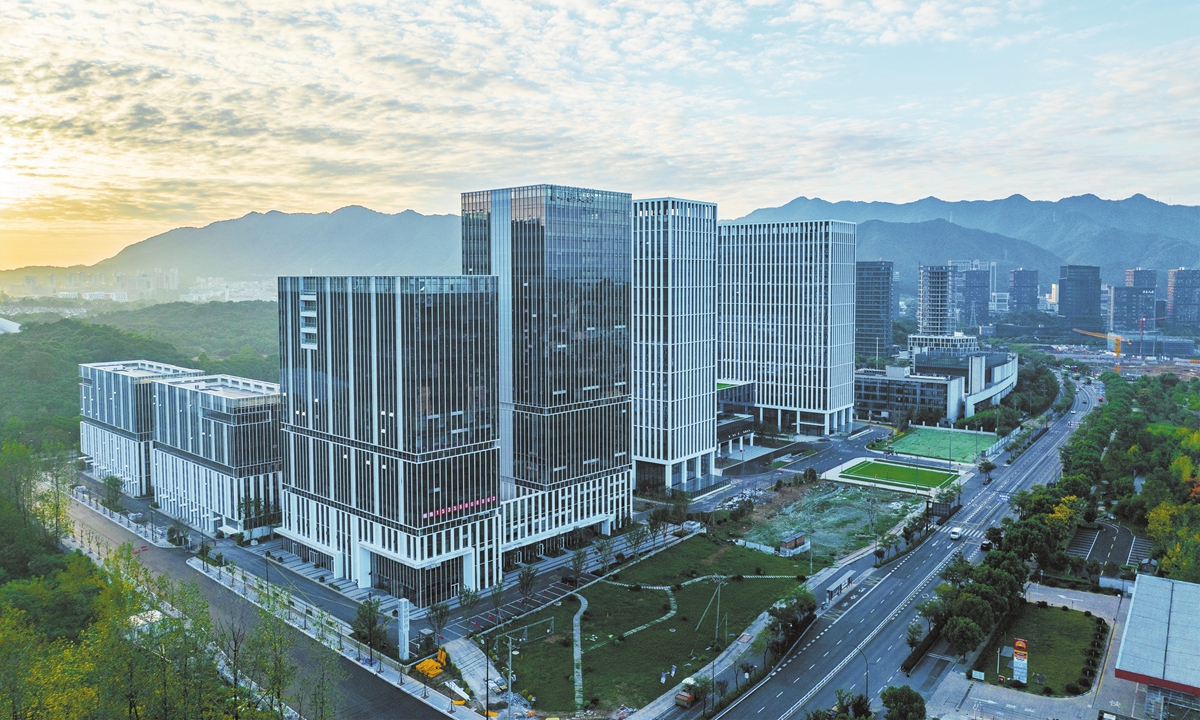
A view of a town, known as a hub for scientific and technological innovation, in Hangzhou, East China's Zhejiang Province Photo: VCG
As China concludes the fourth plenary session of the 20th Central Committee of the Communist Party of China (CPC), the blueprint for the 15th Five-Year Plan (2026-30) has drawn worldwide attention. In China's case, especially at this historical moment, it operates as a strategic compass that reveals how the country interprets global shifts and how it intends to respond. The 15th Five-Year Plan has drawn global attention because it arrives at a time when economic volatility, accelerating technological change, as well as mounting climate and demographic pressures are reshaping the global development landscape. These realities underscore the continuing importance of long-term vision, disciplined planning and institutional adaptability. This new plan offers insight into how a leading global actor intends to navigate and influence these evolving conditions.The new quality productive forces and greater self-reliance and strength in science and technology embody China's transition toward growth powered by innovation, talent and advanced technology. These forces reflect an economic shift away from growth led by low-cost labor and heavy industrial expansion toward growth anchored in innovation, digital capacity and advanced skills. Strengthening scientific capability, pursuing high-value development and placing environmental sustainability at the center of economic planning demonstrate that prosperity can no longer rely on scale alone. The message from China to others is clear: In the 21st century, success will depend on a country's ability to generate knowledge, deploy innovation effectively and cultivate a skilled workforce capable of shaping future industries.
Having lived, studied and served in China since the 11th Five-Year Plan (2006-10) period, I have witnessed the immense transformation of the country's economic structure and global role. China has moved from an era defined predominantly by infrastructure expansion and manufacturing scale into one characterized by digital services, renewable energy solutions, satellite applications and scientific discovery. What stands out in this evolution is not only its scale, but the method: sustained investment in human development, strong institutional coordination, and an ability to refine and redirect strategy as realities evolve. Modernization has been pursued with consistency, patience and a clear awareness of future technologies that will redefine competitiveness.
Just as importantly, China has not pursued scientific and technological strength alone. Progress has been accompanied by initiatives that promote development and cooperation beyond its borders. The Global Development Initiative and the Global Governance Initiative are examples of the belief that global challenges require shared solutions and that technology must support inclusive progress rather than widen divides. These frameworks show that self-reliance is compatible with openness and that leadership in emerging sectors can coexist with support for the development of others.
China's cooperation with African nations increasingly reflects this logic. Partnerships that once centered on traditional infrastructure now extend into areas essential for Africa's future competitiveness: climate-resilient agriculture, digital governance, clean energy, technical education and enhanced data systems. The introduction of Juncao cultivation to strengthen food security and livelihoods, the establishment of Luban Workshops that train young Africans in practical technology skills, and digital early-warning and trade facilitation tools already making a difference in several countries illustrate that cooperation is becoming more knowledge-based and long-term in perspective. Technology delivers lasting value only when societies possess the skills and institutions to govern, adapt and expand it over time.
Somalia stands at a particularly meaningful moment in its own development journey. This year marks the 65th anniversary of diplomatic relations between Somalia and China, a relationship grounded in mutual respect and a long history of cooperation during pivotal national moments. With the elevation of our ties to a strategic partnership, collaboration has increasingly aligned with the priorities essential to Somalia's modernization.
Somalia's position as a latecomer to industrialization is, in many ways, an advantage. We are building in an era when more sustainable, digitally enabled and efficient systems are available and affordable. We are not reversing legacy structures; we are designing institutions equipped for 21st century needs from the outset. By modernizing fisheries and logistics, we create value at home rather than exporting opportunity abroad. By investing in digital public services, we enhance accountability and rebuild trust in the social contract. And by strengthening human capital, we ensure that economic transformation is not only realized, but owned, led and sustained by Somalis.
This opportunity extends across Africa. Technology and innovation can shift countries from vulnerability to resilience and from consumption to productive capability. Yet true progress requires more than importing equipment. It requires governance systems that can regulate and harness digital infrastructure, education systems that prepare youth for emerging industries, and policy and financing frameworks that allow new sectors to take root. China's development experience demonstrates how national priorities, industrial policy and human development can reinforce one another when a unified long-term vision exists.
The deeper significance of the 15th Five-Year Plan lies in the confidence it places in planning as a vital instrument of stability in an age of volatility. Resilience cannot be improvised at moments of crisis. It must be cultivated through foresight, investment and a development structure that can adapt as new opportunities emerge. For African governments striving to modernize under pressure, the principles embedded in China's approach are instructive. Ambitious national goals, coherent institutional alignment and attention to social well-being as fundamental to economic success are necessary foundations for durable transformation.
As Somalia and China deepen cooperation, the priority is to transform shared aspirations into practical outcomes. Technology should expand access to public services and ensure dignity and opportunity in everyday life. Modernization must open pathways for youth and women to contribute to national development. Progress should be rooted in respect for each nation's identity and guided by a long-term outlook that sees development as a generational commitment rather than a quick fix.
China's 15th Five-Year Plan can be understood as an effort to harness innovation and policy discipline to deliver stability and opportunity amid global uncertainty. It suggests that cooperation remains a powerful force for progress even when international systems are strained. And it reinforces a key truth: the decisions nations make today about how they structure their economies and societies will determine the balance of global prosperity for decades to come. For Somalia, for Africa and for the international community, the plan represents not a template to replicate, but a platform for constructive engagement, shared learning and common ambition. The work ahead is to ensure that cooperation strengthens human dignity and expands the ability of every nation to shape its own future with confidence.
The author is the Somali ambassador to China. opinion@globaltimes.com.cn
RELATED ARTICLES