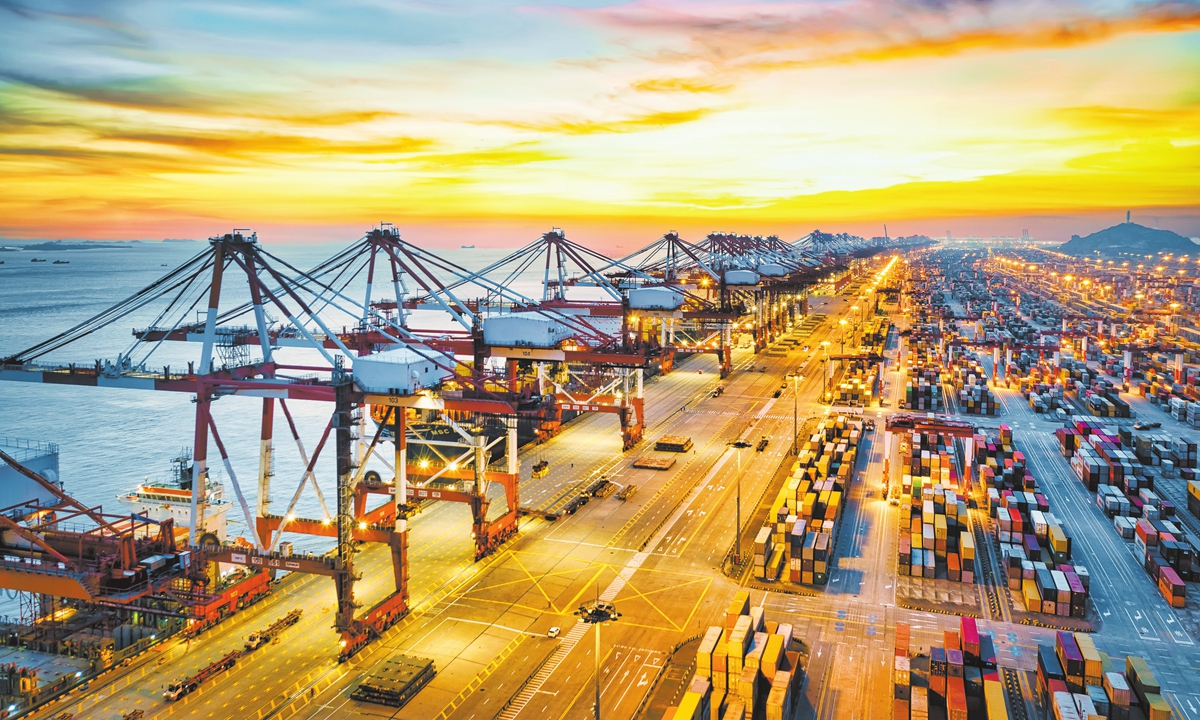
A view of Yangshan deep-water port, a part of the Port of Shanghai. Photo: VCG
The 14th Five-Year Plan period (2021-2025) marks the first five years during which China begins its march toward the second Centenary Goal of building a modern socialist country by building on the success of achieving the first Centenary Goal of building a moderately well-off society. Over the past few years, the world has been undergoing accelerating changes unseen in a century, entering a period of turbulence and transformation. As a deeply integrated part of the global economy, China's open economy has faced daunting challenges head-on, withstood major shocks, navigated severe risks and achieved groundbreaking progress.
First, China has unswervingly advanced high-level opening-up, with institutional openness at its core. Institutional innovation in pilot free trade zones (FTZs) has flourished nationwide. During the 14th Five-Year Plan period, China's FTZs increased to 22, forming a comprehensive reform and opening-up landscape across the country and producing nearly 200 institutional innovations. By 2024, FTZs accounted for 19.6 percent of China's total foreign trade and 24.3 percent of foreign investment inflows. By the end of 2025, Hainan Free Trade Port will achieve full "customs closure," entering a new stage of institutional opening-up.
China has continued to build a world-class business environment that is market-oriented, law-based and internationalized. From 2021 to May 2025, cumulative foreign direct investment in China reached 4.7 trillion yuan (about $657 billion), exceeding the total during the 13th Five-Year Plan (2016-2020).
Meanwhile, China has actively contributed to global trade governance reform through multilateral, regional and bilateral channels. It has also negotiated or upgraded bilateral FTAs with many countries and regions. Today, amid the rampant anti-globalization countercurrent, China has emerged as a major force for global trade liberalization in the face of rising protectionism.
Second, we must resolutely safeguard China's legitimate international trade and economic interests. In the face of rising unilateralism and trade bullying, China has implemented a series of targeted measures to protect its lawful rights and interests.
On the one hand, China introduced the unreliable entity list and anti-discrimination investigations, strengthened its industrial security and export control mechanisms, and established a comprehensive export control system to counter the US' abuse of "national security." On the other, China actively utilized the WTO's dispute settlement mechanism, filing complaints against the US' Section 301 and 232 investigations and other unlawful trade restrictions - and winning related cases. The victories strengthened China's legal and moral position while garnering international support.
Third, China's participation in global circulation has yielded remarkable results, consolidating its position as a leading power in global trade and investment. China's total goods trade increased from 32.2 trillion yuan in 2020 to 43.8 trillion yuan in 2024, an average annual growth of 8 percent, maintaining its position as the world's largest trading nation.
Amid the intensifying anti-globalization trend, China has continued to promote reform and development through openness. The share of trade with partner countries under the framework of the Belt and Road Initiative rose from 29.1 percent in 2020 to 50.3 percent in 2024. Trade diversification has become a powerful tool in countering US tariffs and global protectionism.
Fourth, external opening and industrial upgrading have interacted dynamically, reinforcing each other. The sustained growth of China's trade scale and competitiveness stems fundamentally from advances in manufacturing and technological innovation. During the 14th Five-Year Plan, China made breakthrough achievements in innovation, significantly improving its supply-side capacity and resolving many technological bottlenecks. Traditional industries have been revitalized, emerging industries have grown rapidly and the structure of manufacturing has become more optimized. From 2021 to 2024, manufacturing value added grew by an average of 5.4 percent annually in real terms, accounting for nearly 30 percent of the global total and ranking first globally for 15 consecutive years. China leads the world in output for over 200 major industrial products, while its strengths in equipment manufacturing continue to expand.
The 14th Five-Year Plan period has been one of steady progress in Chinese modernization. Looking ahead to the 15th Five-Year Plan (2026-2030), China will enter another crucial five years, aiming to realize socialist modernization by 2035. Standing at this new historical starting point, China will continue to firmly support economic globalization and global economic governance, expand economic and trade ties with countries worldwide, and advance industrial and economic development under open conditions - contributing even more to the growth and stability of the global economy.
The author is dean of China Institute for WTO Studies at the University of International Business and Economics. opinion@globaltimes.com.cn
RELATED ARTICLES