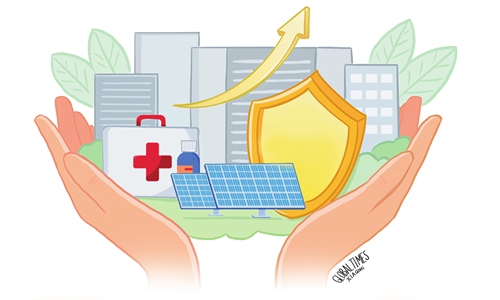
Illustration: Xia Qing/GT
During China's 14th Five-Year Plan (2021-2025), technological innovation has served as the core driving force behind the country's economic development, achieving historic breakthroughs in key technologies, industrial upgrading and green transformation. China's economy is steadily shifting from factor-driven growth to innovation-driven growth.
At the transition between the 14th Five-Year Plan and 15th Five-Year Plan (2026-2030), the economy is also undergoing a shift in the Kondratieff Wave (or K-Wave), a long-term economic cycle in commodity prices and other prices, believed to result from technological innovation.
We are believed to be in the late "winter" phase of the fifth K-Wave (the era of information technology) and possibly at the dawn of the sixth (the era of AI). According to K-Wave theory, long-term economic waves are propelled by technological revolutions, each lasting roughly 50-60 years and passing through four stages: recovery, prosperity, recession and depression.
During the recession phase of a K-Wave, economic growth faces significant pressure. Innovation is the key mechanism to overcome this pressure. One reason China has achieved remarkable results during the 14th Five-Year Plan is that innovation has become a robust engine of development.
Basic research is well-supplied with resources. By the end of 2024, society-wide R&D spending has grown by almost 50 percent since the end of the 13th Five-Year Plan (2016-2020). In 2024, China's R&D intensity of 2.69-percent ranked 12th among major countries in the world, higher than the average of European Union countries of 2.11 percent and approaching that of the Organisation for Economic Cooperation and Development of 2.73 percent. These investments provide a steadily growing reservoir of resources to fuel technological innovation.
Major changes have also occurred in research paradigms and resource allocation. First, the limitations of the existing academic framework have been overcome. For example, China has driven original innovations in cutting-edge fields such as silicon-based optoelectronics and two-dimensional materials. Second, interdisciplinary integration between mathematics and physics has progressed. Third, theoretical innovation in the life sciences has advanced. In brain science, China has achieved a series of milestones in the field of brain-computer interface technology. Fourth, demand-driven basic research mechanisms are now in place.
Through a "companies pose questions, scientists answer" model, leading enterprises such as Huawei and CATL have partnered with universities to establish foundational research funds.
We are witnessing sequential breakthroughs in core technologies. Between 2020 and 2024, China's high-tech manufacturing value added grew at an average annual rate of 8.7 percent, while industries such as artificial intelligence, cloud computing and the bioeconomy saw significant expansion. Over the past five years, China has built the world's largest and most extensive network infrastructure, with 4.59 million 5G base stations by the end of July this year.
Digital technologies are increasingly integrated with the real economy, giving rise to over 400 national-level "little giant" enterprises which specialize in AI. China also leads globally in green technologies, forming a closed-loop system of "technology-manufacturing-market" in fields such as new energy vehicles, photovoltaics and wind power.
During the 14th Five-Year Plan period, innovation was no longer confined to single-field breakthroughs. Technological innovation has evolved into a spiral process of "technological breakthrough - industrial upgrade - ecosystem reconstruction," generating exponential market growth.
Unlike previous K-Waves dominated by a single technology, the sixth K-Wave during the 15th Five-Year Plan period will be driven by multiple technologies in parallel, including energy, AI and biotechnology. Their synergistic effects are critical, as multi-technology coordination drives productivity.
For China, key priorities include achieving practical breakthroughs in quantum technologies, industrializing brain-computer interfaces, retooling traditional industries with intelligent solutions, decarbonizing high-energy sectors and reconstructing the automotive ecosystem.
The source of technological innovation requires three fundamental shifts: moving from merely catching up to taking a shared and leading role, with original breakthroughs in areas such as quantum computing and brain-computer interfaces; shifting from isolated breakthroughs to systemic reconstruction by creating a complete ecosystem - from basic research to technology development, industrialization, tech-finance and talent support - thereby further boosting the impact of technological progress; and moving from self-reliance to global leadership, exporting China's standards and solutions in the fields of new energy and the digital economy, and creating a globally competitive system that integrates technology, manufacturing and standards.
With such strategic planning, China could form a modern industrial system driven by technological innovation by 2030, laying a solid foundation for essentially achieving socialist modernization by 2035 while making greater contributions to building a community with a shared future for humanity.
The author is deputy director general of China Institute for Innovation and Development Strategy. opinion@globaltimes.com.cn
RELATED ARTICLES