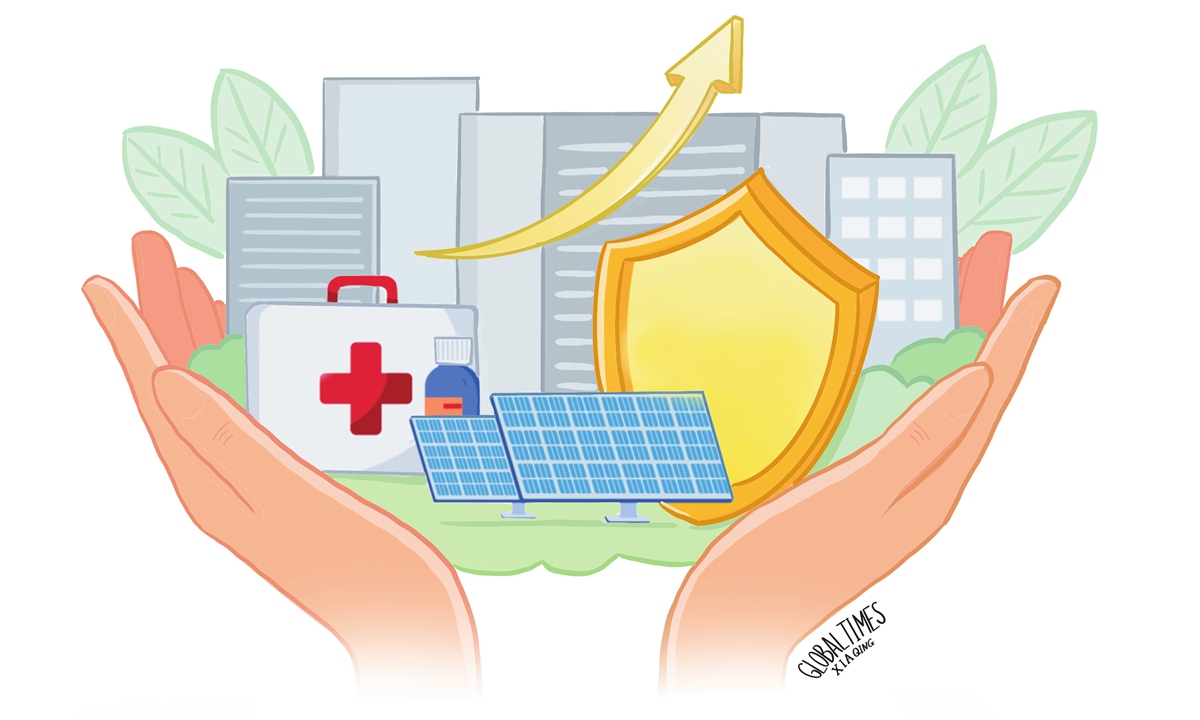
Illustration: Xia Qing/GT
The well-being of the people is the most important aspect of governance, and ensuring and improving people's livelihoods through development is a major task of Chinese modernization. Standing at the historic juncture between the conclusion of the 14th Five-Year Plan (2021-2025) and the start of the 15th Five-Year Plan (2026-2030), we can look back at the breakthroughs achieved in social welfare over the past five years, and clearly find that the core of Chinese modernization has always been anchored on one fundamental goal: ensuring a happy life for the people.
From the "complete victory" in its fight against poverty to significant progress in equalizing basic public services, from residents' incomes keeping pace with economic growth to historic improvements in environmental quality, China's achievements in social welfare vividly demonstrate the strengths of its system. They also lay a solid foundation for promoting common prosperity during the 15th Five-Year Plan period.
Prioritizing employment is the foundation of people's livelihoods. During the 14th Five-Year Plan, employment in China has continued to expand steadily, with nearly 60 million new urban jobs created. Employment structures were optimized, with the service sector contributing significantly to job growth. This achievement would not have been possible without sustained policy support and financial investment. The central government allocating 318.6 billion yuan ($45 billion) for employment subsidies, a 29 percent increase compared to the 13th Five-Year Plan (2016-2020). Significant progress was also made in protecting the rights of workers in new forms of employment.
During the 15th Five-Year Plan period, the focus of the employment strategy will be on adapting institutions to technological change, aiming not only to harness the benefits of the digital economy but also to implement targeted policies to support vulnerable groups. The 15th Five-Year Plan is expected to continue the "employment-first" approach, with an even stronger emphasis on achieving "high-quality and full employment."
Income distribution reform stimulates consumption potential. Since the beginning of the 14th Five-Year Plan, residents' incomes have grown steadily. Per capita disposable income rose from 35,128 yuan in 2021 to 41,314 yuan in 2024. Rural residents' income growth has outpaced that of urban residents, and the income gap continues to narrow.
Optimized income distribution has further released consumption potential. The retail sales of consumer goods in China grew 5.5 percent on average annually over the past four years. Looking ahead to the 15th Five-Year Plan, boosting household income will remain one of the key goals of economic and social development, while governments at all levels will be encouraged to create more channels to help people increase their earnings.
Upgraded public services demonstrate fairness and warmth. Today, China has built the world's largest education, social security and healthcare systems. In education, efforts were made to promote the equitable and inclusive development of education. Social security coverage continued to expand, while the overall level of benefits steadily improved, with urban and rural residents receiving progressively higher pensions each year. In healthcare, 114 new national-level regional medical centers were established, bringing the total to 125, allowing residents to access higher-quality medical services closer to home.
Rural revitalization strengthens the foundation of livelihoods. During the 14th Five-Year Plan, rural revitalization has made substantial progress, bringing agricultural and rural modernization to a new level. Central government funding for rural revitalization increased from 156.5 billion yuan in 2021 to 177 billion yuan in 2025, totaling 850.5 billion yuan over five years - a 60 percent increase from the previous five-year plan period.
Mechanisms for monitoring and preventing a return to poverty have been established. All townships in key counties achieved full 5G coverage. Rural housing renovation and water safety projects also progressed steadily. Looking forward, rural revitalization will transition from external support to self-sustained growth, driven by technology and institutional innovation.
From laying a solid foundation during the 14th Five-Year Plan to building momentum for the 15th Five-Year Plan, China's social welfare system is evolving from individual breakthroughs to integrated development. This systematic approach reflects the institutional strengths of socialism with Chinese characteristics.
Over the next five years, coordinated policies linking employment and industrial development, aligning income measures with taxation, and connecting public services with population planning will help build a robust social security system, enhance people's sense of well-being, and ultimately translate into happier lives for hundreds of millions of individuals.
The path of Chinese modernization will become broader and more dynamic, establishing a new, world-leading model for social development.
The author is an associate professor at School of Marxism Jiangnan University. opinion@globaltimes.com.cn
RELATED ARTICLES