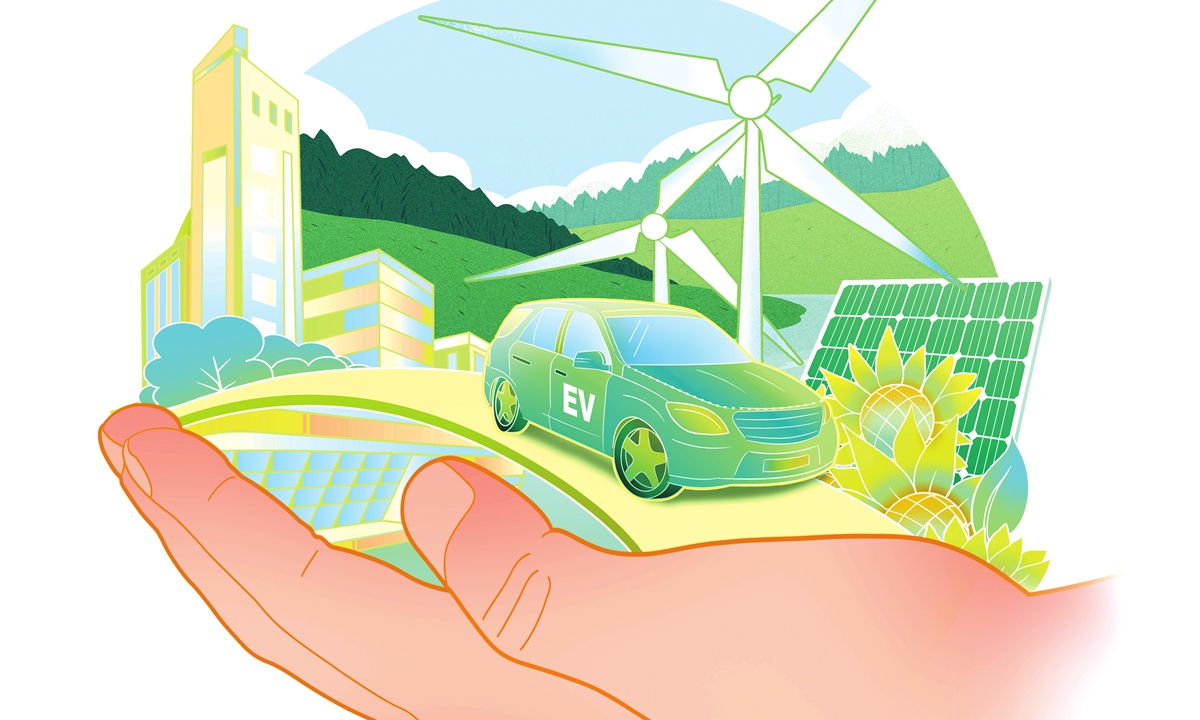
Illustration: Liu Rui/GT
"Dust on sunny days, mud on rainy ones - the village reeked amid piles of garbage." That was once the scene in Yucun village, Anji County of East China's Zhejiang Province, where abandoned quarries were filled with murky water and garbage piled up like hills. Today, the crystal-blue lakes reflect a chic, industrial-style café buzzing with visitors. Nearly 10,000 cups of coffee are sold in a single day. Once the abandoned mine has transformed into a trendy destination. This is not only a successful example of ecological restoration but also a vivid illustration of China's green economic and social transformation.
Green transformation represents a profound revolution in development models and concepts, and also poses a systemic, holistic and coordinated challenge within Chinese modernization process. In terms of the ecological environment, people's aspirations have shifted from seeking basic needs to seeking a better environment - from merely striving to survive to pursuing ecological well-being. The demand for a more pleasant and sustainable environment now constitutes an increasingly significant part of people's overall needs. As a result, the traditional development model characterized by high energy consumption, high emissions, and heavy pollution no longer meets public expectations and has become a serious obstacle to sustainable economic and social development.
The essence of green, low-carbon development lies in achieving economic gains and environmental improvements simultaneously, creating both material and ecological wealth. A high-quality ecological environment is a concentrated reflection of these achievements: It not only embodies a better quality of life but also serves as a key productive force. By "feeding back" into green industries and transforming ecological appeal into tangible value, it provides sustained support for high-quality development.
China's economic and social development has entered a stage of accelerated green and low-carbon high-quality growth. During the 14th Five-Year Plan (2021-2025), China has achieved comprehensive breakthroughs in green transformation.
First, the vigorous development of renewable energy and industries provides strong momentum for the green transition. China's investment in renewable energy accounts for a significant portion of global investment. This has not only promoted China's domestic green and low-carbon transformation but has also positively influenced the optimization and upgrading of the global energy structure. It has effectively stabilized the global supply chain for green products, significantly reduced the cost of the green transition worldwide, and made an outstanding contribution to mitigating climate change.
Second, accelerating the optimization and upgrading of industrial structures provides the key pathway for green transformation. This includes promoting green and low-carbon upgrades in traditional industries such as steel, nonferrous metals, petrochemicals, chemicals, building materials, paper and textile dyeing, vigorously developing strategic emerging and green low-carbon industries.
Third, deepening pollution prevention and control solidifies the ecological foundation for green transformation. In terms of air quality, the average density of PM2.5 in Chinese cities at or above the prefecture level stood at 29.3 micrograms per cubic meter in 2024, down 2.7 percent year-on-year. The proportion of days with good air quality in China reached 87.2 percent.
The year 2025 marks the 20th anniversary of the birth of the "two mountains" concept, which holds that "lucid waters and lush mountains are invaluable assets." It also serves as the conclusion of the 14th Five-Year Plan and a key year for planning the 15th Five-Year Plan (2026-2030). The core tasks for the 15th Five-Year Plan period will continue to focus on cutting carbon emissions, reducing pollution, expanding green development and pursuing economic growth, thereby accelerating a comprehensive green transformation of economic and social development.
Achieving deep and systemic green transformation requires attention to four aspects. First, integrating green transformation concepts and requirements across all sectors and regions: ensuring that the government, enterprises and the public recognize green and low-carbon development not only as an environmental necessity but also as essential for high-quality economic growth.
Second, strengthening systemic thinking: understanding that carbon reduction, pollution control, greening and growth are interconnected and mutually reinforcing.
Third, encouraging theoretical, technological and business model innovation: driving a green and low-carbon technological revolution, developing new quality productive forces tailored to local conditions.
Fourth, improving policies, standards and mechanisms supporting green transformation: This includes fiscal, financial, investment and pricing policies, as well as legal frameworks.
During the 14th Five-Year Plan, solid foundations were laid for making green development a defining feature of high-quality growth. The 15th Five-Year Plan period will be crucial for China to achieve a comprehensive green transformation of its economy and society. By then, green and low-carbon industries will have emerged as a strong pillar of economic growth, and the green upgrading of traditional industries will be largely completed. China's green transformation will not only ensure that the carbon peak target is met by 2030 but will also, through multilateral mechanisms such as energy cooperation under the Belt and Road Initiative, lead global progress in green and low-carbon development, contributing China's profound wisdom and robust strength to the implementation of the UN's 2030 Agenda for Sustainable Development and the building of a clean and beautiful world.
Bao Cunkuan is a professor in the Department of Environmental Science and Engineering, Fudan University, and Qi Zhongwei is a graduate student in the same department. opinion@globaltimes.com.cn
RELATED ARTICLES